3OTB | pdb_00003otb

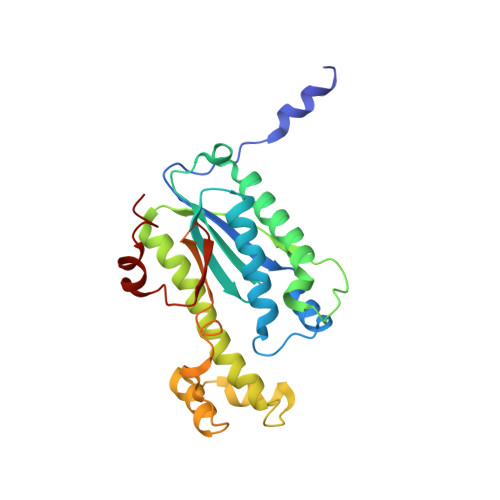
Crystal structure of human tRNAHis guanylyltransferase (Thg1) - dGTP complex


Experimental Data Snapshot

  • Method: X-RAY DIFFRACTION
  • Resolution: 2.95 Å
  • R-Value Free: 
    0.301 (Depositor), 0.304 (DCC) 
  • R-Value Work: 
    0.254 (Depositor), 0.255 (DCC) 

wwPDB Validation 3D Report Full Report

Validation slider image for 3OTB

Ligand Structure Quality Assessment 


This is version 1.3 of the entry. See complete history

Literature

tRNAHis guanylyltransferase (THG1), a unique 3'-5' nucleotidyl transferase, shares unexpected structural homology with canonical 5'-3' DNA polymerases.

Hyde, S.J.Eckenroth, B.E.Smith, B.A.Eberley, W.A.Heintz, N.H.Jackman, J.E.Doublie, S.

(2010) Proc Natl Acad Sci U S A 107: 20305-20310

  • DOI: https://doi.org/10.1073/pnas.1010436107
  • Primary Citation Related Structures: 
    3OTB, 3OTC, 3OTD, 3OTE

  • PubMed Abstract: 

    All known DNA and RNA polymerases catalyze the formation of phosphodiester bonds in a 5' to 3' direction, suggesting this property is a fundamental feature of maintaining and dispersing genetic information. The tRNA(His) guanylyltransferase (Thg1) is a member of a unique enzyme family whose members catalyze an unprecedented reaction in biology: 3'-5' addition of nucleotides to nucleic acid substrates. The 2.3-Å crystal structure of human THG1 (hTHG1) reported here shows that, despite the lack of sequence similarity, hTHG1 shares unexpected structural homology with canonical 5'-3' DNA polymerases and adenylyl/guanylyl cyclases, two enzyme families known to use a two-metal-ion mechanism for catalysis. The ability of the same structural architecture to catalyze both 5'-3' and 3'-5' reactions raises important questions concerning selection of the 5'-3' mechanism during the evolution of nucleotide polymerases.


  • Organizational Affiliation
    • Department of Microbiology and Molecular Genetics, University of Vermont, Burlington, Vermont 05405, USA.

Macromolecule Content 

  • Total Structure Weight: 64.93 kDa 
  • Atom Count: 4,044 
  • Modeled Residue Count: 474 
  • Deposited Residue Count: 538 
  • Unique protein chains: 1

Macromolecules

Find similar proteins by:|  3D Structure
Entity ID: 1
MoleculeChains  Sequence LengthOrganismDetailsImage
tRNA(His) guanylyltransferase
A, B
269Homo sapiensMutation(s): 0 
Gene Names: ICF45THG1L
EC: 2.7.7 (PDB Primary Data), 2.7.7.79 (UniProt)
UniProt & NIH Common Fund Data Resources
Find proteins for Q9NWX6 (Homo sapiens)
Explore Q9NWX6 
Go to UniProtKB:  Q9NWX6
PHAROS:  Q9NWX6
GTEx:  ENSG00000113272 
Entity Groups
Sequence Clusters30% Identity50% Identity70% Identity90% Identity95% Identity100% Identity
UniProt GroupQ9NWX6
Sequence Annotations
Expand
Reference Sequence

Small Molecules

Ligands 3 Unique
IDChains Name / Formula / InChI Key2D Diagram3D Interactions
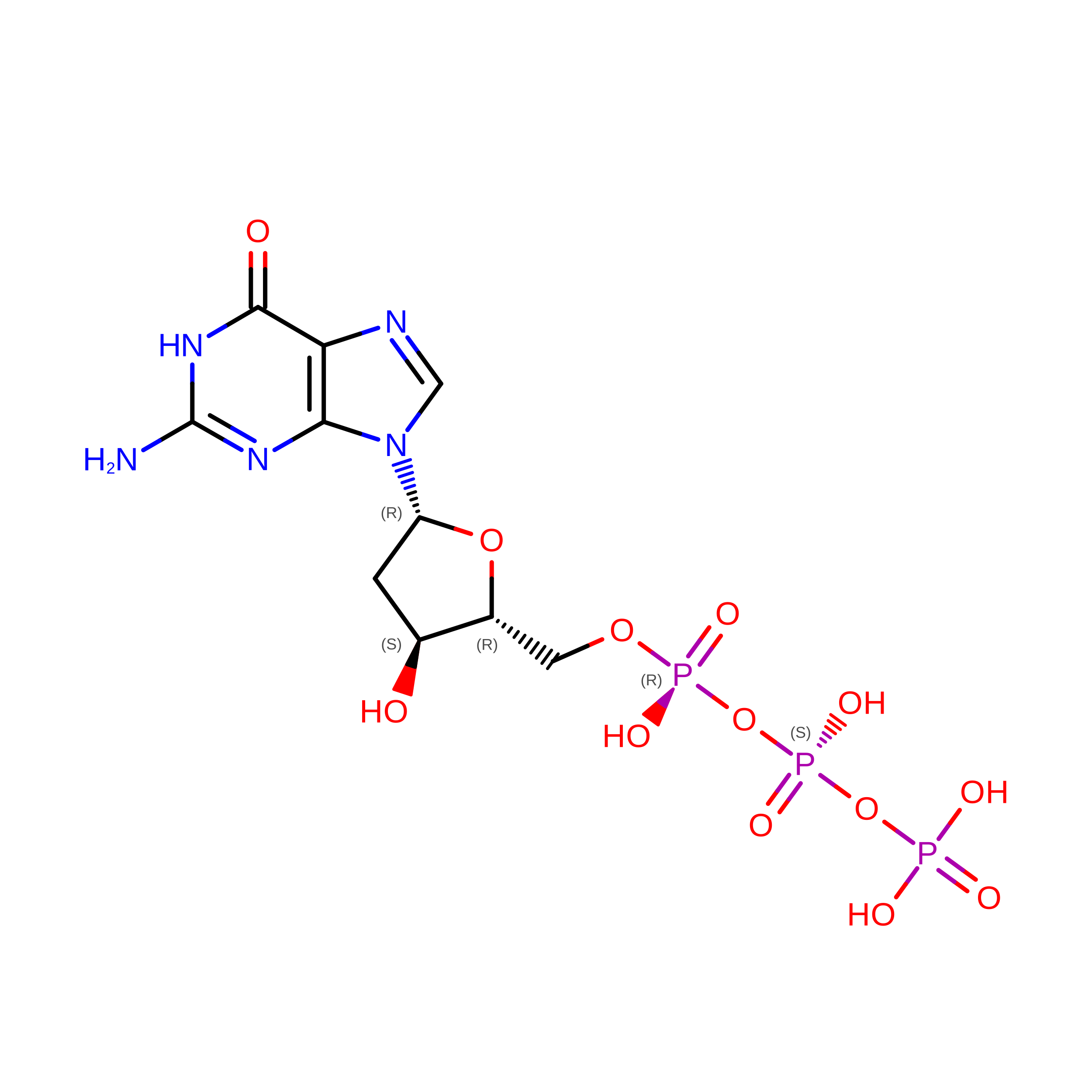
DGT

Query on DGT


Download:Ideal Coordinates CCD File
C [auth A],
I [auth B]
2'-DEOXYGUANOSINE-5'-TRIPHOSPHATE
C10 H16 N5 O13 P3
HAAZLUGHYHWQIW-KVQBGUIXSA-N
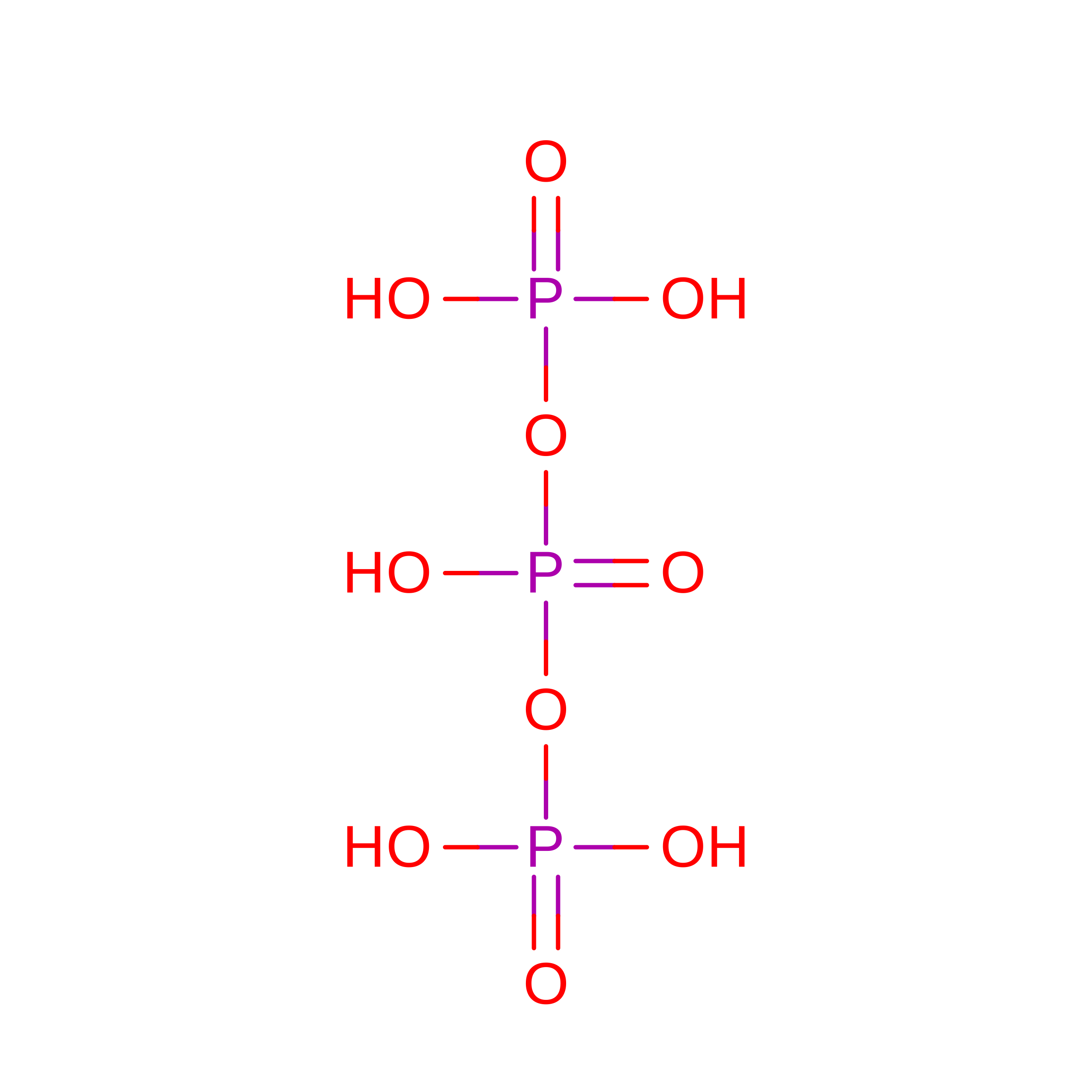
3PO

Query on 3PO


Download:Ideal Coordinates CCD File
G [auth A],
H [auth B]
TRIPHOSPHATE
H5 O10 P3
UNXRWKVEANCORM-UHFFFAOYSA-N
MG

Query on MG


Download:Ideal Coordinates CCD File
D [auth A]
E [auth A]
F [auth A]
J [auth B]
K [auth B]
D [auth A],
E [auth A],
F [auth A],
J [auth B],
K [auth B],
L [auth B]
MAGNESIUM ION
Mg
JLVVSXFLKOJNIY-UHFFFAOYSA-N

Experimental Data & Validation

Experimental Data

  • Method: X-RAY DIFFRACTION
  • Resolution: 2.95 Å
  • R-Value Free:  0.301 (Depositor), 0.304 (DCC) 
  • R-Value Work:  0.254 (Depositor), 0.255 (DCC) 
Space Group: P 43 21 2
Unit Cell:
Length ( Å )Angle ( ˚ )
a = 140.912α = 90
b = 140.912β = 90
c = 81.227γ = 90
Software Package:
Software NamePurpose
DENZOdata reduction
SCALEPACKdata scaling
MOLREPphasing
CNSrefinement
PDB_EXTRACTdata extraction

Structure Validation

View Full Validation Report


Ligand Structure Quality Assessment 


Entry History 

Deposition Data

Revision History  (Full details and data files)

  • Version 1.0: 2010-11-17
    Type: Initial release
  • Version 1.1: 2011-07-13
    Changes: Version format compliance
  • Version 1.2: 2014-04-09
    Changes: Source and taxonomy
  • Version 1.3: 2024-02-21
    Changes: Data collection, Database references, Derived calculations