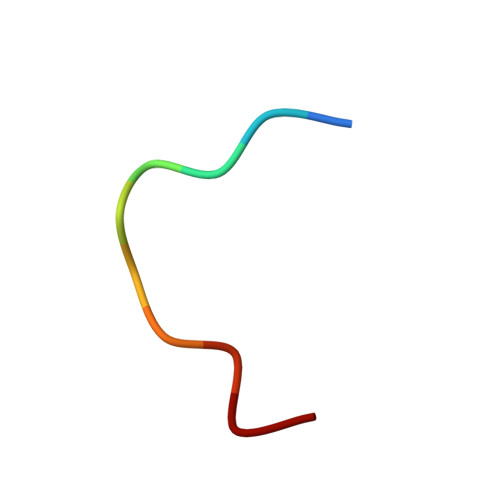
3O2B | pdb_00003o2b

E. coli ClpS in complex with a Phe N-end rule peptide


Experimental Data Snapshot

  • Method: X-RAY DIFFRACTION
  • Resolution: 2.05 Å
  • R-Value Free: 
    0.247 (Depositor), 0.246 (DCC) 
  • R-Value Work: 
    0.210 (Depositor), 0.209 (DCC) 
  • R-Value Observed: 
    0.213 (Depositor) 

wwPDB Validation 3D Report Full Report

Validation slider image for 3O2B

This is version 1.2 of the entry. See complete history

Re-refinement Note

This entry reflects an alternative modeling of the original data in: 2WA8

Literature

The ClpS adaptor mediates staged delivery of N-end rule substrates to the AAA+ ClpAP protease.

Roman-Hernandez, G.Hou, J.Y.Grant, R.A.Sauer, R.T.Baker, T.A.

(2011) Mol Cell 43: 217-228

  • DOI: https://doi.org/10.1016/j.molcel.2011.06.009
  • Primary Citation Related Structures: 
    3O1F, 3O2B, 3O2H, 3O2O

  • PubMed Abstract: 

    The ClpS adaptor delivers N-end rule substrates to ClpAP, an energy-dependent AAA+ protease, for degradation. How ClpS binds specific N-end residues is known in atomic detail and clarified here, but the delivery mechanism is poorly understood. We show that substrate binding is enhanced when ClpS binds hexameric ClpA. Reciprocally, N-end rule substrates increase ClpS affinity for ClpA(6). Enhanced binding requires the N-end residue and a peptide bond of the substrate, as well as multiple aspects of ClpS, including a side chain that contacts the substrate α-amino group and the flexible N-terminal extension (NTE). Finally, enhancement also needs the N domain and AAA+ rings of ClpA, connected by a long linker. The NTE can be engaged by the ClpA translocation pore, but ClpS resists unfolding/degradation. We propose a staged-delivery model that illustrates how intimate contacts between the substrate, adaptor, and protease reprogram specificity and coordinate handoff from the adaptor to the protease.


  • Organizational Affiliation
    • Department of Biology, Massachusetts Institute of Technology, Cambridge, MA 02139, USA.

Macromolecule Content 

  • Total Structure Weight: 26.69 kDa 
  • Atom Count: 1,757 
  • Modeled Residue Count: 204 
  • Deposited Residue Count: 230 
  • Unique protein chains: 2

Macromolecules

Find similar proteins by:|  3D Structure
Entity ID: 1
MoleculeChains  Sequence LengthOrganismDetailsImage
ATP-dependent Clp protease adaptor protein ClpS
A, C
105Escherichia coli K-12Mutation(s): 0 
Gene Names: clpSyljA
UniProt
Find proteins for P0A8Q6 (Escherichia coli (strain K12))
Explore P0A8Q6 
Go to UniProtKB:  P0A8Q6
Entity Groups
Sequence Clusters30% Identity50% Identity70% Identity90% Identity95% Identity100% Identity
UniProt GroupP0A8Q6
Sequence Annotations
Expand
Reference Sequence
Find similar proteins by:  Sequence   |   3D Structure  
Entity ID: 2
MoleculeChains  Sequence LengthOrganismDetailsImage
Phe N-end rule peptide
B, D
10N/AMutation(s): 0 

Experimental Data & Validation

Experimental Data

  • Method: X-RAY DIFFRACTION
  • Resolution: 2.05 Å
  • R-Value Free:  0.247 (Depositor), 0.246 (DCC) 
  • R-Value Work:  0.210 (Depositor), 0.209 (DCC) 
  • R-Value Observed: 0.213 (Depositor) 
Space Group: P 1 21 1
Unit Cell:
Length ( Å )Angle ( ˚ )
a = 32.223α = 90
b = 58.405β = 101.89
c = 56.413γ = 90
Software Package:
Software NamePurpose
PHENIXrefinement
REFMACrefinement
PDB_EXTRACTdata extraction
PHASERphasing

Structure Validation

View Full Validation Report


Entry History 

Deposition Data

Revision History  (Full details and data files)

  • Version 1.0: 2011-12-14
    Type: Initial release
  • Version 1.1: 2019-07-17
    Changes: Data collection, Refinement description
  • Version 1.2: 2024-02-21
    Changes: Data collection, Database references, Derived calculations