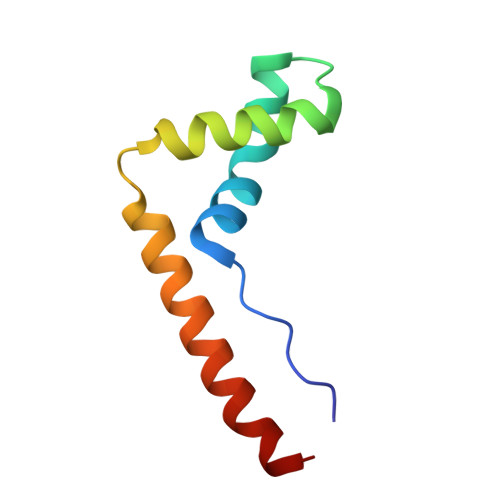
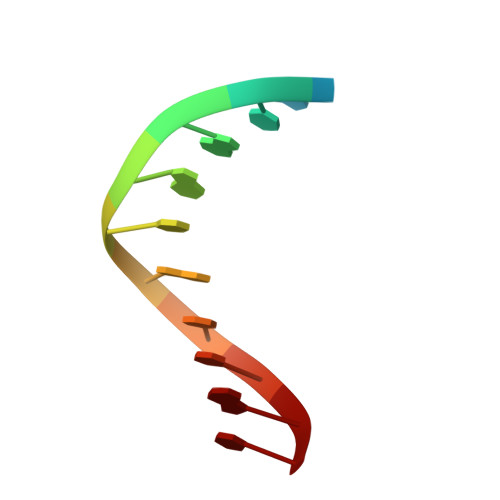
3NM9 | pdb_00003nm9

HMGD(M13A)-DNA complex


Experimental Data Snapshot

  • Method: X-RAY DIFFRACTION
  • Resolution: 2.85 Å
  • R-Value Free: 
    0.296 (Depositor), 0.306 (DCC) 
  • R-Value Work: 
    0.245 (Depositor) 
  • R-Value Observed: 
    0.248 (Depositor) 

Starting Model: experimental
View more details

wwPDB Validation 3D Report Full Report

Validation slider image for 3NM9

This is version 1.2 of the entry. See complete history

Literature

Structural analysis of HMGD-DNA complexes reveals influence of intercalation on sequence selectivity and DNA bending.

Churchill, M.E.Klass, J.Zoetewey, D.L.

(2010) J Mol Biology 403: 88-102

  • DOI: https://doi.org/10.1016/j.jmb.2010.08.031
  • Primary Citation Related Structures: 
    3NM9

  • PubMed Abstract: 

    The ubiquitous, eukaryotic, high-mobility group box (HMGB) chromosomal proteins promote many chromatin-mediated cellular activities through their non-sequence-specific binding and bending of DNA. Minor-groove DNA binding by the HMG box results in substantial DNA bending toward the major groove owing to electrostatic interactions, shape complementarity, and DNA intercalation that occurs at two sites. Here, the structures of the complexes formed with DNA by a partially DNA intercalation-deficient mutant of Drosophila melanogaster HMGD have been determined by X-ray crystallography at a resolution of 2.85 Å. The six proteins and 50 bp of DNA in the crystal structure revealed a variety of bound conformations. All of the proteins bound in the minor groove, bridging DNA molecules, presumably because these DNA regions are easily deformed. The loss of the primary site of DNA intercalation decreased overall DNA bending and shape complementarity. However, DNA bending at the secondary site of intercalation was retained and most protein-DNA contacts were preserved. The mode of binding resembles the HMGB1 box A-cisplatin-DNA complex, which also lacks a primary intercalating residue. This study provides new insights into the binding mechanisms used by HMG boxes to recognize varied DNA structures and sequences as well as modulate DNA structure and DNA bending.


  • Organizational Affiliation
    • Department of Pharmacology, University of Colorado Denver School of Medicine, Aurora, CO 80045, USA; Molecular Biology Program, University of Colorado Denver School of Medicine, Aurora, CO 80045, USA. Electronic address: mair.churchill@ucdenver.edu.

Macromolecule Content 

  • Total Structure Weight: 83.6 kDa 
  • Atom Count: 5,556 
  • Modeled Residue Count: 539 
  • Deposited Residue Count: 548 
  • Unique protein chains: 1
  • Unique nucleic acid chains: 1

Macromolecules


Find similar proteins by:|  3D Structure
Entity ID: 1
MoleculeChains  Sequence LengthOrganismDetailsImage
High mobility group protein D73Drosophila melanogasterMutation(s): 1 
Gene Names: CG17950HmgD
UniProt
Find proteins for Q05783 (Drosophila melanogaster)
Explore Q05783 
Go to UniProtKB:  Q05783
Entity Groups
Sequence Clusters30% Identity50% Identity70% Identity90% Identity95% Identity100% Identity
UniProt GroupQ05783
Sequence Annotations
Expand
Reference Sequence
Find similar nucleic acids by:  Sequence
Entity ID: 2
MoleculeChains LengthOrganismImage
DNA 5'-D(*G*GP*CP*GP*AP*TP*AP*TP*CP*GP*C)-3'11N/A
Sequence Annotations
Expand
Reference Sequence

Experimental Data & Validation

Experimental Data

  • Method: X-RAY DIFFRACTION
  • Resolution: 2.85 Å
  • R-Value Free:  0.296 (Depositor), 0.306 (DCC) 
  • R-Value Work:  0.245 (Depositor) 
  • R-Value Observed: 0.248 (Depositor) 
Space Group: P 1
Unit Cell:
Length ( Å )Angle ( ˚ )
a = 44.75α = 92.49
b = 71.7β = 91.12
c = 89.02γ = 107.1
Software Package:
Software NamePurpose
CrystalCleardata collection
MOLREPphasing
REFMACrefinement
DENZOdata reduction
SCALEPACKdata scaling

Structure Validation

View Full Validation Report


Entry History 

Deposition Data

Revision History  (Full details and data files)

  • Version 1.0: 2010-09-22
    Type: Initial release
  • Version 1.1: 2011-07-13
    Changes: Version format compliance
  • Version 1.2: 2023-09-06
    Changes: Data collection, Database references, Refinement description