3NDB | pdb_00003ndb

Crystal structure of a signal sequence bound to the signal recognition particle


Experimental Data Snapshot

  • Method: X-RAY DIFFRACTION
  • Resolution: 3.00 Å
  • R-Value Free: 
    0.267 (Depositor), 0.290 (DCC) 
  • R-Value Work: 
    0.228 (Depositor) 
  • R-Value Observed: 
    0.230 (Depositor) 

Starting Model: experimental
View more details

wwPDB Validation 3D Report Full Report

Validation slider image for 3NDB

This is version 2.0 of the entry. See complete history

Literature

Structural basis of signal-sequence recognition by the signal recognition particle.

Hainzl, T.Huang, S.Merilainen, G.Brannstrom, K.Sauer-Eriksson, A.E.

(2011) Nat Struct Mol Biol 18: 389-391

  • DOI: https://doi.org/10.1038/nsmb.1994
  • Primary Citation Related Structures: 
    3NDB

  • PubMed Abstract: 

    The signal recognition particle (SRP) recognizes and binds the signal sequence of nascent proteins as they emerge from the ribosome. We present here the 3.0-Å structure of a signal sequence bound to the Methanococcus jannaschii SRP core. Structural comparison with the free SRP core shows that signal-sequence binding induces formation of the GM-linker helix and a 180° flip of the NG domain-structural changes that ensure a hierarchical succession of events during protein targeting.


  • Organizational Affiliation
    • Department of Chemistry, Umeå University, Umeå, Sweden. tobias.hainzl@chem.umu.se

Macromolecule Content 

  • Total Structure Weight: 104.63 kDa 
  • Atom Count: 6,926 
  • Modeled Residue Count: 643 
  • Deposited Residue Count: 677 
  • Unique protein chains: 2
  • Unique nucleic acid chains: 1

Macromolecules


Find similar proteins by:|  3D Structure
Entity ID: 1
MoleculeChains  Sequence LengthOrganismDetailsImage
Signal recognition particle 19 kDa protein87Methanocaldococcus jannaschiiMutation(s): 0 
Gene Names: MJ1034srp19
UniProt
Find proteins for Q58440 (Methanocaldococcus jannaschii (strain ATCC 43067 / DSM 2661 / JAL-1 / JCM 10045 / NBRC 100440))
Explore Q58440 
Go to UniProtKB:  Q58440
Entity Groups
Sequence Clusters30% Identity50% Identity70% Identity90% Identity95% Identity100% Identity
UniProt GroupQ58440
Sequence Annotations
Expand
Reference Sequence
Find similar proteins by:|  3D Structure
Entity ID: 2
MoleculeChains  Sequence LengthOrganismDetailsImage
Signal recognition 54 kDa protein454Methanocaldococcus jannaschiiMutation(s): 0 
Gene Names: MJ0101srp54
EC: 3.6.5.4
UniProt
Find proteins for Q57565 (Methanocaldococcus jannaschii (strain ATCC 43067 / DSM 2661 / JAL-1 / JCM 10045 / NBRC 100440))
Explore Q57565 
Go to UniProtKB:  Q57565
Entity Groups
Sequence Clusters30% Identity50% Identity70% Identity90% Identity95% Identity100% Identity
UniProt GroupQ57565
Sequence Annotations
Expand
Reference Sequence
Find similar nucleic acids by:  (by identity cutoff) 
Entity ID: 3
MoleculeChains LengthOrganismImage
SRP RNAC [auth M]136Methanocaldococcus jannaschii DSM 2661
Sequence Annotations
Expand
Reference Sequence

Small Molecules

Ligands 1 Unique
IDChains Name / Formula / InChI Key2D Diagram3D Interactions
PO4

Query on PO4


Download:Ideal Coordinates CCD File
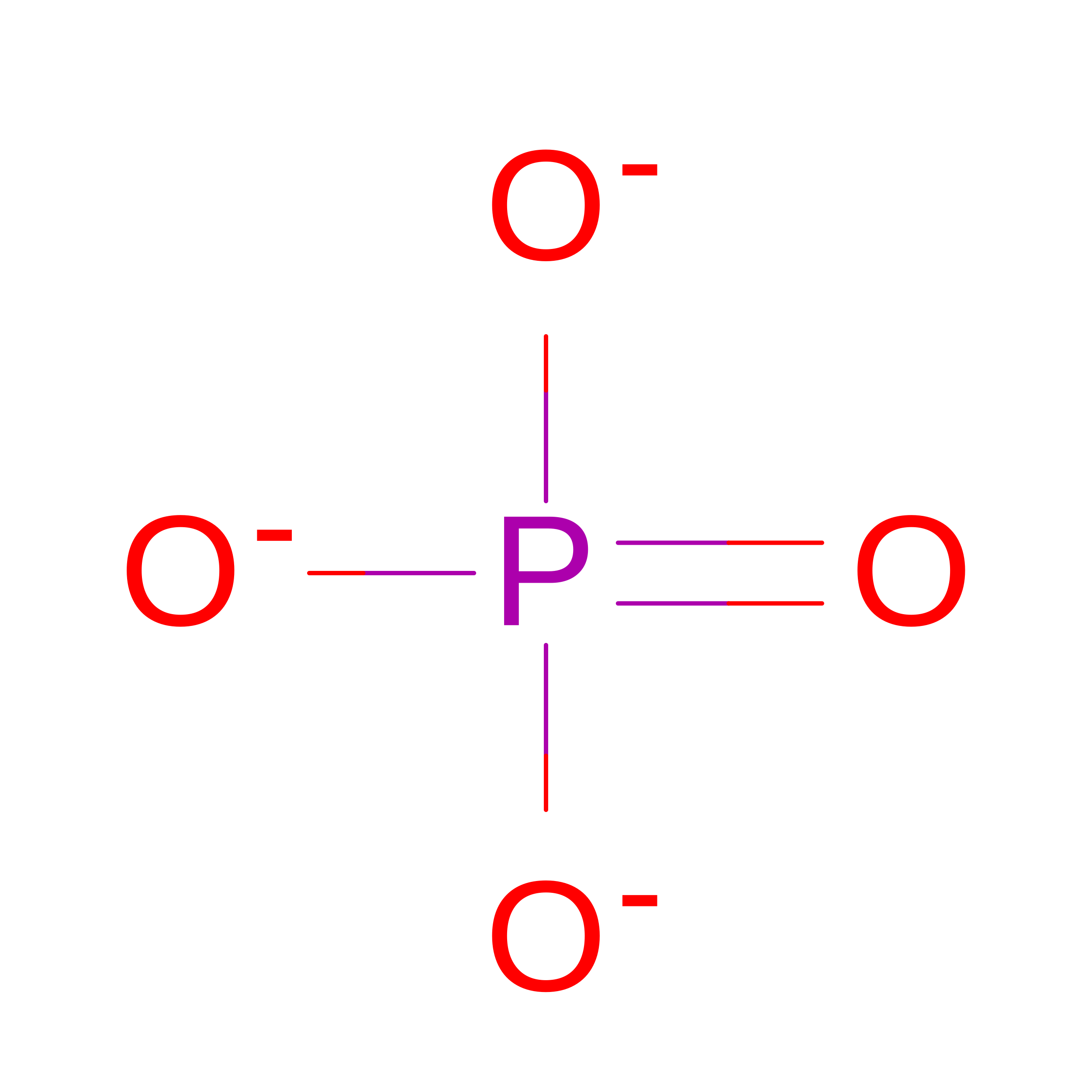
D [auth B]PHOSPHATE ION
O4 P
NBIIXXVUZAFLBC-UHFFFAOYSA-K

Experimental Data & Validation

Experimental Data

  • Method: X-RAY DIFFRACTION
  • Resolution: 3.00 Å
  • R-Value Free:  0.267 (Depositor), 0.290 (DCC) 
  • R-Value Work:  0.228 (Depositor) 
  • R-Value Observed: 0.230 (Depositor) 
Space Group: I 2 2 2
Unit Cell:
Length ( Å )Angle ( ˚ )
a = 108.835α = 90
b = 126.275β = 90
c = 201.758γ = 90
Software Package:
Software NamePurpose
ADSCdata collection
MOLREPphasing
REFMACrefinement
SCALAdata scaling

Structure Validation

View Full Validation Report


Entry History 

Deposition Data

Revision History  (Full details and data files)

  • Version 1.0: 2011-02-23
    Type: Initial release
  • Version 1.1: 2011-07-13
    Changes: Version format compliance
  • Version 1.2: 2023-09-06
    Changes: Data collection, Database references, Derived calculations, Refinement description
  • Version 2.0: 2024-03-13
    Changes: Atomic model, Data collection, Derived calculations