3MYR | pdb_00003myr

Crystal structure of [NiFe] hydrogenase from Allochromatium vinosum in its Ni-A state


Experimental Data Snapshot

  • Method: X-RAY DIFFRACTION
  • Resolution: 2.10 Å
  • R-Value Free: 
    0.168 (Depositor), 0.178 (DCC) 
  • R-Value Work: 
    0.138 (Depositor), 0.151 (DCC) 
  • R-Value Observed: 
    0.140 (Depositor) 

Starting Model: experimental
View more details

wwPDB Validation 3D Report Full Report

Validation slider image for 3MYR

This is version 1.4 of the entry. See complete history

Literature

The crystal structure of the [NiFe] hydrogenase from the photosynthetic bacterium Allochromatium vinosum: characterization of the oxidized enzyme (Ni-A state).

Ogata, H.Kellers, P.Lubitz, W.

(2010) J Mol Biology 402: 428-444

  • DOI: https://doi.org/10.1016/j.jmb.2010.07.041
  • Primary Citation Related Structures: 
    3MYR

  • PubMed Abstract: 

    The crystal structure of the membrane-associated [NiFe] hydrogenase from Allochromatium vinosum has been determined to 2.1 Å resolution. Electron paramagnetic resonance (EPR) and Fourier transform infrared spectroscopy on dissolved crystals showed that it is present in the Ni-A state (>90%). The structure of the A. vinosum [NiFe] hydrogenase shows significant similarities with [NiFe] hydrogenase structures derived from Desulfovibrio species. The amino acid sequence identity is ∼ 50%. The bimetallic [NiFe] active site is located in the large subunit of the heterodimer and possesses three diatomic non-protein ligands coordinated to the Fe (two CN(-) , one CO). Ni is bound to the protein backbone via four cysteine thiolates; two of them also bridge the two metals. One of the bridging cysteines (Cys64) exhibits a modified thiolate in part of the sample. A mono-oxo bridging ligand was assigned between the metal ions of the catalytic center. This is in contrast to a proposal for Desulfovibrio sp. hydrogenases that show a di-oxo species in this position for the Ni-A state. The additional metal site located in the large subunit appears to be a Mg(2+) ion. Three iron-sulfur clusters were found in the small subunit that forms the electron transfer chain connecting the catalytic site with the molecular surface. The calculated anomalous Fourier map indicates a distorted proximal iron-sulfur cluster in part of the crystals. This altered proximal cluster is supposed to be paramagnetic and is exchange coupled to the Ni(3+) ion and the medial [Fe(3)S(4)](+) cluster that are both EPR active (S=1/2 species). This finding of a modified proximal cluster in the [NiFe] hydrogenase might explain the observation of split EPR signals that are occasionally detected in the oxidized state of membrane-bound [NiFe] hydrogenases as from A. vinosum.


  • Organizational Affiliation
    • Max-Planck-Institut für Bioanorganische Chemie, Stiftstrasse 34-36, D-45470 Mülheim an der Ruhr, Germany. ogata@mpi-muelheim.mpg.de

Macromolecule Content 

  • Total Structure Weight: 369.98 kDa 
  • Atom Count: 27,720 
  • Modeled Residue Count: 3,313 
  • Deposited Residue Count: 3,320 
  • Unique protein chains: 2

Macromolecules

Find similar proteins by:|  3D Structure
Entity ID: 1
MoleculeChains  Sequence LengthOrganismDetailsImage
Hydrogenase (NiFe) small subunit HydA
A, C, E, G
269Allochromatium vinosumMutation(s): 0 
EC: 1.12.99.6
UniProt
Find proteins for D3RV29 (Allochromatium vinosum (strain ATCC 17899 / DSM 180 / NBRC 103801 / NCIMB 10441 / D))
Explore D3RV29 
Go to UniProtKB:  D3RV29
Entity Groups
Sequence Clusters30% Identity50% Identity70% Identity90% Identity95% Identity100% Identity
UniProt GroupD3RV29
Sequence Annotations
Expand
Reference Sequence
Find similar proteins by:|  3D Structure
Entity ID: 2
MoleculeChains  Sequence LengthOrganismDetailsImage
Nickel-dependent hydrogenase large subunit
B, D, F, H
561Allochromatium vinosumMutation(s): 0 
EC: 1.12.99.6
UniProt
Find proteins for D3RV26 (Allochromatium vinosum (strain ATCC 17899 / DSM 180 / NBRC 103801 / NCIMB 10441 / D))
Explore D3RV26 
Go to UniProtKB:  D3RV26
Entity Groups
Sequence Clusters30% Identity50% Identity70% Identity90% Identity95% Identity100% Identity
UniProt GroupD3RV26
Sequence Annotations
Expand
Reference Sequence

Small Molecules

Ligands 6 Unique
IDChains Name / Formula / InChI Key2D Diagram3D Interactions
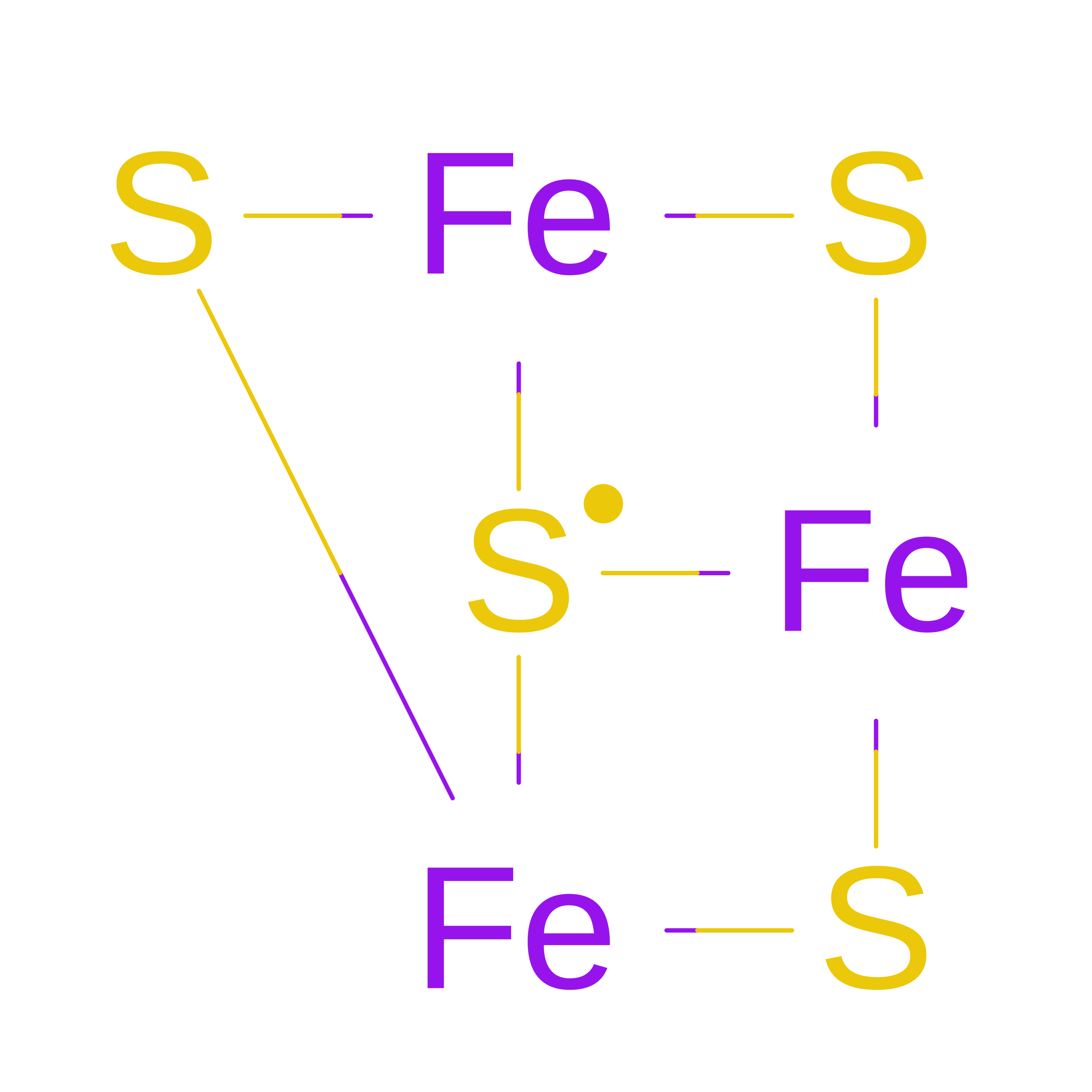
SF4

Query on SF4


Download:Ideal Coordinates CCD File
BA [auth G]
CA [auth G]
I [auth A]
J [auth A]
Q [auth C]
BA [auth G],
CA [auth G],
I [auth A],
J [auth A],
Q [auth C],
R [auth C],
V [auth E],
W [auth E]
IRON/SULFUR CLUSTER
Fe4 S4
LJBDFODJNLIPKO-UHFFFAOYSA-N
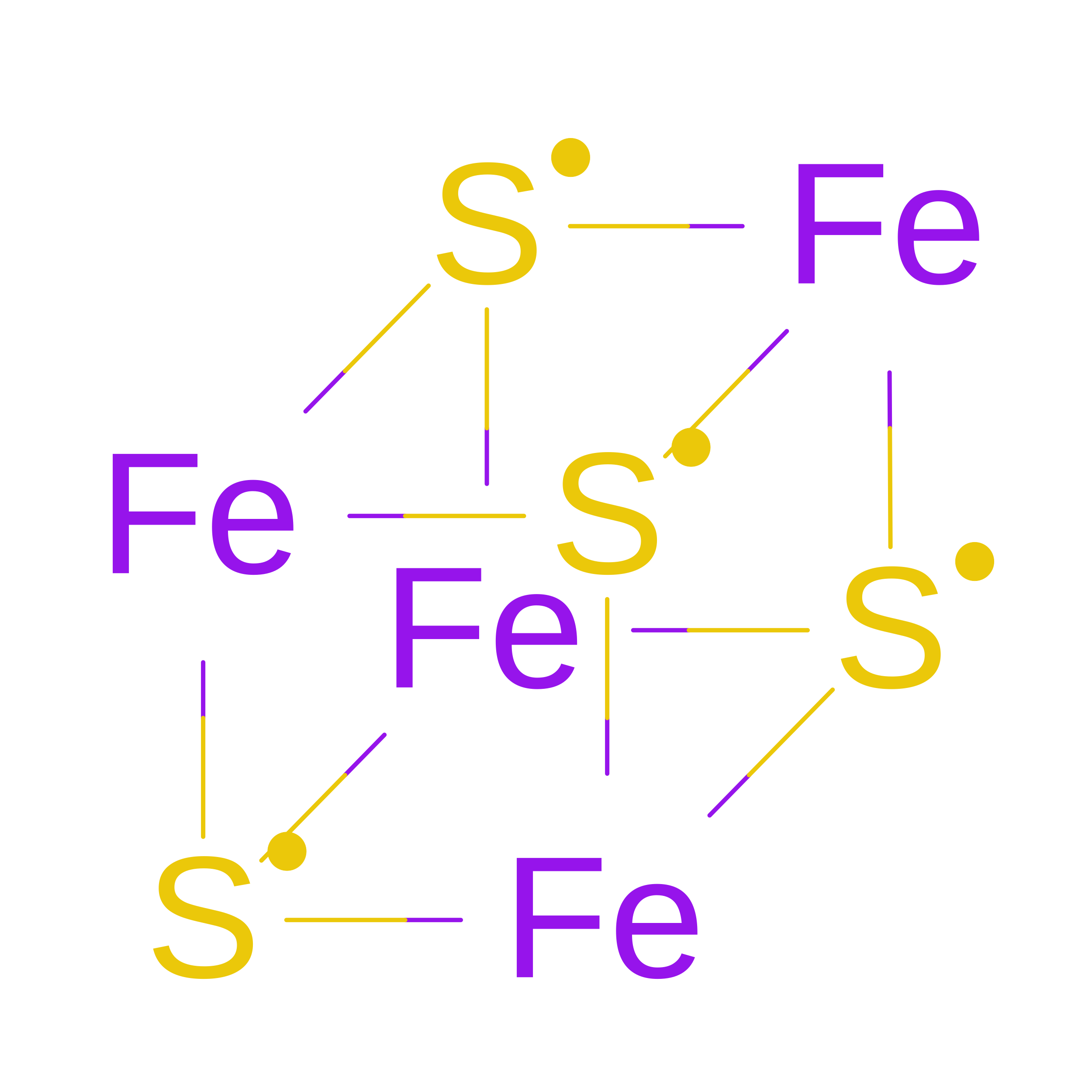
F3S

Query on F3S


Download:Ideal Coordinates CCD File
DA [auth G],
K [auth A],
S [auth C],
X [auth E]
FE3-S4 CLUSTER
Fe3 S4
FCXHZBQOKRZXKS-UHFFFAOYSA-N
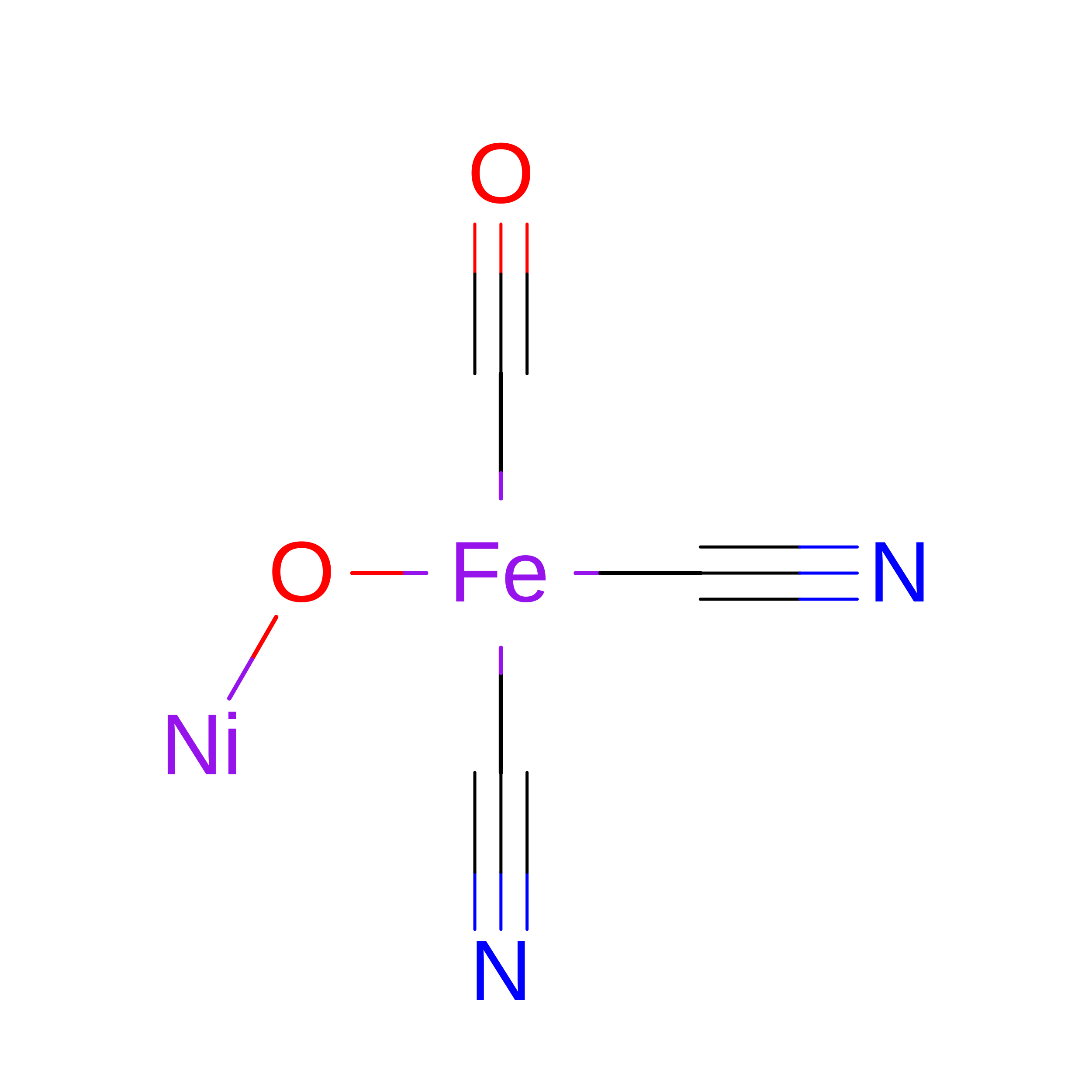
NFV

Query on NFV


Download:Ideal Coordinates CCD File
GA [auth H],
N [auth B],
T [auth D],
Z [auth F]
NI-FE OXIDIZED ACTIVE CENTER
C3 Fe N2 Ni O2
MPQMGFDSXFFIQL-UHFFFAOYSA-N
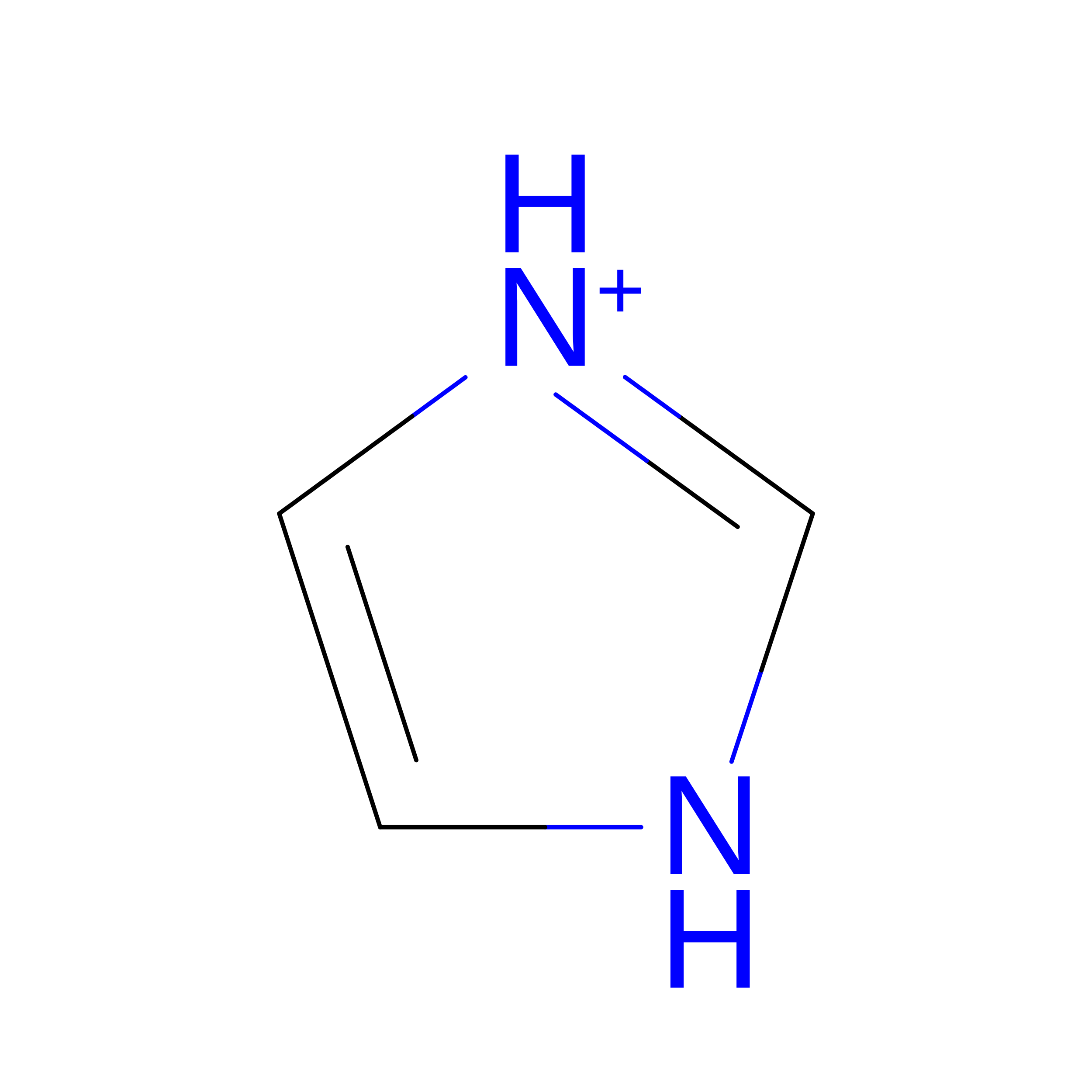
IMD

Query on IMD


Download:Ideal Coordinates CCD File
FA [auth G],
L [auth A]
IMIDAZOLE
C3 H5 N2
RAXXELZNTBOGNW-UHFFFAOYSA-O
CL

Query on CL


Download:Ideal Coordinates CCD File
EA [auth G],
M [auth A],
P [auth C],
Y [auth E]
CHLORIDE ION
Cl
VEXZGXHMUGYJMC-UHFFFAOYSA-M
MG

Query on MG


Download:Ideal Coordinates CCD File
AA [auth F],
HA [auth H],
O [auth B],
U [auth D]
MAGNESIUM ION
Mg
JLVVSXFLKOJNIY-UHFFFAOYSA-N

Experimental Data & Validation

Experimental Data

  • Method: X-RAY DIFFRACTION
  • Resolution: 2.10 Å
  • R-Value Free:  0.168 (Depositor), 0.178 (DCC) 
  • R-Value Work:  0.138 (Depositor), 0.151 (DCC) 
  • R-Value Observed: 0.140 (Depositor) 
Space Group: P 21 21 2
Unit Cell:
Length ( Å )Angle ( ˚ )
a = 205.75α = 90
b = 216.96β = 90
c = 119.8γ = 90
Software Package:
Software NamePurpose
REFMACrefinement
CNSrefinement
XDSdata scaling
XDSdata reduction
XSCALEdata scaling
CNSphasing

Structure Validation

View Full Validation Report


Entry History 

Deposition Data

Revision History  (Full details and data files)

  • Version 1.0: 2010-08-04
    Type: Initial release
  • Version 1.1: 2011-07-13
    Changes: Version format compliance
  • Version 1.2: 2019-07-17
    Changes: Data collection, Refinement description
  • Version 1.3: 2023-09-06
    Changes: Data collection, Database references, Derived calculations, Refinement description
  • Version 1.4: 2024-11-06
    Changes: Structure summary