Download Mendeley
Antibody modeling assessment.
Almagro, J.C., Beavers, M.P., Hernandez-Guzman, F., Maier, J., Shaulsky, J., Butenhof, K., Labute, P., Thorsteinson, N., Kelly, K., Teplyakov, A., Luo, J., Sweet, R., Gilliland, G.L.(2011) Proteins 79: 3050-3066
- PubMed: 21935986 Search on PubMed
- DOI: https://doi.org/10.1002/prot.23130
- Primary Citation Related Structures:
3MCK - PubMed Abstract:
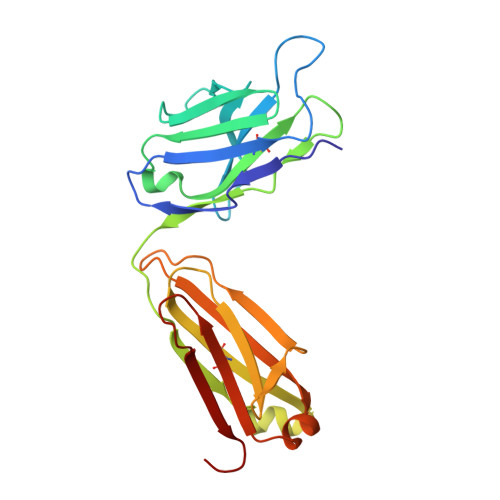
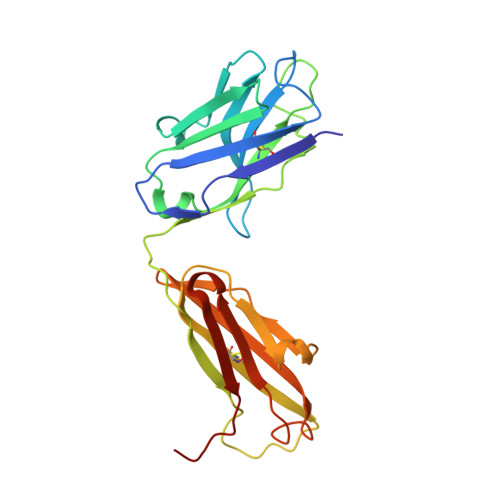
A blinded study to assess the state of the art in three-dimensional structure modeling of the variable region (Fv) of antibodies was conducted. Nine unpublished high-resolution x-ray Fab crystal structures covering a wide range of antigen-binding site conformations were used as benchmark to compare Fv models generated by four structure prediction methodologies. The methodologies included two homology modeling strategies independently developed by CCG (Chemical Computer Group) and Accerlys Inc, and two fully automated antibody modeling servers: PIGS (Prediction of ImmunoGlobulin Structure), based on the canonical structure model, and Rosetta Antibody Modeling, based on homology modeling and Rosetta structure prediction methodology. The benchmark structure sequences were submitted to Accelrys and CCG and a set of models for each of the nine antibody structures were generated. PIGS and Rosetta models were obtained using the default parameters of the servers. In most cases, we found good agreement between the models and x-ray structures. The average rmsd (root mean square deviation) values calculated over the backbone atoms between the models and structures were fairly consistent, around 1.2 Å. Average rmsd values of the framework and hypervariable loops with canonical structures (L1, L2, L3, H1, and H2) were close to 1.0 Å. H3 prediction yielded rmsd values around 3.0 Å for most of the models. Quality assessment of the models and the relative strengths and weaknesses of the methods are discussed. We hope this initiative will serve as a model of scientific partnership and look forward to future antibody modeling assessments.
- Centocor R&D, Inc, Radnor, Pennsylvania 19087, USA. jcalmagro@hotmail.com
Organizational Affiliation: