3L41 | pdb_00003l41

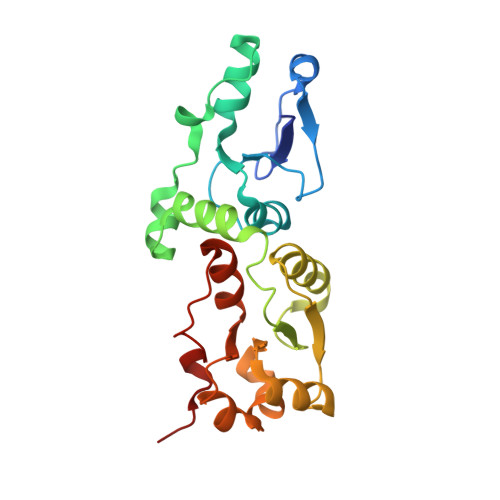
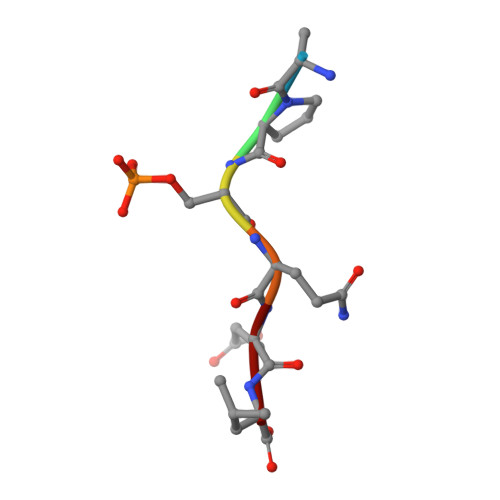
Crystal Structure of S. pombe Brc1 BRCT5-BRCT6 domains in complex with phosphorylated H2A


Experimental Data Snapshot

  • Method: X-RAY DIFFRACTION
  • Resolution: 1.45 Å
  • R-Value Free: 
    0.188 (Depositor), 0.192 (DCC) 
  • R-Value Work: 
    0.131 (Depositor), 0.138 (DCC) 
  • R-Value Observed: 
    0.133 (Depositor) 

wwPDB Validation 3D Report Full Report

Validation slider image for 3L41

This is version 1.2 of the entry. See complete history

Literature

gammaH2A binds Brc1 to maintain genome integrity during S-phase.

Williams, J.S.Williams, R.S.Dovey, C.L.Guenther, G.Tainer, J.A.Russell, P.

(2010) EMBO J 29: 1136-1148

  • DOI: https://doi.org/10.1038/emboj.2009.413
  • Primary Citation Related Structures: 
    3L40, 3L41

  • PubMed Abstract: 

    ATM(Tel1) and ATR(Rad3) checkpoint kinases phosphorylate the C-terminus of histone H2AX (H2A in yeasts) in chromatin flanking DNA damage, establishing a recruitment platform for checkpoint and repair proteins. Phospho-H2A/X (gammaH2A/X)-binding proteins at double-strand breaks (DSBs) have been characterized, but those required for replication stress responses are unknown. Here, we present genetic, biochemical, small angle X-ray scattering (SAXS), and X-ray structural studies of the Schizosaccharomyces pombe Brc1, a 6-BRCT-domain protein that is structurally related to Saccharomyces cerevisiae Rtt107 and mammalian PTIP. Brc1 binds gammaH2A to form spontaneous and DNA damage-induced nuclear foci. Spontaneous Brc1 foci colocalize with ribosomal DNA repeats, a region prone to fork pausing and genomic instability, whereas DNA damage-induced Brc1 foci colocalize with DSB response factors. gammaH2A binding is critical for Brc1 function. The 1.45 A resolution crystal structure of Brc1-gammaH2A complex shows how variable BRCT insertion loops sculpt tandem-BRCT phosphoprotein-binding pockets to facilitate unique phosphoprotein-interaction specificities, and unveils an acidic DNA-mimicking Brc1 surface. From these results, Brc1 docking to gammaH2A emerges as a critical chromatin-specific response to replication-associated DNA damage.


  • Organizational Affiliation
    • Department of Molecular Biology, The Scripps Research Institute, La Jolla, CA, USA.

Macromolecule Content 

  • Total Structure Weight: 25.61 kDa 
  • Atom Count: 2,175 
  • Modeled Residue Count: 220 
  • Deposited Residue Count: 226 
  • Unique protein chains: 2

Macromolecules

Find similar proteins by:|  3D Structure
Entity ID: 1
MoleculeChains  Sequence LengthOrganismDetailsImage
BRCT-containing protein 1220Schizosaccharomyces pombeMutation(s): 0 
Gene Names: brc1SPBC582.05c
UniProt
Find proteins for Q10337 (Schizosaccharomyces pombe (strain 972 / ATCC 24843))
Explore Q10337 
Go to UniProtKB:  Q10337
Entity Groups
Sequence Clusters30% Identity50% Identity70% Identity90% Identity95% Identity100% Identity
UniProt GroupQ10337
Sequence Annotations
Expand
Reference Sequence
Find similar proteins by:  Sequence   |   3D Structure  
Entity ID: 2
MoleculeChains  Sequence LengthOrganismDetailsImage
phosphorylated H2A tail6N/AMutation(s): 0 

Small Molecules

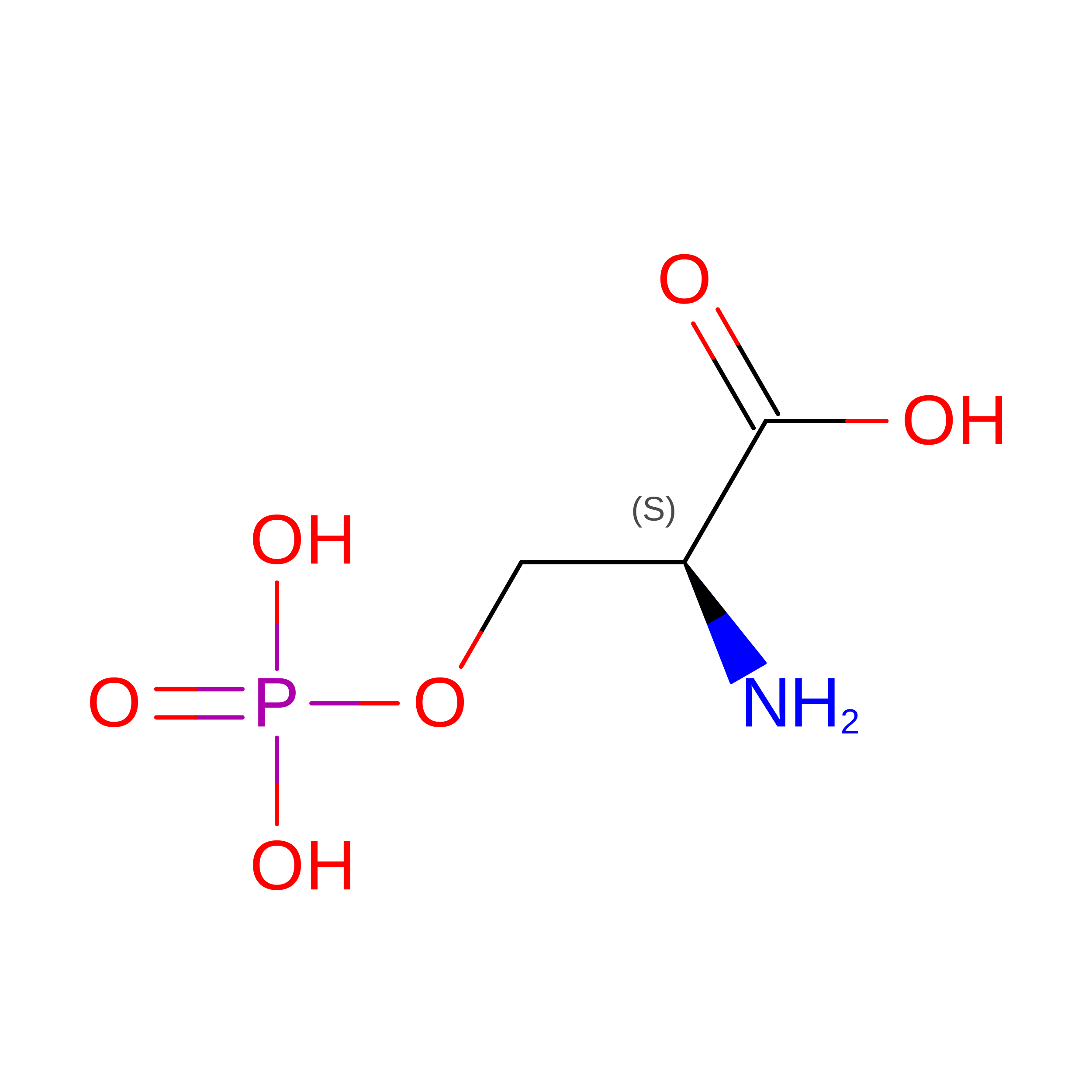
Modified Residues  1 Unique
IDChains TypeFormula2D DiagramParent
SEP
Query on SEP
B
L-PEPTIDE LINKINGC3 H8 N O6 PSER

Experimental Data & Validation

Experimental Data

  • Method: X-RAY DIFFRACTION
  • Resolution: 1.45 Å
  • R-Value Free:  0.188 (Depositor), 0.192 (DCC) 
  • R-Value Work:  0.131 (Depositor), 0.138 (DCC) 
  • R-Value Observed: 0.133 (Depositor) 
Space Group: P 21 21 21
Unit Cell:
Length ( Å )Angle ( ˚ )
a = 41.577α = 90
b = 71.117β = 90
c = 72.007γ = 90
Software Package:
Software NamePurpose
Blu-Icedata collection
MOLREPphasing
REFMACrefinement
HKL-2000data reduction
HKL-2000data scaling

Structure Validation

View Full Validation Report


Entry History 

Deposition Data

Revision History  (Full details and data files)

  • Version 1.0: 2010-02-09
    Type: Initial release
  • Version 1.1: 2011-07-13
    Changes: Version format compliance
  • Version 1.2: 2024-11-27
    Changes: Data collection, Database references, Derived calculations, Structure summary