3KGR | pdb_00003kgr

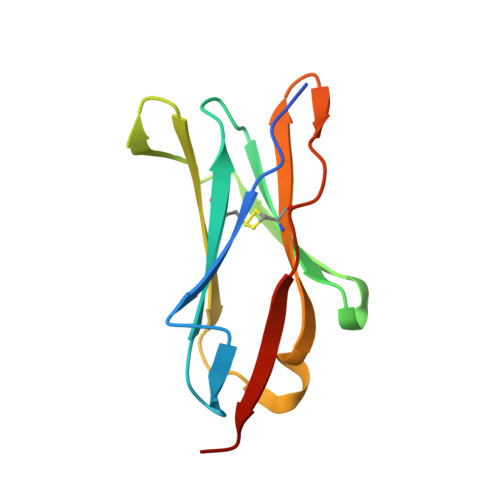
Crystal structure of the human leukocyte-associated Ig-like receptor-1 (LAIR-1)


Experimental Data Snapshot

  • Method: X-RAY DIFFRACTION
  • Resolution: 1.80 Å
  • R-Value Free: 
    0.157 (Depositor), 0.232 (DCC) 
  • R-Value Work: 
    0.123 (Depositor) 
  • R-Value Observed: 
    0.124 (Depositor) 

Starting Models: experimental
View more details

wwPDB Validation 3D Report Full Report

Validation slider image for 3KGR

This is version 1.4 of the entry. See complete history. 

Literature

Crystal structure and collagen-binding site of immune inhibitory receptor LAIR-1: unexpected implications for collagen binding by platelet receptor GPVI

Brondijk, T.H.C., de Ruiter, T., Ballering, J., Wienk, H., Lebbink, R.J., van Ingen, H., Boelens, R., Farndale, R.W., Meyaard, L., Huizinga, E.G.

(2010) Blood 115: 1364-1373

  • DOI: https://doi.org/10.1182/blood-2009-10-246322
  • Primary Citation Related Structures: 
    3KGR

  • PubMed Abstract: 

    Leukocyte-associated immunoglobulin-like receptor-1 (LAIR-1), one of the most widely spread immune receptors, attenuates immune cell activation when bound to specific sites in collagen. The collagen-binding domain of LAIR-1 is homologous to that of glycoprotein VI (GPVI), a collagen receptor crucial for platelet activation. Because LAIR-1 and GPVI also display overlapping collagen-binding specificities, a common structural basis for collagen recognition would appear likely. Therefore, it is crucial to gain insight into the molecular interaction of both receptors with their ligand to prevent unwanted cross-reactions during therapeutic intervention. We determined the crystal structure of LAIR-1 and mapped its collagen-binding site by nuclear magnetic resonance (NMR) titrations and mutagenesis. Our data identify R59, E61, and W109 as key residues for collagen interaction. These residues are strictly conserved in LAIR-1 and GPVI alike; however, they are located outside the previously proposed GPVI collagen-binding site. Our data provide evidence for an unanticipated mechanism of collagen recognition common to LAIR-1 and GPVI. This fundamental insight will contribute to the exploration of specific means of intervention in collagen-induced signaling in immunity and hemostasis.


  • Organizational Affiliation: 
    • Crystal and Structural Chemistry, Bijvoet Center for Biomolecular Research, Utrecht University, Utrecht, The Netherlands.

Macromolecule Content 

  • Total Structure Weight: 35.38 kDa 
  • Atom Count: 2,843 
  • Modeled Residue Count: 295 
  • Deposited Residue Count: 318 
  • Unique protein chains: 1

Macromolecules

Find similar proteins by:|  3D Structure
Entity ID: 1
MoleculeChains  Sequence LengthOrganismDetailsImage
Leukocyte-associated immunoglobulin-like receptor 1
A, B, C
106Homo sapiensMutation(s): 0 
Gene Names: LAIR1
UniProt & NIH Common Fund Data Resources
Find proteins for Q6GTX8 (Homo sapiens)
Explore Q6GTX8 
Go to UniProtKB:  Q6GTX8
PHAROS:  Q6GTX8
GTEx:  ENSG00000167613 
Entity Groups
Sequence Clusters30% Identity50% Identity70% Identity90% Identity95% Identity100% Identity
UniProt GroupQ6GTX8
Sequence Annotations
Expand
Reference Sequence

Experimental Data & Validation

Experimental Data

  • Method: X-RAY DIFFRACTION
  • Resolution: 1.80 Å
  • R-Value Free:  0.157 (Depositor), 0.232 (DCC) 
  • R-Value Work:  0.123 (Depositor) 
  • R-Value Observed: 0.124 (Depositor) 
Space Group: P 32
Unit Cell:
Length ( Å )Angle ( ˚ )
a = 69.395α = 90
b = 69.395β = 90
c = 54.258γ = 120
Software Package:
Software NamePurpose
MOSFLMdata reduction
SCALAdata scaling
PHENIXrefinement
PDB_EXTRACTdata extraction
MOLREPphasing

Structure Validation

View Full Validation Report


Entry History 

Deposition Data

Revision History  (Full details and data files)

  • Version 1.0: 2009-12-22
    Type: Initial release
  • Version 1.1: 2011-07-13
    Changes: Non-polymer description, Version format compliance
  • Version 1.2: 2012-04-11
    Changes: Database references
  • Version 1.3: 2023-11-01
    Changes: Data collection, Database references, Derived calculations, Refinement description
  • Version 1.4: 2024-11-06
    Changes: Structure summary