3JU9 | pdb_00003ju9

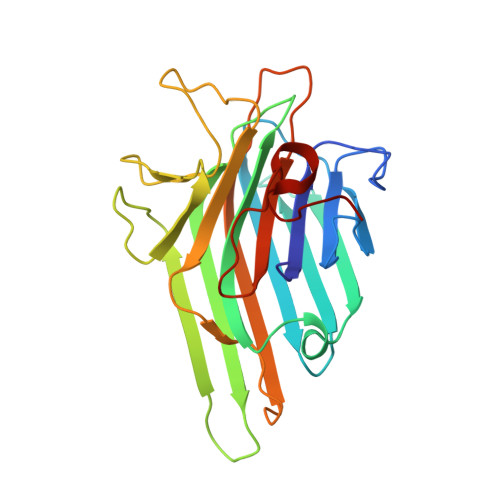
Crystal structure of a lectin from Canavalia brasiliensis seed (ConBr) complexed with alpha-aminobutyric acid


Experimental Data Snapshot

  • Method: X-RAY DIFFRACTION
  • Resolution: 2.10 Å
  • R-Value Free: 
    0.253 (Depositor), 0.257 (DCC) 
  • R-Value Work: 
    0.204 (Depositor), 0.204 (DCC) 
  • R-Value Observed: 
    0.207 (Depositor) 

Starting Model: experimental
View more details

wwPDB Validation 3D Report Full Report

Validation slider image for 3JU9

This is version 1.3 of the entry. See complete history

Literature

Structural analysis of ConBr reveals molecular correlation between the carbohydrate recognition domain and endothelial NO synthase activation.

Bezerra, E.H.Rocha, B.A.Nagano, C.S.Bezerra, G.A.Moura, T.R.Bezerra, M.J.Benevides, R.G.Sampaio, A.H.Assreuy, A.M.Delatorre, P.Cavada, B.S.

(2011) Biochem Biophys Res Commun 408: 566-570

  • DOI: https://doi.org/10.1016/j.bbrc.2011.04.061
  • Primary Citation Related Structures: 
    3JU9

  • PubMed Abstract: 

    Diocleinae lectins are highly homologous in their primary structure which features metal binding sites and a carbohydrate recognition domain (CRD). Differences in the biological activity of legume lectins have been widely investigated using hemagglutination inhibition assays, isothermal titration microcalorimetry and co-crystallization with mono- and oligosaccharides. Here we report a new lectin crystal structure (ConBr) extracted from seeds of Canavalia brasiliensis, predict dimannoside binding by docking, identify the α-aminobutyric acid (Abu) binding pocket and compare the CRD of ConBr to that of homologous lectins. Based on the hypothesis that the carbohydrate affinity of lectins depends on CRD configuration, the relationship between tridimensional structure and endothelial NO synthase activation was used to clarify differences in biological activity. Our study established a correlation between the position of CRD amino acid side chains and the stimulation of NO release from endothelium.


  • Organizational Affiliation
    • Departamento de Bioquímica e Biologia Molecular, Universidade Federal do Ceará, Fortaleza, CE, Brazil.

Macromolecule Content 

  • Total Structure Weight: 25.95 kDa 
  • Atom Count: 1,963 
  • Modeled Residue Count: 237 
  • Deposited Residue Count: 237 
  • Unique protein chains: 1

Macromolecules

Find similar proteins by:|  3D Structure
Entity ID: 1
MoleculeChains  Sequence LengthOrganismDetailsImage
Concanavalin-Br237Canavalia brasiliensisMutation(s): 0 
UniProt
Find proteins for P55915 (Canavalia brasiliensis)
Explore P55915 
Go to UniProtKB:  P55915
Entity Groups
Sequence Clusters30% Identity50% Identity70% Identity90% Identity95% Identity100% Identity
UniProt GroupP55915
Sequence Annotations
Expand
Reference Sequence

Small Molecules

Ligands 5 Unique
IDChains Name / Formula / InChI Key2D Diagram3D Interactions
DBB

Query on DBB


Download:Ideal Coordinates CCD File
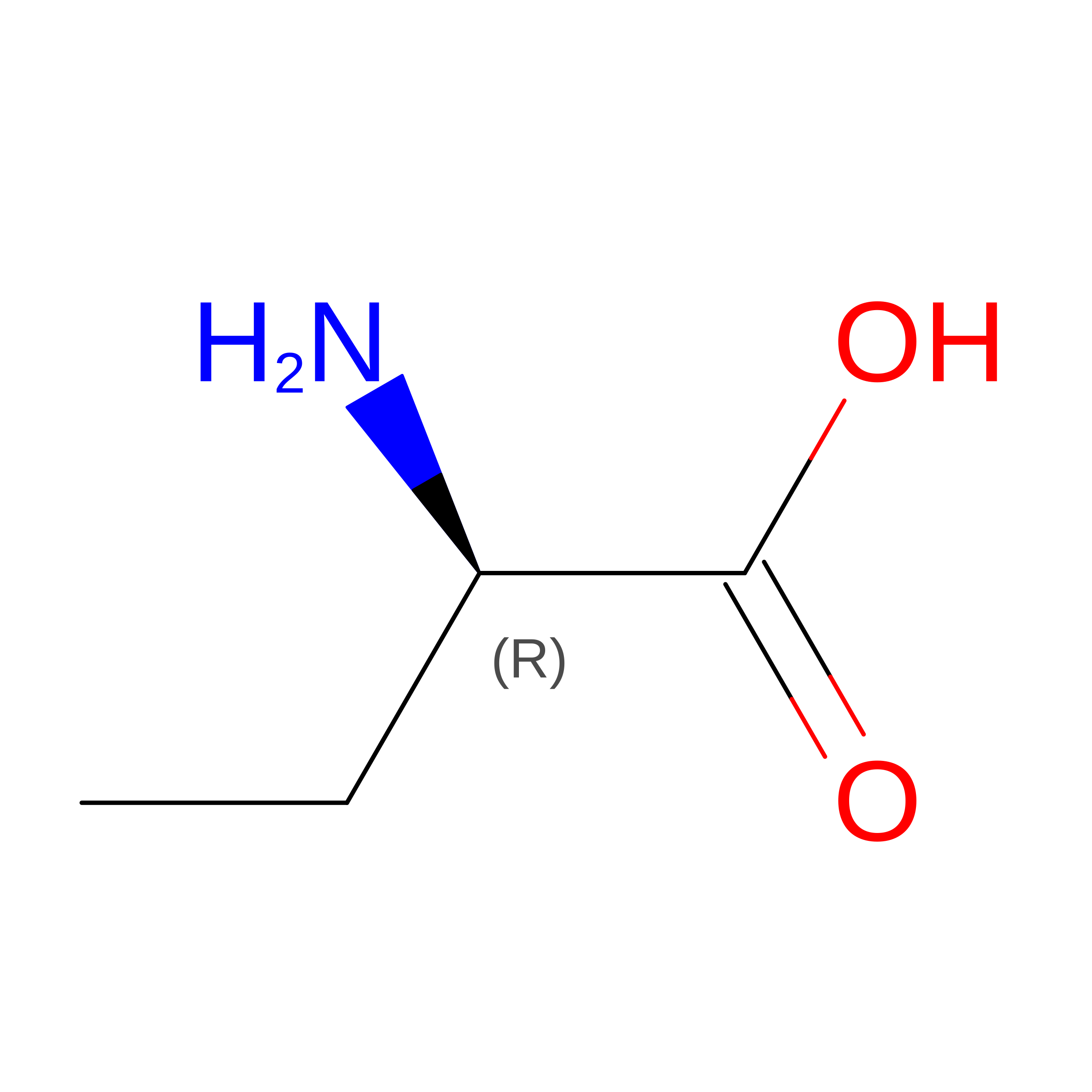
B [auth A]D-ALPHA-AMINOBUTYRIC ACID
C4 H9 N O2
QWCKQJZIFLGMSD-GSVOUGTGSA-N
GOL

Query on GOL


Download:Ideal Coordinates CCD File
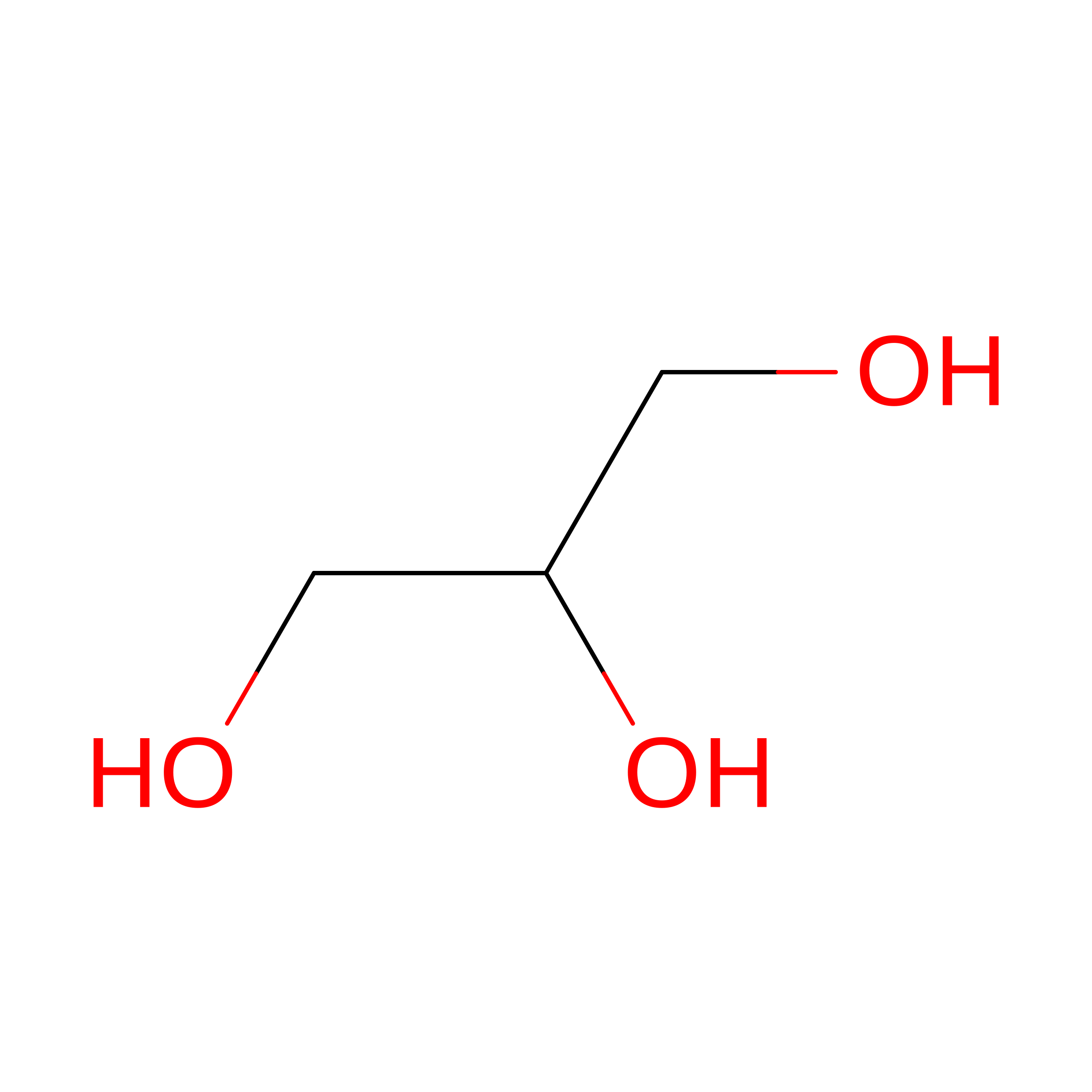
C [auth A]GLYCEROL
C3 H8 O3
PEDCQBHIVMGVHV-UHFFFAOYSA-N
MN

Query on MN


Download:Ideal Coordinates CCD File
E [auth A]MANGANESE (II) ION
Mn
WAEMQWOKJMHJLA-UHFFFAOYSA-N
CA

Query on CA


Download:Ideal Coordinates CCD File
D [auth A]CALCIUM ION
Ca
BHPQYMZQTOCNFJ-UHFFFAOYSA-N
CL

Query on CL


Download:Ideal Coordinates CCD File
F [auth A],
G [auth A]
CHLORIDE ION
Cl
VEXZGXHMUGYJMC-UHFFFAOYSA-M

Experimental Data & Validation

Experimental Data

  • Method: X-RAY DIFFRACTION
  • Resolution: 2.10 Å
  • R-Value Free:  0.253 (Depositor), 0.257 (DCC) 
  • R-Value Work:  0.204 (Depositor), 0.204 (DCC) 
  • R-Value Observed: 0.207 (Depositor) 
Space Group: I 2 2 2
Unit Cell:
Length ( Å )Angle ( ˚ )
a = 68.323α = 90
b = 73.02β = 90
c = 99.542γ = 90
Software Package:
Software NamePurpose
HKL-2000data collection
MOLREPphasing
REFMACrefinement
MOSFLMdata reduction
SCALAdata scaling

Structure Validation

View Full Validation Report


Entry History 

Revision History  (Full details and data files)

  • Version 1.0: 2010-12-08
    Type: Initial release
  • Version 1.1: 2011-07-13
    Changes: Version format compliance
  • Version 1.2: 2023-09-06
    Changes: Data collection, Database references, Derived calculations, Refinement description
  • Version 1.3: 2023-11-22
    Changes: Data collection