3JRQ | pdb_00003jrq

Crystal structure of (+)-ABA-bound PYL1 in complex with ABI1


Experimental Data Snapshot

  • Method: X-RAY DIFFRACTION
  • Resolution: 2.10 Å
  • R-Value Free: 
    0.249 (Depositor), 0.255 (DCC) 
  • R-Value Work: 
    0.198 (Depositor), 0.203 (DCC) 
  • R-Value Observed: 
    0.201 (Depositor) 

Starting Models: experimental
View more details

wwPDB Validation 3D Report Full Report

Validation slider image for 3JRQ

Ligand Structure Quality Assessment 


This is version 1.2 of the entry. See complete history

Literature

Structural basis of abscisic acid signalling

Miyazono, K.Miyakawa, T.Sawano, Y.Kubota, K.Kang, H.J.Asano, A.Miyauchi, Y.Takahashi, M.Zhi, Y.Fujita, Y.Yoshida, T.Kodaira, K.Yamaguchi-Shinozaki, K.Tanokura, M.

(2009) Nature 462: 609-614

  • DOI: https://doi.org/10.1038/nature08583
  • Primary Citation Related Structures: 
    3JRQ, 3JRS

  • PubMed Abstract: 

    The phytohormone abscisic acid (ABA) mediates the adaptation of plants to environmental stresses such as drought and regulates developmental signals such as seed maturation. Within plants, the PYR/PYL/RCAR family of START proteins receives ABA to inhibit the phosphatase activity of the group-A protein phosphatases 2C (PP2Cs), which are major negative regulators in ABA signalling. Here we present the crystal structures of the ABA receptor PYL1 bound with (+)-ABA, and the complex formed by the further binding of (+)-ABA-bound PYL1 with the PP2C protein ABI1. PYL1 binds (+)-ABA using the START-protein-specific ligand-binding site, thereby forming a hydrophobic pocket on the surface of the closed lid. (+)-ABA-bound PYL1 tightly interacts with a PP2C domain of ABI1 by using the hydrophobic pocket to cover the active site of ABI1 like a plug. Our results reveal the structural basis of the mechanism of (+)-ABA-dependent inhibition of ABI1 by PYL1 in ABA signalling.


  • Organizational Affiliation
    • Department of Applied Biological Chemistry, Graduate School of Agricultural and Life Sciences, The University of Tokyo, Tokyo 113-8657, Japan.

Macromolecule Content 

  • Total Structure Weight: 57.59 kDa 
  • Atom Count: 3,619 
  • Modeled Residue Count: 444 
  • Deposited Residue Count: 512 
  • Unique protein chains: 2

Macromolecules

Find similar proteins by:|  3D Structure
Entity ID: 1
MoleculeChains  Sequence LengthOrganismDetailsImage
Protein phosphatase 2C 56326Arabidopsis thalianaMutation(s): 0 
Gene Names: ABI1
EC: 3.1.3.16
UniProt
Find proteins for P49597 (Arabidopsis thaliana)
Explore P49597 
Go to UniProtKB:  P49597
Entity Groups
Sequence Clusters30% Identity50% Identity70% Identity90% Identity95% Identity100% Identity
UniProt GroupP49597
Sequence Annotations
Expand
Reference Sequence
Find similar proteins by:|  3D Structure
Entity ID: 2
MoleculeChains  Sequence LengthOrganismDetailsImage
Putative uncharacterized protein At5g46790186Arabidopsis thalianaMutation(s): 0 
UniProt
Find proteins for Q8VZS8 (Arabidopsis thaliana)
Explore Q8VZS8 
Go to UniProtKB:  Q8VZS8
Entity Groups
Sequence Clusters30% Identity50% Identity70% Identity90% Identity95% Identity100% Identity
UniProt GroupQ8VZS8
Sequence Annotations
Expand
Reference Sequence

Small Molecules

Ligands 1 Unique
IDChains Name / Formula / InChI Key2D Diagram3D Interactions
A8S

Query on A8S


Download:Ideal Coordinates CCD File
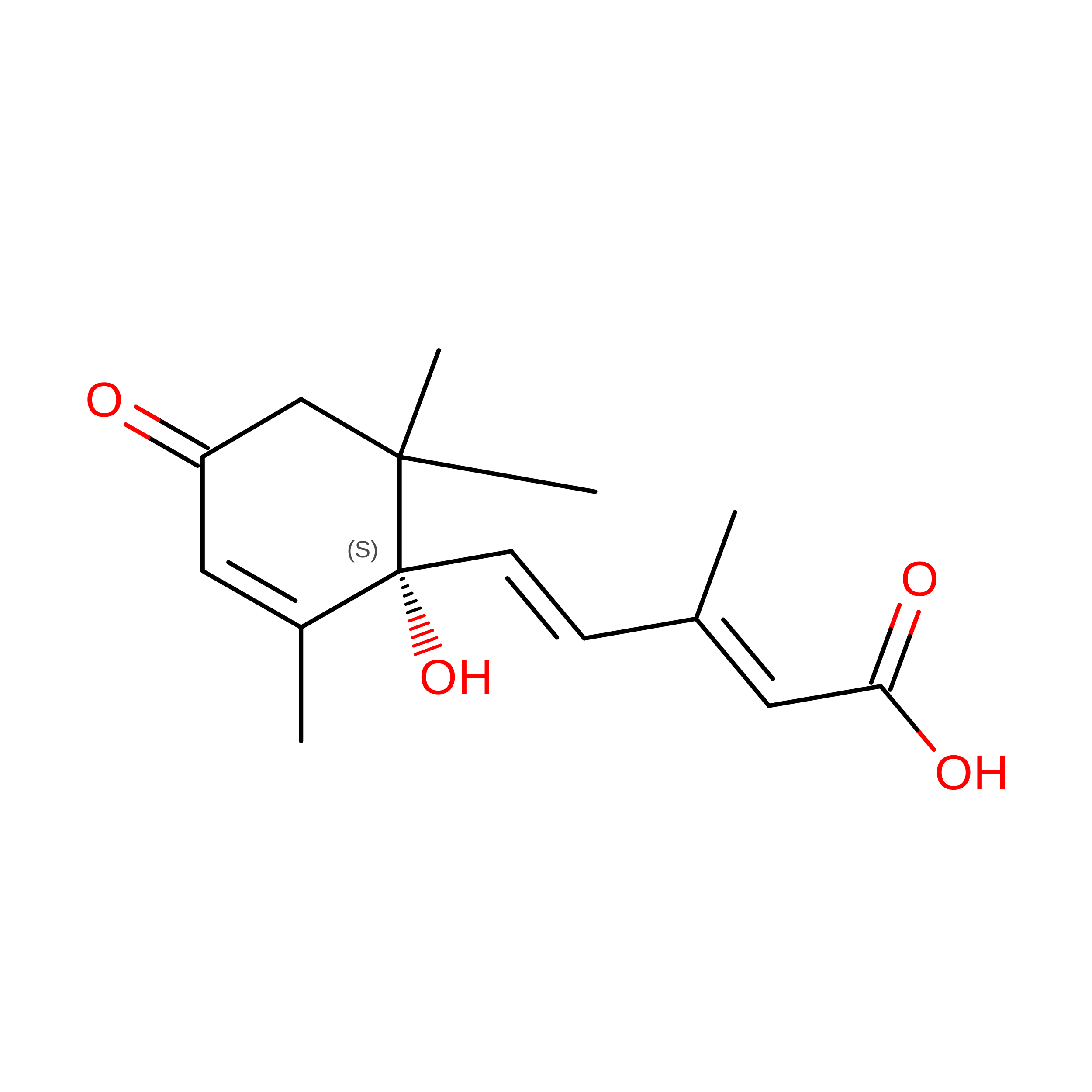
C [auth B](2Z,4E)-5-[(1S)-1-hydroxy-2,6,6-trimethyl-4-oxocyclohex-2-en-1-yl]-3-methylpenta-2,4-dienoic acid
C15 H20 O4
JLIDBLDQVAYHNE-YKALOCIXSA-N

Experimental Data & Validation

Experimental Data

  • Method: X-RAY DIFFRACTION
  • Resolution: 2.10 Å
  • R-Value Free:  0.249 (Depositor), 0.255 (DCC) 
  • R-Value Work:  0.198 (Depositor), 0.203 (DCC) 
  • R-Value Observed: 0.201 (Depositor) 
Space Group: P 1 21 1
Unit Cell:
Length ( Å )Angle ( ˚ )
a = 49.01α = 90
b = 60.62β = 104.56
c = 84.96γ = 90
Software Package:
Software NamePurpose
XSCALEdata scaling
REFMACrefinement
PDB_EXTRACTdata extraction
XDSdata reduction

Structure Validation

View Full Validation Report


Ligand Structure Quality Assessment 


Entry History 

Deposition Data

Revision History  (Full details and data files)

  • Version 1.0: 2009-11-03
    Type: Initial release
  • Version 1.1: 2011-07-13
    Changes: Advisory, Version format compliance
  • Version 1.2: 2023-11-01
    Changes: Data collection, Database references, Derived calculations, Refinement description, Structure summary