3JBL | pdb_00003jbl

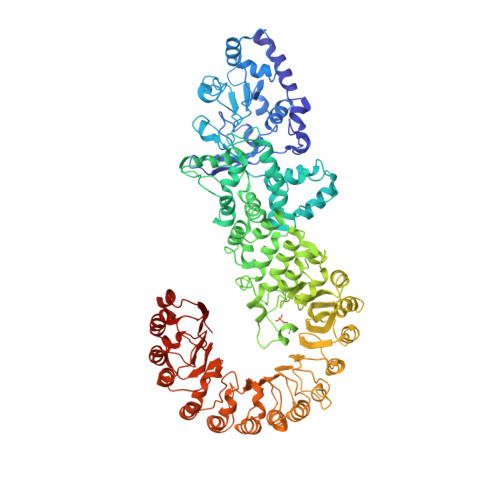
Cryo-EM Structure of the Activated NAIP2/NLRC4 Inflammasome Reveals Nucleated Polymerization


Experimental Data Snapshot

  • Method: ELECTRON MICROSCOPY
  • Resolution: 4.70 Å
  • Aggregation State: PARTICLE 
  • Reconstruction Method: SINGLE PARTICLE 

wwPDB Validation 3D Report Full Report

Validation slider image for 3JBL

This is version 1.3 of the entry. See complete history. 

Literature

Cryo-EM structure of the activated NAIP2-NLRC4 inflammasome reveals nucleated polymerization.

Zhang, L., Chen, S., Ruan, J., Wu, J., Tong, A.B., Yin, Q., Li, Y., David, L., Lu, A., Wang, W.L., Marks, C., Ouyang, Q., Zhang, X., Mao, Y., Wu, H.

(2015) Science 350: 404-409

  • DOI: https://doi.org/10.1126/science.aac5789
  • Primary Citation Related Structures: 
    3JBL

  • PubMed Abstract: 

    The NLR family apoptosis inhibitory proteins (NAIPs) bind conserved bacterial ligands, such as the bacterial rod protein PrgJ, and recruit NLR family CARD-containing protein 4 (NLRC4) as the inflammasome adapter to activate innate immunity. We found that the PrgJ-NAIP2-NLRC4 inflammasome is assembled into multisubunit disk-like structures through a unidirectional adenosine triphosphatase polymerization, primed with a single PrgJ-activated NAIP2 per disk. Cryo-electron microscopy (cryo-EM) reconstruction at subnanometer resolution revealed a ~90° hinge rotation accompanying NLRC4 activation. Unlike in the related heptameric Apaf-1 apoptosome, in which each subunit needs to be conformationally activated by its ligand before assembly, a single PrgJ-activated NAIP2 initiates NLRC4 polymerization in a domino-like reaction to promote the disk assembly. These insights reveal the mechanism of signal amplification in NAIP-NLRC4 inflammasomes.


  • Organizational Affiliation: 
    • Department of Biological Chemistry and Molecular Pharmacology, Harvard Medical School, Boston, MA 02115, USA. Program in Cellular and Molecular Medicine, Boston Children's Hospital, Boston, MA 02115, USA.

Macromolecule Content 

  • Total Structure Weight: 1,168.64 kDa 
  • Atom Count: 80,124 
  • Modeled Residue Count: 9,999 
  • Deposited Residue Count: 10,252 
  • Unique protein chains: 1

Macromolecules

Find similar proteins by:|  3D Structure
Entity ID: 1
MoleculeChains  Sequence LengthOrganismDetailsImage
NLR family CARD domain-containing protein 4932Mus musculusMutation(s): 0 
Gene Names: Nlrc4, Card12, Ipaf
UniProt
Find proteins for Q3UP24 (Mus musculus)
Explore Q3UP24 
Go to UniProtKB:  Q3UP24
Entity Groups
Sequence Clusters30% Identity50% Identity70% Identity90% Identity95% Identity100% Identity
UniProt GroupQ3UP24
Sequence Annotations
Expand
Reference Sequence

Small Molecules

Modified Residues  1 Unique
IDChains TypeFormula2D DiagramParent
SEP
Query on SEP
A [auth K]
B [auth A]
C [auth B]
D [auth C]
E [auth D]
A [auth K],
B [auth A],
C [auth B],
D [auth C],
E [auth D],
F [auth E],
G [auth F],
H [auth G],
I [auth H],
J [auth I],
K [auth J]
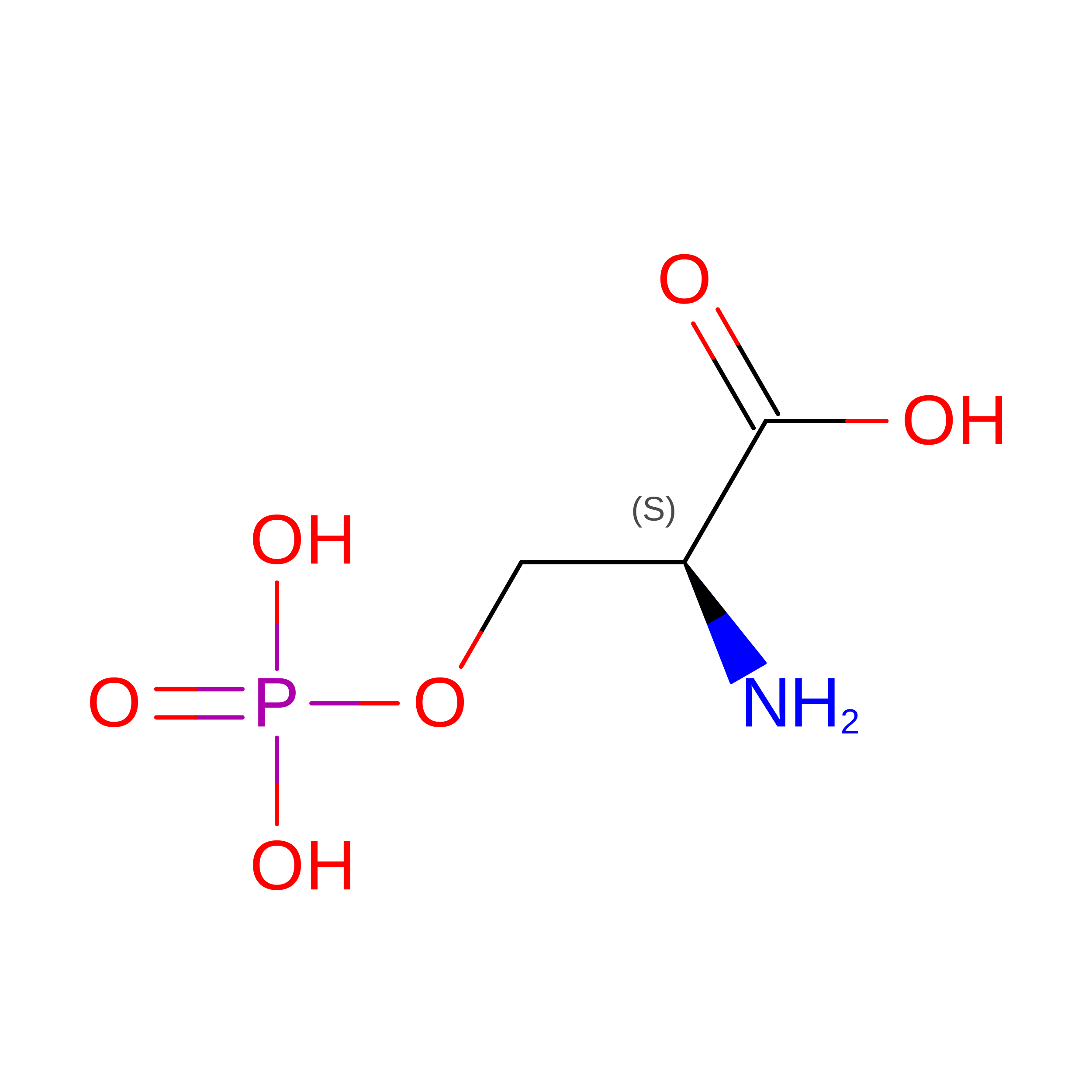
L-PEPTIDE LINKINGC3 H8 N O6 PSER

Experimental Data & Validation

Experimental Data

  • Method: ELECTRON MICROSCOPY
  • Resolution: 4.70 Å
  • Aggregation State: PARTICLE 
  • Reconstruction Method: SINGLE PARTICLE 
EM Software:
TaskSoftware PackageVersion
RECONSTRUCTIONEMAN2
RECONSTRUCTIONRELION
RECONSTRUCTIONSPIDER

Structure Validation

View Full Validation Report


Entry History 

Deposition Data

Revision History  (Full details and data files)

  • Version 1.0: 2015-10-21
    Type: Initial release
  • Version 1.1: 2015-11-04
    Changes: Database references, Other
  • Version 1.2: 2018-07-18
    Changes: Data collection
  • Version 1.3: 2024-11-20
    Changes: Data collection, Database references, Derived calculations, Refinement description, Structure summary