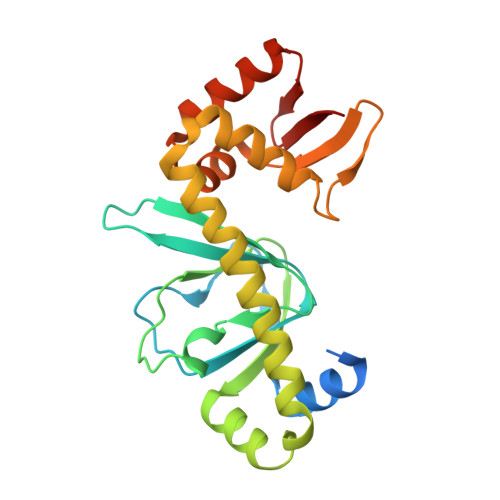
3IWZ | pdb_00003iwz

The c-di-GMP Responsive Global Regulator CLP Links Cell-Cell Signaling to Virulence Gene Expression in Xanthomonas campestris


Experimental Data Snapshot

  • Method: X-RAY DIFFRACTION
  • Resolution: 2.30 Å
  • R-Value Free: 
    0.305 (Depositor), 0.259 (DCC) 
  • R-Value Work: 
    0.244 (Depositor), 0.257 (DCC) 
  • R-Value Observed: 
    0.244 (Depositor) 

wwPDB Validation 3D Report Full Report

Validation slider image for 3IWZ

This is version 1.3 of the entry. See complete history

Literature

The cAMP receptor-like protein CLP is a novel c-di-GMP receptor linking cell-cell signaling to virulence gene expression in Xanthomonas campestris.

Chin, K.H.Lee, Y.C.Tu, Z.L.Chen, C.H.Tseng, Y.H.Yang, J.M.Ryan, R.P.McCarthy, Y.Dow, J.M.Wang, A.H.Chou, S.H.

(2010) J Mol Biology 396: 646-662

  • DOI: https://doi.org/10.1016/j.jmb.2009.11.076
  • Primary Citation Related Structures: 
    3IWZ

  • PubMed Abstract: 

    Cyclic-di-GMP [bis-(3'-5')-cyclic diguanosine monophosphate] controls a wide range of functions in eubacteria, yet little is known about the underlying regulatory mechanisms. In the plant pathogen Xanthomonas campestris, expression of a subset of virulence genes is regulated by c-di-GMP and also by the CAP (catabolite activation protein)-like protein XcCLP, a global regulator in the CRP/FNR superfamily. Here, we report structural and functional insights into the interplay between XcCLP and c-di-GMP in regulation of gene expression. XcCLP bound target promoter DNA with submicromolar affinity in the absence of any ligand. This DNA-binding capability was abrogated by c-di-GMP, which bound to XcCLP with micromolar affinity. The crystal structure of XcCLP showed that the protein adopted an intrinsically active conformation for DNA binding. Alteration of residues of XcCLP implicated in c-di-GMP binding through modeling studies caused a substantial reduction in binding affinity for the nucleotide and rendered DNA binding by these variant proteins insensitive to inhibition by c-di-GMP. Together, these findings reveal the structural mechanism behind a novel class of c-di-GMP effector proteins in the CRP/FNR superfamily and indicate that XcCLP regulates bacterial virulence gene expression in a manner negatively controlled by the c-di-GMP concentrations.


  • Organizational Affiliation
    • Institute of Biochemistry, National Chung-Hsing University, Taichung 40227, Taiwan, ROC.

Macromolecule Content 

  • Total Structure Weight: 102.99 kDa 
  • Atom Count: 6,817 
  • Modeled Residue Count: 829 
  • Deposited Residue Count: 920 
  • Unique protein chains: 1

Macromolecules

Find similar proteins by:|  3D Structure
Entity ID: 1
MoleculeChains  Sequence LengthOrganismDetailsImage
Catabolite activation-like protein
A, B, C, D
230Xanthomonas campestris pv. campestrisMutation(s): 0 
UniProt
Find proteins for P22260 (Xanthomonas campestris pv. campestris (strain ATCC 33913 / DSM 3586 / NCPPB 528 / LMG 568 / P 25))
Explore P22260 
Go to UniProtKB:  P22260
Entity Groups
Sequence Clusters30% Identity50% Identity70% Identity90% Identity95% Identity100% Identity
UniProt GroupP22260
Sequence Annotations
Expand
Reference Sequence

Experimental Data & Validation

Experimental Data

  • Method: X-RAY DIFFRACTION
  • Resolution: 2.30 Å
  • R-Value Free:  0.305 (Depositor), 0.259 (DCC) 
  • R-Value Work:  0.244 (Depositor), 0.257 (DCC) 
  • R-Value Observed: 0.244 (Depositor) 
Space Group: P 1 21 1
Unit Cell:
Length ( Å )Angle ( ˚ )
a = 67.69α = 90
b = 67.69β = 104.2
c = 110.37γ = 90
Software Package:
Software NamePurpose
HKL-2000data collection
SOLVEphasing
CNSrefinement
HKL-2000data reduction
HKL-2000data scaling

Structure Validation

View Full Validation Report


Entry History 

Deposition Data

Revision History  (Full details and data files)

  • Version 1.0: 2009-12-15
    Type: Initial release
  • Version 1.1: 2011-07-13
    Changes: Version format compliance
  • Version 1.2: 2015-12-09
    Changes: Database references
  • Version 1.3: 2024-03-20
    Changes: Data collection, Database references