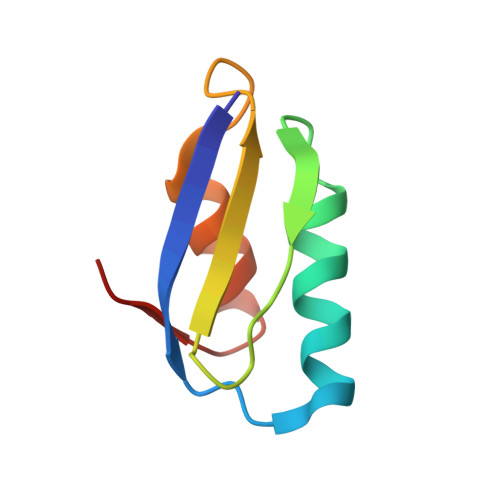
3I9Z | pdb_00003i9z

Crystal structure of a metallochaperone with a trinuclear Cu(I) cluster


Experimental Data Snapshot

  • Method: X-RAY DIFFRACTION
  • Resolution: 1.90 Å
  • R-Value Free: 
    0.265 (Depositor) 
  • R-Value Work: 
    0.191 (Depositor), 0.186 (DCC) 
  • R-Value Observed: 
    0.191 (Depositor) 

wwPDB Validation 3D Report Full Report

Validation slider image for 3I9Z

This is version 1.3 of the entry. See complete history

Literature

Mechanistic insights into Cu(I) cluster transfer between the chaperone CopZ and its cognate Cu(I)-transporting P-type ATPase, CopA.

Singleton, C.Hearnshaw, S.Zhou, L.Le Brun, N.E.Hemmings, A.M.

(2009) Biochem J 424: 347-356

  • DOI: https://doi.org/10.1042/BJ20091079
  • Primary Citation Related Structures: 
    3I9Z

  • PubMed Abstract: 

    Multinuclear Cu(I) clusters are common in nature, but little is known about their formation or transfer between proteins. CopZ and CopA from Bacillus subtilis, which are involved in a copper-efflux pathway, both readily accommodate multinuclear Cu(I) clusters. Using the luminescence properties of a multinuclear Cu(I)-bound form of the two N-terminal soluble domains of CopA (CopAab) we have investigated the thermodynamic and kinetic properties of cluster formation and loss. We demonstrate that Cu(I)-bound forms of dimeric CopZ containing more than one Cu(I) per CopZ monomer can transfer Cu(I) to apo-CopAab, leading to the formation of luminescent dimeric CopAab. Kinetic studies demonstrated that transfer is a first-order process and that the rate-determining steps for transfer from CopZ to CopAab and vice versa are different processes. The rate of formation of luminescent CopAab via transfer of Cu(I) from CopZ was more rapid than that observed when Cu(I) was added 'directly' from solution or in complex with a cysteine variant of CopZ, indicating that transfer occurs via a transient protein-protein complex. Such a complex would probably require the interaction of at least one domain of CopAab with the CopZ dimer. Insight into how such a complex might form is provided by the high resolution crystal structure of Cu3(CopZ)3, a thus far unique trimeric form of CopZ containing a trinuclear Cu(I) cluster. Modelling studies showed that one of the CopZ monomers can be substituted for either domain of CopAab, resulting in a heterotrimer, thus providing a model for a 'trapped' copper exchange complex.


  • Organizational Affiliation
    • Centre for Molecular and Structural Biochemistry, School of Chemistry, University of East Anglia, Norwich NR4 7TJ, UK.

Macromolecule Content 

  • Total Structure Weight: 7.41 kDa 
  • Atom Count: 527 
  • Modeled Residue Count: 69 
  • Deposited Residue Count: 69 
  • Unique protein chains: 1

Macromolecules

Find similar proteins by:|  3D Structure
Entity ID: 1
MoleculeChains  Sequence LengthOrganismDetailsImage
Copper chaperone copZ69Bacillus subtilisMutation(s): 0 
Gene Names: BSU33510copZCOPZ_BACSUyvgY
UniProt
Find proteins for O32221 (Bacillus subtilis (strain 168))
Explore O32221 
Go to UniProtKB:  O32221
Entity Groups
Sequence Clusters30% Identity50% Identity70% Identity90% Identity95% Identity100% Identity
UniProt GroupO32221
Sequence Annotations
Expand
Reference Sequence

Small Molecules

Ligands 1 Unique
IDChains Name / Formula / InChI Key2D Diagram3D Interactions
CU1

Query on CU1


Download:Ideal Coordinates CCD File
B [auth A]COPPER (I) ION
Cu
VMQMZMRVKUZKQL-UHFFFAOYSA-N

Experimental Data & Validation

Experimental Data

  • Method: X-RAY DIFFRACTION
  • Resolution: 1.90 Å
  • R-Value Free:  0.265 (Depositor) 
  • R-Value Work:  0.191 (Depositor), 0.186 (DCC) 
  • R-Value Observed: 0.191 (Depositor) 
Space Group: P 63
Unit Cell:
Length ( Å )Angle ( ˚ )
a = 63.96α = 90
b = 63.96β = 90
c = 27.298γ = 120
Software Package:
Software NamePurpose
MAR345data collection
MOLREPphasing
SHELXL-97refinement
MOSFLMdata reduction
SCALAdata scaling

Structure Validation

View Full Validation Report


Entry History 

Deposition Data

Revision History  (Full details and data files)

  • Version 1.0: 2009-11-17
    Type: Initial release
  • Version 1.1: 2011-07-13
    Changes: Version format compliance
  • Version 1.2: 2017-11-01
    Changes: Refinement description
  • Version 1.3: 2024-02-21
    Changes: Data collection, Database references, Derived calculations