3HTU | pdb_00003htu

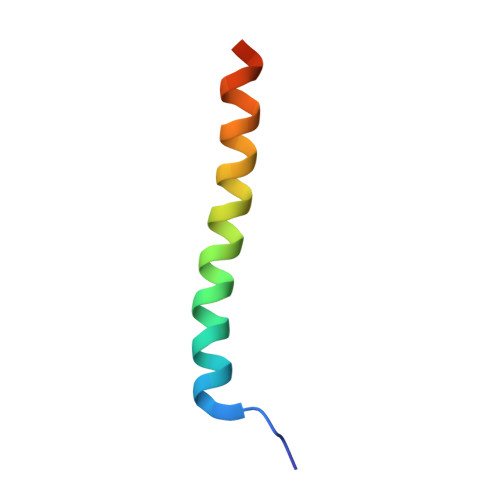
Crystal structure of the human VPS25-VPS20 subcomplex


Experimental Data Snapshot

  • Method: X-RAY DIFFRACTION
  • Resolution: 2.00 Å
  • R-Value Free: 
    0.273 (Depositor), 0.282 (DCC) 
  • R-Value Work: 
    0.239 (Depositor), 0.256 (DCC) 
  • R-Value Observed: 
    0.240 (Depositor) 

Starting Model: experimental
View more details

wwPDB Validation 3D Report Full Report

Validation slider image for 3HTU

This is version 1.2 of the entry. See complete history

Literature

Structure and function of the ESCRT-II-III interface in multivesicular body biogenesis.

Im, Y.J.Wollert, T.Boura, E.Hurley, J.H.

(2009) Dev Cell 17: 234-243

  • DOI: https://doi.org/10.1016/j.devcel.2009.07.008
  • Primary Citation Related Structures: 
    3HTU

  • PubMed Abstract: 

    The ESCRT-II-ESCRT-III interaction coordinates the sorting of ubiquitinated cargo with the budding and scission of intralumenal vesicles into multivesicular bodies. The interacting regions of these complexes were mapped to the second winged helix domain of human ESCRT-II subunit VPS25 and the first helix of ESCRT-III subunit VPS20. The crystal structure of this complex was determined at 2.0 A resolution. Residues involved in structural interactions explain the specificity of ESCRT-II for Vps20, and are critical for cargo sorting in vivo. ESCRT-II directly activates ESCRT-III-driven vesicle budding and scission in vitro via these structural interactions. VPS20 and ESCRT-II bind membranes with nanomolar affinity, explaining why binding to ESCRT-II is dispensable for the recruitment of Vps20 to membranes. Docking of the ESCRT-II-VPS20(2) supercomplex reveals a convex membrane-binding surface, suggesting a hypothesis for negative membrane curvature induction in the nascent intralumenal vesicle.


  • Organizational Affiliation
    • Laboratory of Molecular Biology, National Institute of Diabetes and Digestive and Kidney Diseases, National Institutes of Health, U.S. Department of Health and Human Services, Bethesda, MD 20892, USA.

Macromolecule Content 

  • Total Structure Weight: 54.92 kDa 
  • Atom Count: 3,870 
  • Modeled Residue Count: 439 
  • Deposited Residue Count: 472 
  • Unique protein chains: 2

Macromolecules

Find similar proteins by:|  3D Structure
Entity ID: 1
MoleculeChains  Sequence LengthOrganismDetailsImage
Vacuolar protein-sorting-associated protein 25
A, C, E, G
79Homo sapiensMutation(s): 0 
Gene Names: DERP9EAP20VPS25
UniProt & NIH Common Fund Data Resources
Find proteins for Q9BRG1 (Homo sapiens)
Explore Q9BRG1 
Go to UniProtKB:  Q9BRG1
PHAROS:  Q9BRG1
GTEx:  ENSG00000131475 
Entity Groups
Sequence Clusters30% Identity50% Identity70% Identity90% Identity95% Identity100% Identity
UniProt GroupQ9BRG1
Sequence Annotations
Expand
Reference Sequence
Find similar proteins by:|  3D Structure
Entity ID: 2
MoleculeChains  Sequence LengthOrganismDetailsImage
Vacuolar protein-sorting-associated protein 20
B, D, F, H
39Homo sapiensMutation(s): 0 
Gene Names: CHMP6VPS20
UniProt & NIH Common Fund Data Resources
Find proteins for Q96FZ7 (Homo sapiens)
Explore Q96FZ7 
Go to UniProtKB:  Q96FZ7
PHAROS:  Q96FZ7
GTEx:  ENSG00000176108 
Entity Groups
Sequence Clusters30% Identity50% Identity70% Identity90% Identity95% Identity100% Identity
UniProt GroupQ96FZ7
Sequence Annotations
Expand
Reference Sequence

Experimental Data & Validation

Experimental Data

  • Method: X-RAY DIFFRACTION
  • Resolution: 2.00 Å
  • R-Value Free:  0.273 (Depositor), 0.282 (DCC) 
  • R-Value Work:  0.239 (Depositor), 0.256 (DCC) 
  • R-Value Observed: 0.240 (Depositor) 
Space Group: P 1 21 1
Unit Cell:
Length ( Å )Angle ( ˚ )
a = 58.562α = 90
b = 51.043β = 90.39
c = 76.987γ = 90
Software Package:
Software NamePurpose
HKL-2000data collection
PHASERphasing
REFMACrefinement
HKL-2000data reduction
HKL-2000data scaling

Structure Validation

View Full Validation Report


Entry History 

Deposition Data

Revision History  (Full details and data files)

  • Version 1.0: 2009-08-25
    Type: Initial release
  • Version 1.1: 2011-07-13
    Changes: Version format compliance
  • Version 1.2: 2023-09-06
    Changes: Data collection, Database references, Refinement description