3HFV | pdb_00003hfv

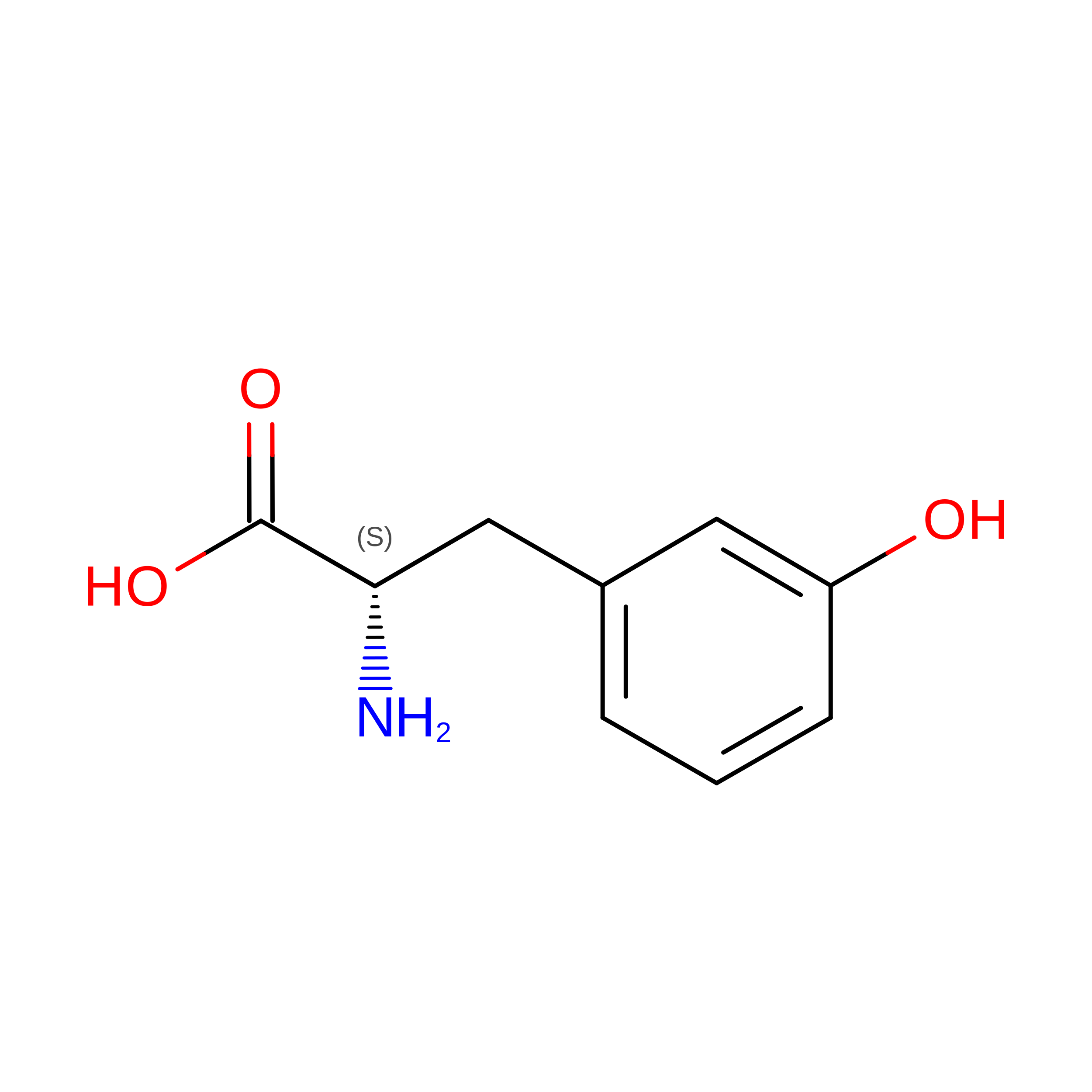
Crystal structure of human mitochondrial phenylalanyl-tRNA synthetase complexed with m-tyrosine


Experimental Data Snapshot

  • Method: X-RAY DIFFRACTION
  • Resolution: 2.60 Å
  • R-Value Free: 
    0.239 (Depositor), 0.237 (DCC) 
  • R-Value Work: 
    0.192 (Depositor), 0.192 (DCC) 
  • R-Value Observed: 
    0.194 (Depositor) 

Starting Model: experimental
View more details

wwPDB Validation 3D Report Full Report

Validation slider image for 3HFV

Ligand Structure Quality Assessment 


This is version 1.3 of the entry. See complete history

Literature

Eukaryotic cytosolic and mitochondrial phenylalanyl-tRNA synthetases catalyze the charging of tRNA with the meta-tyrosine

Klipcan, L.Moor, N.Kessler, N.Safro, M.G.

(2009) Proc Natl Acad Sci U S A 106: 11045-11048

  • DOI: https://doi.org/10.1073/pnas.0905212106
  • Primary Citation Related Structures: 
    3HFV, 3HFZ

  • PubMed Abstract: 

    The accumulation of proteins damaged by reactive oxygen species (ROS), conventionally regarded as having pathological potentials, is associated with age-related diseases such as Alzheimer's, atherosclerosis, and cataractogenesis. Exposure of the aromatic amino acid phenylalanine to ROS-generating systems produces multiple isomers of tyrosine: m-tyrosine (m-Tyr), o-tyrosine (o-Tyr), and the standard p-tyrosine (Tyr). Previously it was demonstrated that exogenously supplied, oxidized amino acids could be incorporated into bacterial and eukaryotic proteins. It is, therefore, likely that in many cases, in vivo-damaged amino acids are available for de novo synthesis of proteins. Although the involvement of aminoacyl-tRNA synthetases in this process has been hypothesized, the specific pathway by which ROS-damaged amino acids are incorporated into proteins remains unclear. We provide herein evidence that mitochondrial and cytoplasmic phenylalanyl-tRNA synthetases (HsmtPheRS and HsctPheRS, respectively) catalyze direct attachment of m-Tyr to tRNA(Phe), thereby opening the way for delivery of the misacylated tRNA to the ribosome and incorporation of ROS-damaged amino acid into eukaryotic proteins. Crystal complexes of mitochondrial and bacterial PheRSs with m-Tyr reveal the net of highly specific interactions within the synthetic and editing sites.


  • Organizational Affiliation
    • Department of Structural Biology, Weizmann Institute of Science, 76100 Rehovot, Israel.

Macromolecule Content 

  • Total Structure Weight: 48.69 kDa 
  • Atom Count: 3,450 
  • Modeled Residue Count: 405 
  • Deposited Residue Count: 415 
  • Unique protein chains: 1

Macromolecules

Find similar proteins by:|  3D Structure
Entity ID: 1
MoleculeChains  Sequence LengthOrganismDetailsImage
Phenylalanyl-tRNA synthetase, mitochondrial415Homo sapiensMutation(s): 0 
Gene Names: FARS2FARS1HSPC320
EC: 6.1.1.20
UniProt & NIH Common Fund Data Resources
Find proteins for O95363 (Homo sapiens)
Explore O95363 
Go to UniProtKB:  O95363
PHAROS:  O95363
GTEx:  ENSG00000145982 
Entity Groups
Sequence Clusters30% Identity50% Identity70% Identity90% Identity95% Identity100% Identity
UniProt GroupO95363
Sequence Annotations
Expand
Reference Sequence

Small Molecules

Ligands 1 Unique
IDChains Name / Formula / InChI Key2D Diagram3D Interactions
MTY

Query on MTY


Download:Ideal Coordinates CCD File
B [auth A]META-TYROSINE
C9 H11 N O3
JZKXXXDKRQWDET-QMMMGPOBSA-N

Experimental Data & Validation

Experimental Data

  • Method: X-RAY DIFFRACTION
  • Resolution: 2.60 Å
  • R-Value Free:  0.239 (Depositor), 0.237 (DCC) 
  • R-Value Work:  0.192 (Depositor), 0.192 (DCC) 
  • R-Value Observed: 0.194 (Depositor) 
Space Group: P 21 21 21
Unit Cell:
Length ( Å )Angle ( ˚ )
a = 54.64α = 90
b = 90.143β = 90
c = 97.133γ = 90
Software Package:
Software NamePurpose
REFMACrefinement
CNSrefinement
HKL-2000data collection
HKL-2000data reduction
HKL-2000data scaling
CNSphasing

Structure Validation

View Full Validation Report


Ligand Structure Quality Assessment 


Entry History 

Deposition Data

Revision History  (Full details and data files)

  • Version 1.0: 2009-07-21
    Type: Initial release
  • Version 1.1: 2011-07-13
    Changes: Version format compliance
  • Version 1.2: 2019-07-24
    Changes: Data collection, Refinement description
  • Version 1.3: 2023-09-06
    Changes: Data collection, Database references, Derived calculations, Refinement description