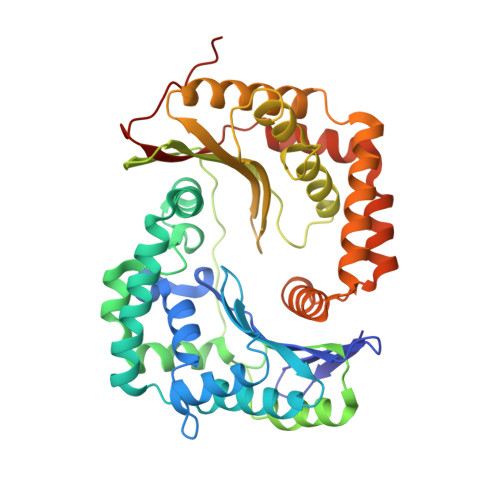
3HDI | pdb_00003hdi

Crystal structure of Bacillus halodurans metallo peptidase


Experimental Data Snapshot

  • Method: X-RAY DIFFRACTION
  • Resolution: 2.70 Å
  • R-Value Free: 
    0.269 (Depositor) 
  • R-Value Work: 
    0.196 (Depositor), 0.202 (DCC) 
  • R-Value Observed: 
    0.196 (Depositor) 

Starting Model: experimental
View more details

wwPDB Validation 3D Report Full Report

Validation slider image for 3HDI

This is version 1.2 of the entry. See complete history

Literature

Crystal and solution structures of a prokaryotic M16B peptidase: an open and shut case.

Aleshin, A.E.Gramatikova, S.Hura, G.L.Bobkov, A.Strongin, A.Y.Stec, B.Tainer, J.A.Liddington, R.C.Smith, J.W.

(2009) Structure 17: 1465-1475

  • DOI: https://doi.org/10.1016/j.str.2009.09.009
  • Primary Citation Related Structures: 
    3HDI

  • PubMed Abstract: 

    The M16 family of zinc peptidases comprises a pair of homologous domains that form two halves of a "clam-shell" surrounding the active site. The M16A and M16C subfamilies form one class ("peptidasomes"): they degrade 30-70 residue peptides, and adopt both open and closed conformations. The eukaryotic M16B subfamily forms a second class ("processing proteases"): they adopt a single partly-open conformation that enables them to cleave signal sequences from larger proteins. Here, we report the solution and crystal structures of a prokaryotic M16B peptidase, and demonstrate that it has features of both classes: thus, it forms stable "open" homodimers in solution that resemble the processing proteases; but the clam-shell closes upon binding substrate, a feature of the M16A/C peptidasomes. Moreover, clam-shell closure is required for proteolytic activity. We predict that other prokaryotic M16B family members will form dimeric peptidasomes, and propose a model for the evolution of the M16 family.


  • Organizational Affiliation
    • Burnham Institute for Medical Research, La Jolla, CA 92037, USA.

Macromolecule Content 

  • Total Structure Weight: 98.32 kDa 
  • Atom Count: 6,988 
  • Modeled Residue Count: 859 
  • Deposited Residue Count: 876 
  • Unique protein chains: 2

Macromolecules

Find similar proteins by:|  3D Structure
Entity ID: 1
MoleculeChains  Sequence LengthOrganismDetailsImage
Processing protease
A, B
421Halalkalibacterium halodurans C-125Mutation(s): 0 
Gene Names: BH2405
UniProt
Find proteins for Q9KA85 (Halalkalibacterium halodurans (strain ATCC BAA-125 / DSM 18197 / FERM 7344 / JCM 9153 / C-125))
Explore Q9KA85 
Go to UniProtKB:  Q9KA85
Entity Groups
Sequence Clusters30% Identity50% Identity70% Identity90% Identity95% Identity100% Identity
UniProt GroupQ9KA85
Sequence Annotations
Expand
Reference Sequence
Find similar proteins by:  Sequence   |   3D Structure  
Entity ID: 2
MoleculeChains  Sequence LengthOrganismDetailsImage
Synthetic peptide
C, D
17N/AMutation(s): 0 

Small Molecules

Ligands 2 Unique
IDChains Name / Formula / InChI Key2D Diagram3D Interactions
SO4

Query on SO4


Download:Ideal Coordinates CCD File
F [auth A]
G [auth A]
H [auth A]
I [auth A]
K [auth B]
F [auth A],
G [auth A],
H [auth A],
I [auth A],
K [auth B],
L [auth B]
SULFATE ION
O4 S
QAOWNCQODCNURD-UHFFFAOYSA-L
CO

Query on CO


Download:Ideal Coordinates CCD File
E [auth A],
J [auth B]
COBALT (II) ION
Co
XLJKHNWPARRRJB-UHFFFAOYSA-N

Experimental Data & Validation

Experimental Data

  • Method: X-RAY DIFFRACTION
  • Resolution: 2.70 Å
  • R-Value Free:  0.269 (Depositor) 
  • R-Value Work:  0.196 (Depositor), 0.202 (DCC) 
  • R-Value Observed: 0.196 (Depositor) 
Space Group: C 2 2 21
Unit Cell:
Length ( Å )Angle ( ˚ )
a = 91.141α = 90
b = 193.981β = 90
c = 125.567γ = 90
Software Package:
Software NamePurpose
HKL-2000data collection
PHASERphasing
CNSrefinement
HKL-2000data reduction
HKL-2000data scaling

Structure Validation

View Full Validation Report


Entry History 

Deposition Data

Revision History  (Full details and data files)

  • Version 1.0: 2009-12-08
    Type: Initial release
  • Version 1.1: 2011-07-13
    Changes: Version format compliance
  • Version 1.2: 2023-09-06
    Changes: Data collection, Database references, Derived calculations, Refinement description