3H5V | pdb_00003h5v

Crystal structure of the GluR2-ATD


Experimental Data Snapshot

  • Method: X-RAY DIFFRACTION
  • Resolution: 2.33 Å
  • R-Value Free: 
    0.235 (Depositor) 
  • R-Value Work: 
    0.186 (Depositor) 
  • R-Value Observed: 
    0.190 (Depositor) 

wwPDB Validation 3D Report Full Report

Validation slider image for 3H5V

This is version 2.1 of the entry. See complete history

Literature

Crystal structure and association behaviour of the GluR2 amino-terminal domain.

Jin, R.Singh, S.K.Gu, S.Furukawa, H.Sobolevsky, A.I.Zhou, J.Jin, Y.Gouaux, E.

(2009) EMBO J 28: 1812-1823

  • DOI: https://doi.org/10.1038/emboj.2009.140
  • Primary Citation Related Structures: 
    3H5V, 3H5W

  • PubMed Abstract: 

    Fast excitatory neurotransmission is mediated largely by ionotropic glutamate receptors (iGluRs), tetrameric, ligand-gated ion channel proteins comprised of three subfamilies, AMPA, kainate and NMDA receptors, with each subfamily sharing a common, modular-domain architecture. For all receptor subfamilies, active channels are exclusively formed by assemblages of subunits within the same subfamily, a molecular process principally encoded by the amino-terminal domain (ATD). However, the molecular basis by which the ATD guides subfamily-specific receptor assembly is not known. Here we show that AMPA receptor GluR1- and GluR2-ATDs form tightly associated dimers and, by the analysis of crystal structures of the GluR2-ATD, propose mechanisms by which the ATD guides subfamily-specific receptor assembly.


  • Organizational Affiliation
    • Center for Neuroscience, Aging, and Stem Cell Research, Burnham Institute for Medical Research, La Jolla, CA, USA. rjin@burnham.org

Macromolecule Content 

  • Total Structure Weight: 134.38 kDa 
  • Atom Count: 9,392 
  • Modeled Residue Count: 1,125 
  • Deposited Residue Count: 1,182 
  • Unique protein chains: 1

Macromolecules

Find similar proteins by:|  3D Structure
Entity ID: 1
MoleculeChains  Sequence LengthOrganismDetailsImage
Glutamate receptor 2
A, B, C
394Rattus norvegicusMutation(s): 0 
Gene Names: Gria2Glur2
UniProt
Find proteins for P19491 (Rattus norvegicus)
Explore P19491 
Go to UniProtKB:  P19491
Entity Groups
Sequence Clusters30% Identity50% Identity70% Identity90% Identity95% Identity100% Identity
UniProt GroupP19491
Glycosylation
Glycosylation Sites: 1Go to GlyGen: P19491-1
Sequence Annotations
Expand
Reference Sequence

Oligosaccharides

Help  
Entity ID: 2
MoleculeChains Length2D Diagram GlycosylationD Interactions
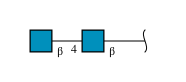
2-acetamido-2-deoxy-beta-D-glucopyranose-(1-4)-2-acetamido-2-deoxy-beta-D-glucopyranose
D, E
2N-Glycosylation
Glycosylation Resources
GlyTouCan: G42666HT
GlyCosmos: G42666HT
GlyGen: G42666HT

Experimental Data & Validation

Experimental Data

  • Method: X-RAY DIFFRACTION
  • Resolution: 2.33 Å
  • R-Value Free:  0.235 (Depositor) 
  • R-Value Work:  0.186 (Depositor) 
  • R-Value Observed: 0.190 (Depositor) 
Space Group: P 21 21 2
Unit Cell:
Length ( Å )Angle ( ˚ )
a = 64.003α = 90
b = 362.993β = 90
c = 61.434γ = 90
Software Package:
Software NamePurpose
HKL-2000data collection
SOLVEphasing
PHENIXrefinement
HKL-2000data reduction
HKL-2000data scaling

Structure Validation

View Full Validation Report


Entry History 

Deposition Data

Revision History  (Full details and data files)

  • Version 1.0: 2009-06-09
    Type: Initial release
  • Version 1.1: 2011-07-13
    Changes: Non-polymer description, Version format compliance
  • Version 2.0: 2020-07-29
    Type: Remediation
    Reason: Carbohydrate remediation
    Changes: Advisory, Atomic model, Data collection, Database references, Derived calculations, Structure summary
  • Version 2.1: 2024-11-06
    Changes: Advisory, Data collection, Database references, Structure summary