3G20 | pdb_00003g20

Crystal structure of the major pseudopilin from the type 2 secretion system of enterohaemorrhagic Escherichia coli


Experimental Data Snapshot

  • Method: X-RAY DIFFRACTION
  • Resolution: 1.78 Å
  • R-Value Free: 
    0.222 (Depositor), 0.233 (DCC) 
  • R-Value Work: 
    0.168 (Depositor), 0.185 (DCC) 
  • R-Value Observed: 
    0.170 (Depositor) 

Starting Model: experimental
View more details

wwPDB Validation 3D Report Full Report

Validation slider image for 3G20

This is version 1.3 of the entry. See complete history

Literature

Calcium is essential for the major pseudopilin in the type 2 secretion system.

Korotkov, K.V.Gray, M.D.Kreger, A.Turley, S.Sandkvist, M.Hol, W.G.

(2009) J Biological Chem 284: 25466-25470

  • DOI: https://doi.org/10.1074/jbc.C109.037655
  • Primary Citation Related Structures: 
    3FU1, 3G20, 3GN9

  • PubMed Abstract: 

    The pseudopilus is a key feature of the type 2 secretion system (T2SS) and is made up of multiple pseudopilins that are similar in fold to the type 4 pilins. However, pilins have disulfide bridges, whereas the major pseudopilins of T2SS do not. A key question is therefore how the pseudopilins, and in particular, the most abundant major pseudopilin, GspG, obtain sufficient stability to perform their function. Crystal structures of Vibrio cholerae, Vibrio vulnificus, and enterohemorrhagic Escherichia coli (EHEC) GspG were elucidated, and all show a calcium ion bound at the same site. Conservation of the calcium ligands fully supports the suggestion that calcium ion binding by the major pseudopilin is essential for the T2SS. Functional studies of GspG with mutated calcium ion-coordinating ligands were performed to investigate this hypothesis and show that in vivo protease secretion by the T2SS is severely impaired. Taking all evidence together, this allows the conclusion that, in complete contrast to the situation in the type 4 pili system homologs, in the T2SS, the major protein component of the central pseudopilus is dependent on calcium ions for activity.


  • Organizational Affiliation
    • Department of Biochemistry, Biomolecular Structure Center, University of Washington, Seattle, Washington 98195, USA.

Macromolecule Content 

  • Total Structure Weight: 28.12 kDa 
  • Atom Count: 2,177 
  • Modeled Residue Count: 233 
  • Deposited Residue Count: 246 
  • Unique protein chains: 1

Macromolecules

Find similar proteins by:|  3D Structure
Entity ID: 1
MoleculeChains  Sequence LengthOrganismDetailsImage
Type II secretion protein
A, B
123Escherichia coli O157:H7Mutation(s): 0 
Gene Names: ECO57PM05etpGGSPGL7036
UniProt
Find proteins for Q7BSV8 (Escherichia coli O157:H7)
Explore Q7BSV8 
Go to UniProtKB:  Q7BSV8
Entity Groups
Sequence Clusters30% Identity50% Identity70% Identity90% Identity95% Identity100% Identity
UniProt GroupQ7BSV8
Sequence Annotations
Expand
Reference Sequence

Small Molecules

Ligands 4 Unique
IDChains Name / Formula / InChI Key2D Diagram3D Interactions
NHE

Query on NHE


Download:Ideal Coordinates CCD File
C [auth A],
F [auth B]
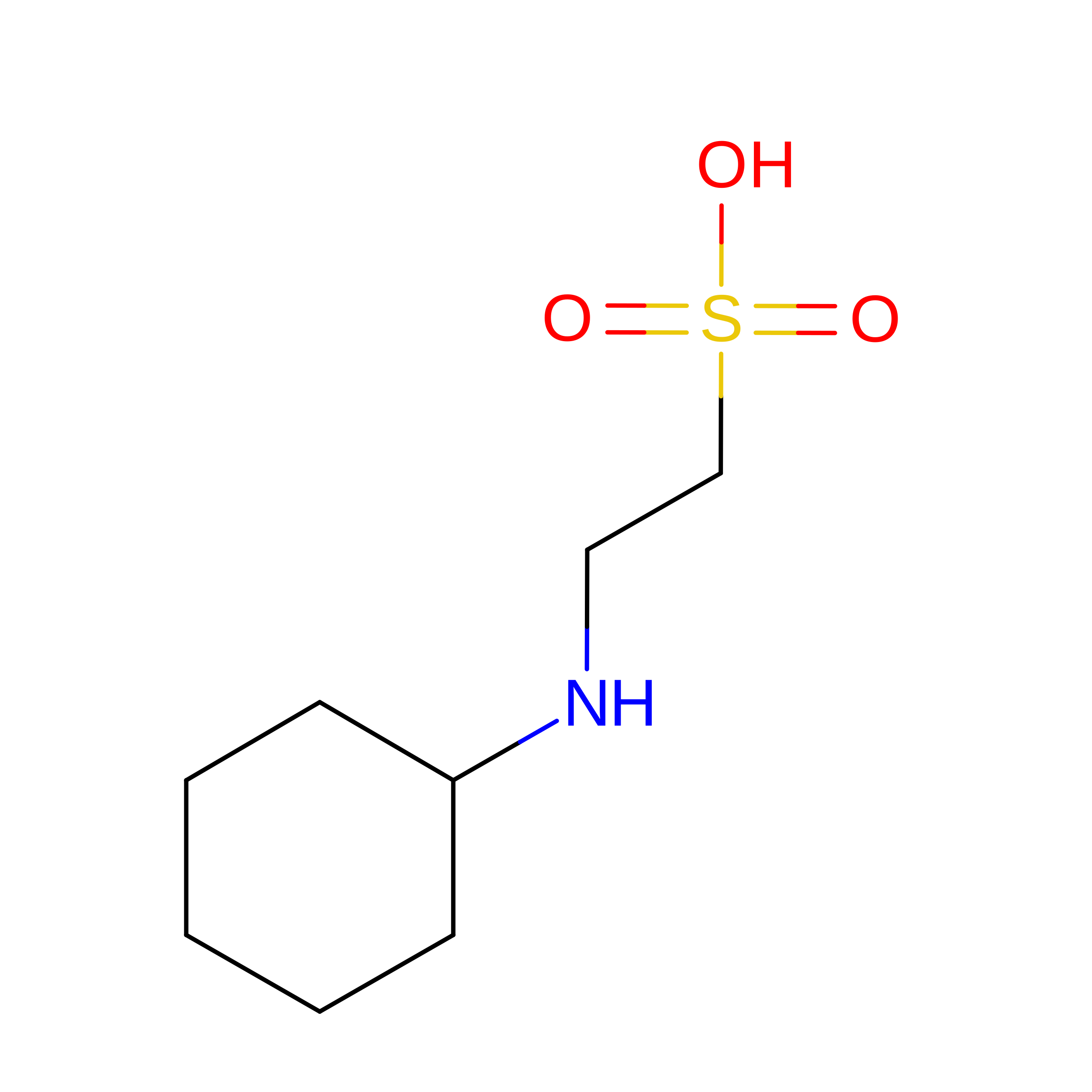
2-[N-CYCLOHEXYLAMINO]ETHANE SULFONIC ACID
C8 H17 N O3 S
MKWKNSIESPFAQN-UHFFFAOYSA-N
GOL

Query on GOL


Download:Ideal Coordinates CCD File
J [auth B]GLYCEROL
C3 H8 O3
PEDCQBHIVMGVHV-UHFFFAOYSA-N
CA

Query on CA


Download:Ideal Coordinates CCD File
D [auth A],
G [auth B]
CALCIUM ION
Ca
BHPQYMZQTOCNFJ-UHFFFAOYSA-N
NA

Query on NA


Download:Ideal Coordinates CCD File
E [auth A],
H [auth B],
I [auth B]
SODIUM ION
Na
FKNQFGJONOIPTF-UHFFFAOYSA-N

Experimental Data & Validation

Experimental Data

  • Method: X-RAY DIFFRACTION
  • Resolution: 1.78 Å
  • R-Value Free:  0.222 (Depositor), 0.233 (DCC) 
  • R-Value Work:  0.168 (Depositor), 0.185 (DCC) 
  • R-Value Observed: 0.170 (Depositor) 
Space Group: P 1
Unit Cell:
Length ( Å )Angle ( ˚ )
a = 26.12α = 106.94
b = 36.83β = 99.05
c = 61.27γ = 90.17
Software Package:
Software NamePurpose
XSCALEdata scaling
PHASERphasing
REFMACrefinement
PDB_EXTRACTdata extraction
Blu-Icedata collection
XDSdata reduction

Structure Validation

View Full Validation Report


Entry History 

Deposition Data

Revision History  (Full details and data files)

  • Version 1.0: 2009-07-28
    Type: Initial release
  • Version 1.1: 2011-07-13
    Changes: Advisory, Version format compliance
  • Version 1.2: 2017-11-01
    Changes: Refinement description
  • Version 1.3: 2023-09-06
    Changes: Data collection, Database references, Derived calculations, Refinement description