3FXE | pdb_00003fxe

Crystal structure of interacting domains of IcmR and IcmQ (seleno-derivative)


Experimental Data Snapshot

  • Method: X-RAY DIFFRACTION
  • Resolution: 2.20 Å
  • R-Value Free: 
    0.250 (Depositor) 
  • R-Value Work: 
    0.230 (Depositor), 0.230 (DCC) 
  • R-Value Observed: 
    0.230 (Depositor) 

wwPDB Validation 3D Report Full Report

Validation slider image for 3FXE

This is version 1.3 of the entry. See complete history

Literature

Structure and Function of Interacting IcmR-IcmQ Domains from a Type IVb Secretion System in Legionella pneumophila.

Raychaudhury, S.Farelli, J.D.Montminy, T.P.Matthews, M.Menetret, J.F.Dumenil, G.Roy, C.R.Head, J.F.Isberg, R.R.Akey, C.W.

(2009) Structure 17: 590-601

  • DOI: https://doi.org/10.1016/j.str.2009.02.011
  • Primary Citation Related Structures: 
    3FXD, 3FXE

  • PubMed Abstract: 

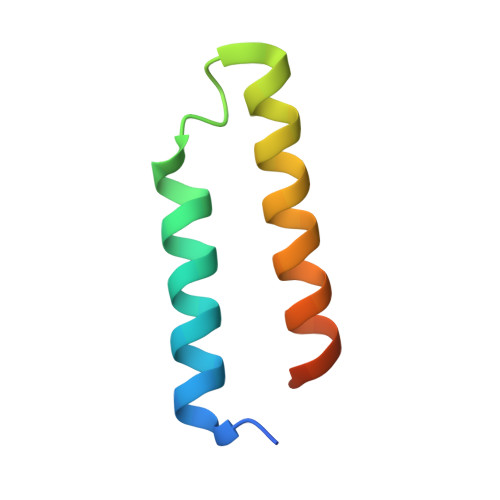
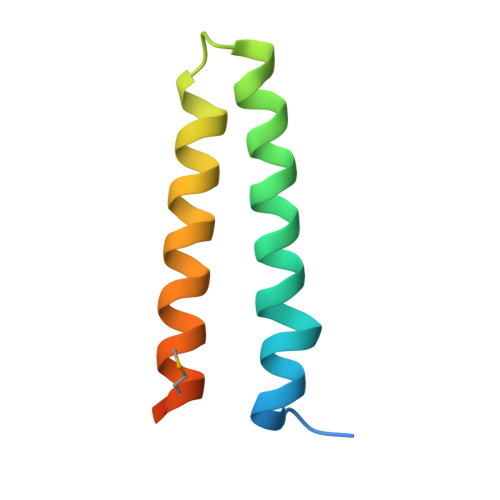
    During infection, Legionella pneumophila creates a replication vacuole within eukaryotic cells and this requires a Type IVb secretion system (T4bSS). IcmQ plays a critical role in the translocase and associates with IcmR. In this paper, we show that the N-terminal domain of IcmQ (Qn) mediates self-dimerization, whereas the C-terminal domain with a basic linker promotes membrane association. In addition, the binding of IcmR to IcmQ prevents self-dimerization and also blocks membrane permeabilization. However, IcmR does not completely block membrane binding by IcmQ. We then determined crystal structures of Qn with the interacting region of IcmR. In this complex, each protein forms an alpha-helical hairpin within a parallel four-helix bundle. The amphipathic nature of helices in Qn suggests two possible models for membrane permeabilization by IcmQ. The Rm-Qn structure also suggests how IcmR-like proteins in other L. pneumophila species may interact with their IcmQ partners.


  • Organizational Affiliation
    • Department of Physiology and Biophysics, Boston University School of Medicine, Boston, MA 02118-2526, USA.

Macromolecule Content 

  • Total Structure Weight: 14.42 kDa 
  • Atom Count: 836 
  • Modeled Residue Count: 104 
  • Deposited Residue Count: 130 
  • Unique protein chains: 2

Macromolecules

Find similar proteins by:|  3D Structure
Entity ID: 1
MoleculeChains  Sequence LengthOrganismDetailsImage
Protein IcmQ57Legionella pneumophila str. CorbyMutation(s): 0 
Gene Names: icmQLPC_2899
Find similar proteins by:|  3D Structure
Entity ID: 2
MoleculeChains  Sequence LengthOrganismDetailsImage
Protein IcmR73Legionella pneumophila subsp. pneumophila str. Philadelphia 1Mutation(s): 1 
Gene Names: icmRlpg0443
UniProt
Find proteins for Q5ZYC9 (Legionella pneumophila subsp. pneumophila (strain Philadelphia 1 / ATCC 33152 / DSM 7513))
Explore Q5ZYC9 
Go to UniProtKB:  Q5ZYC9
Entity Groups
Sequence Clusters30% Identity50% Identity70% Identity90% Identity95% Identity100% Identity
UniProt GroupQ5ZYC9
Sequence Annotations
Expand
Reference Sequence

Small Molecules

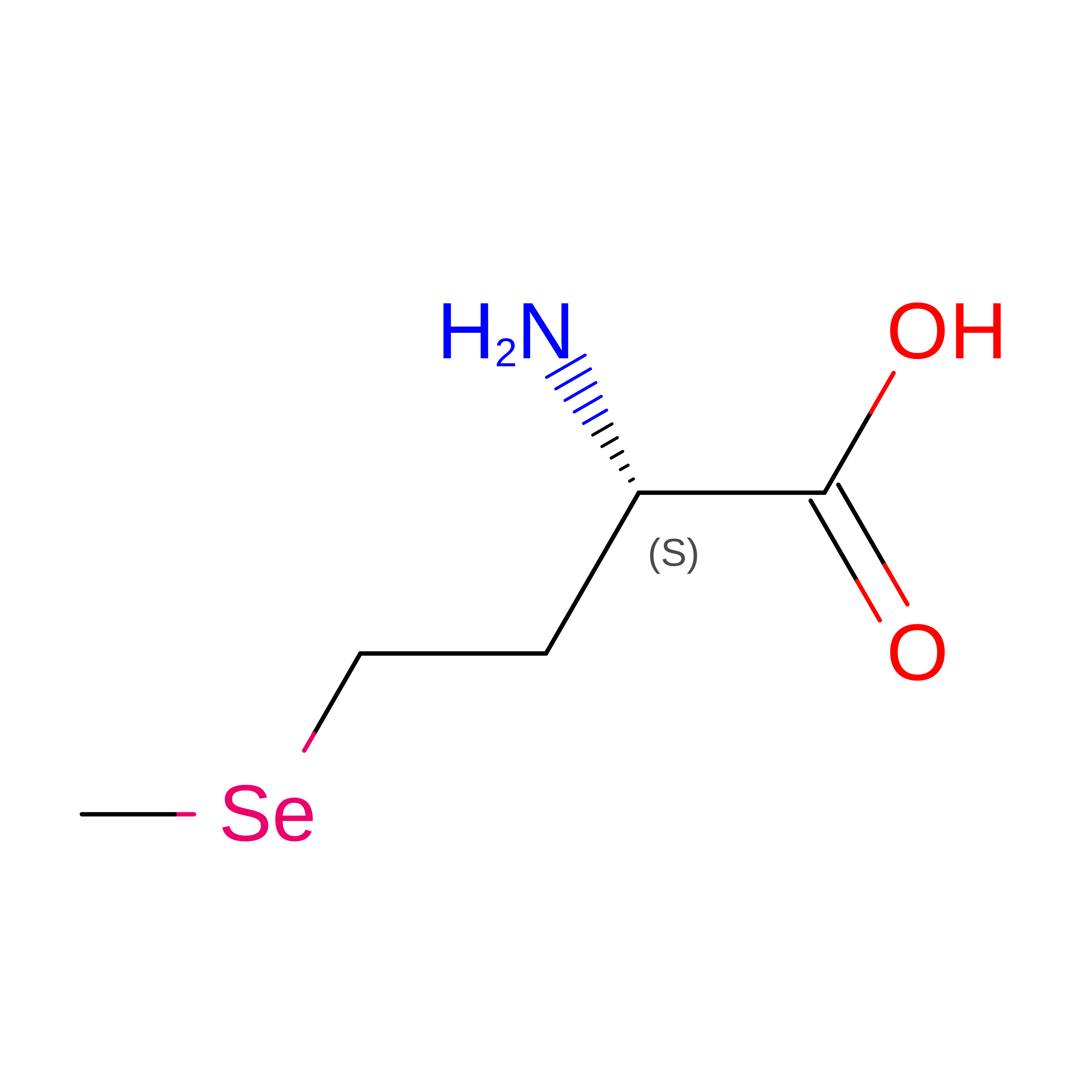
Modified Residues  1 Unique
IDChains TypeFormula2D DiagramParent
MSE
Query on MSE
A
L-PEPTIDE LINKINGC5 H11 N O2 SeMET

Experimental Data & Validation

Experimental Data

  • Method: X-RAY DIFFRACTION
  • Resolution: 2.20 Å
  • R-Value Free:  0.250 (Depositor) 
  • R-Value Work:  0.230 (Depositor), 0.230 (DCC) 
  • R-Value Observed: 0.230 (Depositor) 
Space Group: P 21 21 21
Unit Cell:
Length ( Å )Angle ( ˚ )
a = 31.09α = 90
b = 42.1β = 90
c = 78.92γ = 90
Software Package:
Software NamePurpose
HKL-2000data collection
SOLVEphasing
CNSrefinement
HKL-2000data reduction
HKL-2000data scaling

Structure Validation

View Full Validation Report


Entry History 

Deposition Data

Revision History  (Full details and data files)

  • Version 1.0: 2009-04-28
    Type: Initial release
  • Version 1.1: 2011-07-13
    Changes: Source and taxonomy, Version format compliance
  • Version 1.2: 2021-10-20
    Changes: Database references, Derived calculations
  • Version 1.3: 2024-11-06
    Changes: Data collection, Structure summary