3FRQ | pdb_00003frq

Structure of the macrolide biosensor protein, MphR(A), with erythromcyin


Experimental Data Snapshot

  • Method: X-RAY DIFFRACTION
  • Resolution: 1.76 Å
  • R-Value Free: 
    0.221 (Depositor), 0.220 (DCC) 
  • R-Value Work: 
    0.181 (Depositor), 0.181 (DCC) 
  • R-Value Observed: 
    0.183 (Depositor) 

wwPDB Validation 3D Report Full Report

Validation slider image for 3FRQ

Ligand Structure Quality Assessment 


This is version 1.2 of the entry. See complete history

Literature

Structure and function of the macrolide biosensor protein, MphR(A), with and without erythromycin

Zheng, J.Sagar, V.Smolinsky, A.Bourke, C.LaRonde-LeBlanc, N.Cropp, T.A.

(2009) J Mol Biology 387: 1250-1260

  • DOI: https://doi.org/10.1016/j.jmb.2009.02.058
  • Primary Citation Related Structures: 
    3FRQ, 3G56

  • PubMed Abstract: 

    The regulatory protein MphR(A) has recently seen extensive use in synthetic biological applications, such as metabolite sensing and exogenous control of gene expression. This protein negatively regulates the expression of a macrolide 2'-phosphotransferase I resistance gene (mphA) via binding to a 35-bp DNA operator upstream of the start codon and is de-repressed by the presence of erythromycin. Here, we present the refined crystal structure of the MphR(A) protein free of erythromycin and that of the MphR(A) protein with bound erythromycin at 2.00- and 1.76-A resolutions, respectively. We also studied the DNA binding properties of the protein and identified mutants of MphR(A) that are defective in gene repression and ligand binding in a cell-based reporter assay. The combination of these two structures illustrates the molecular basis of erythromycin-induced gene expression and provides a framework for additional applied uses of this protein in the isolation and engineered biosynthesis of polyketide natural products.


  • Organizational Affiliation
    • Department of Chemistry and Biochemistry, University of Maryland, College Park, MD 20742, USA.

Macromolecule Content 

  • Total Structure Weight: 45.51 kDa 
  • Atom Count: 3,322 
  • Modeled Residue Count: 369 
  • Deposited Residue Count: 390 
  • Unique protein chains: 1

Macromolecules

Find similar proteins by:|  3D Structure
Entity ID: 1
MoleculeChains  Sequence LengthOrganismDetailsImage
Repressor protein MphR(A)
A, B
195Escherichia coliMutation(s): 0 
Gene Names: mphR(A)
UniProt
Find proteins for Q9EVJ6 (Escherichia coli)
Explore Q9EVJ6 
Go to UniProtKB:  Q9EVJ6
Entity Groups
Sequence Clusters30% Identity50% Identity70% Identity90% Identity95% Identity100% Identity
UniProt GroupQ9EVJ6
Sequence Annotations
Expand
Reference Sequence

Small Molecules

Ligands 3 Unique
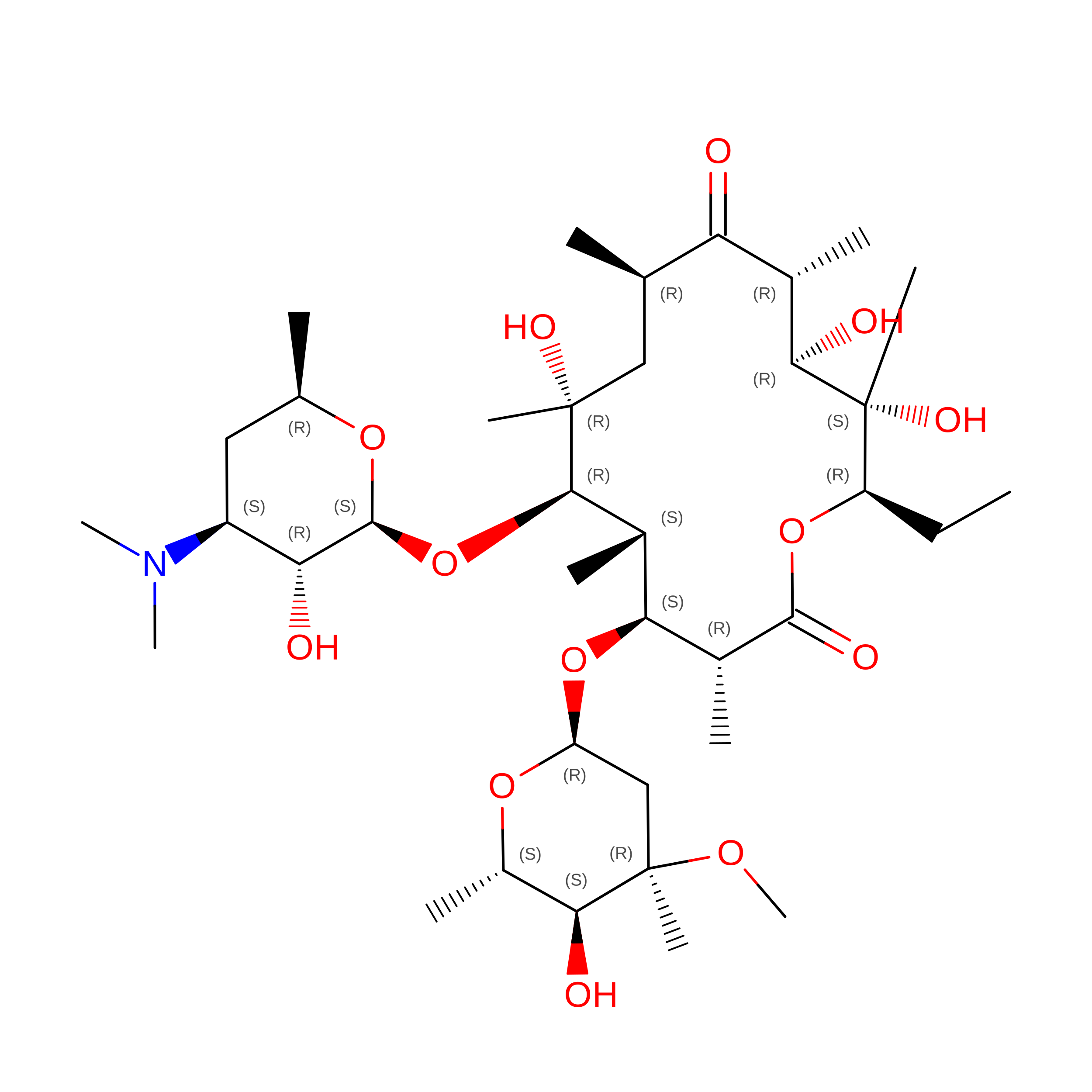
IDChains Name / Formula / InChI Key2D Diagram3D Interactions
ERY

Query on ERY


Download:Ideal Coordinates CCD File
C [auth A],
G [auth B]
ERYTHROMYCIN A
C37 H67 N O13
ULGZDMOVFRHVEP-RWJQBGPGSA-N
GOL

Query on GOL


Download:Ideal Coordinates CCD File
D [auth A]
E [auth A]
H [auth B]
I [auth B]
J [auth B]
D [auth A],
E [auth A],
H [auth B],
I [auth B],
J [auth B],
K [auth B]
GLYCEROL
C3 H8 O3
PEDCQBHIVMGVHV-UHFFFAOYSA-N
CL

Query on CL


Download:Ideal Coordinates CCD File
F [auth A],
L [auth B]
CHLORIDE ION
Cl
VEXZGXHMUGYJMC-UHFFFAOYSA-M

Experimental Data & Validation

Experimental Data

  • Method: X-RAY DIFFRACTION
  • Resolution: 1.76 Å
  • R-Value Free:  0.221 (Depositor), 0.220 (DCC) 
  • R-Value Work:  0.181 (Depositor), 0.181 (DCC) 
  • R-Value Observed: 0.183 (Depositor) 
Space Group: P 21 21 21
Unit Cell:
Length ( Å )Angle ( ˚ )
a = 44.294α = 90
b = 61.201β = 90
c = 134.642γ = 90
Software Package:
Software NamePurpose
HKL-2000data collection
SHELXSphasing
REFMACrefinement
HKL-2000data reduction
HKL-2000data scaling

Structure Validation

View Full Validation Report


Ligand Structure Quality Assessment 


Entry History 

Deposition Data

Revision History  (Full details and data files)

  • Version 1.0: 2009-03-24
    Type: Initial release
  • Version 1.1: 2011-07-13
    Changes: Advisory, Version format compliance
  • Version 1.2: 2024-02-21
    Changes: Data collection, Database references, Derived calculations