3EJW | pdb_00003ejw

Crystal Structure of the Sinorhizobium meliloti AI-2 receptor, SmLsrB


Experimental Data Snapshot

  • Method: X-RAY DIFFRACTION
  • Resolution: 1.80 Å
  • R-Value Free: 
    0.214 (Depositor), 0.199 (DCC) 
  • R-Value Work: 
    0.168 (Depositor), 0.150 (DCC) 
  • R-Value Observed: 
    0.170 (Depositor) 

Starting Model: experimental
View more details

wwPDB Validation 3D Report Full Report

Validation slider image for 3EJW

Ligand Structure Quality Assessment 


This is version 2.2 of the entry. See complete history

Literature

Sinorhizobium meliloti, a bacterium lacking the autoinducer-2 (AI-2) synthase, responds to AI-2 supplied by other bacteria.

Pereira, C.S.McAuley, J.R.Taga, M.E.Xavier, K.B.Miller, S.T.

(2008) Mol Microbiol 70: 1223-1235

  • DOI: https://doi.org/10.1111/j.1365-2958.2008.06477.x
  • Primary Citation Related Structures: 
    3EJW

  • PubMed Abstract: 

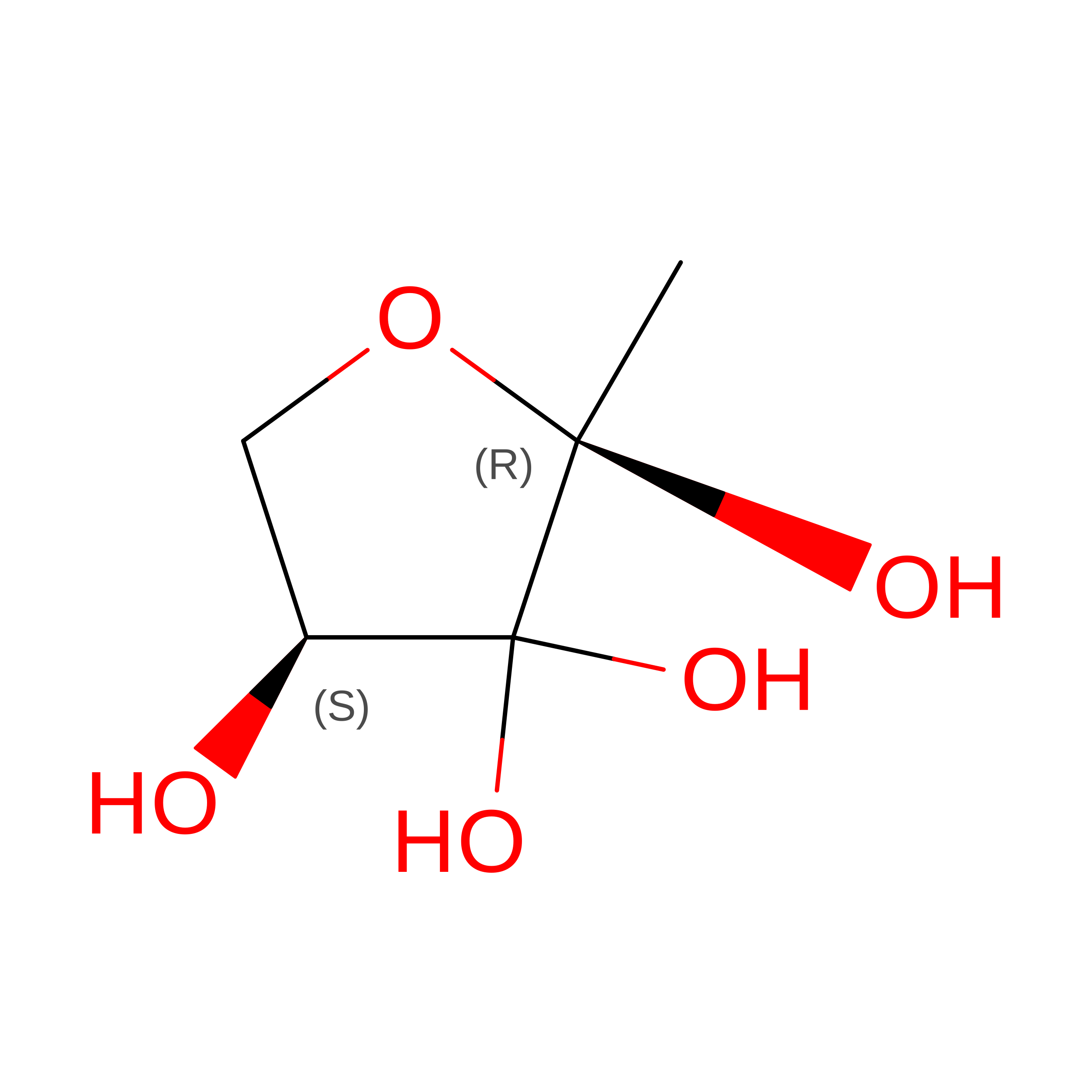
    Many bacterial species respond to the quorum-sensing signal autoinducer-2 (AI-2) by regulating different niche-specific genes. Here, we show that Sinorhizobium meliloti, a plant symbiont lacking the gene for the AI-2 synthase, while not capable of producing AI-2 can nonetheless respond to AI-2 produced by other species. We demonstrate that S. meliloti has a periplasmic binding protein that binds AI-2. The crystal structure of this protein (here named SmlsrB) with its ligand reveals that it binds (2R,4S)-2-methyl-2,3,3,4-tetrahydroxytetrahydrofuran (R-THMF), the identical AI-2 isomer recognized by LsrB of Salmonella typhimurium. The gene encoding SmlsrB is in an operon with orthologues of the lsr genes required for AI-2 internalization in enteric bacteria. Accordingly, S. meliloti internalizes exogenous AI-2, and mutants in this operon are defective in AI-2 internalization. S. meliloti does not gain a metabolic benefit from internalizing AI-2, suggesting that AI-2 functions as a signal in S. meliloti. Furthermore, S. meliloti can completely eliminate the AI-2 secreted by Erwinia carotovora, a plant pathogen shown to use AI-2 to regulate virulence. Our findings suggest that S. meliloti is capable of 'eavesdropping' on the AI-2 signalling of other species and interfering with AI-2-regulated behaviours such as virulence.


  • Organizational Affiliation
    • Bacterial Signaling Laboratory, Instituto Gulbenkian de Ciência, Oeiras, Portugal.

Macromolecule Content 

  • Total Structure Weight: 68.1 kDa 
  • Atom Count: 5,842 
  • Modeled Residue Count: 630 
  • Deposited Residue Count: 630 
  • Unique protein chains: 1

Macromolecules

Find similar proteins by:|  3D Structure
Entity ID: 1
MoleculeChains  Sequence LengthOrganismDetailsImage
SmLsrB
A, B
315Sinorhizobium melilotiMutation(s): 0 
Gene Names: AitBRB0590SM_b21016SMb21016
UniProt
Find proteins for Q926H7 (Rhizobium meliloti (strain 1021))
Explore Q926H7 
Go to UniProtKB:  Q926H7
Entity Groups
Sequence Clusters30% Identity50% Identity70% Identity90% Identity95% Identity100% Identity
UniProt GroupQ926H7
Sequence Annotations
Expand
Reference Sequence

Small Molecules

Experimental Data & Validation

Experimental Data

  • Method: X-RAY DIFFRACTION
  • Resolution: 1.80 Å
  • R-Value Free:  0.214 (Depositor), 0.199 (DCC) 
  • R-Value Work:  0.168 (Depositor), 0.150 (DCC) 
  • R-Value Observed: 0.170 (Depositor) 
Space Group: P 1 21 1
Unit Cell:
Length ( Å )Angle ( ˚ )
a = 57.848α = 90
b = 71.488β = 98.69
c = 68.035γ = 90
Software Package:
Software NamePurpose
MOSFLMdata reduction
SCALAdata scaling
PHASERphasing
PHENIXrefinement
PDB_EXTRACTdata extraction
CrystalCleardata collection

Structure Validation

View Full Validation Report


Ligand Structure Quality Assessment 


Entry History 

Deposition Data

Revision History  (Full details and data files)

  • Version 1.0: 2008-12-02
    Type: Initial release
  • Version 1.1: 2011-07-13
    Changes: Version format compliance
  • Version 1.2: 2018-04-04
    Changes: Data collection
  • Version 2.0: 2020-07-29
    Type: Remediation
    Reason: Carbohydrate remediation
    Changes: Atomic model, Derived calculations, Structure summary
  • Version 2.1: 2023-08-30
    Changes: Data collection, Database references, Refinement description
  • Version 2.2: 2024-10-30
    Changes: Structure summary