3ED8 | pdb_00003ed8

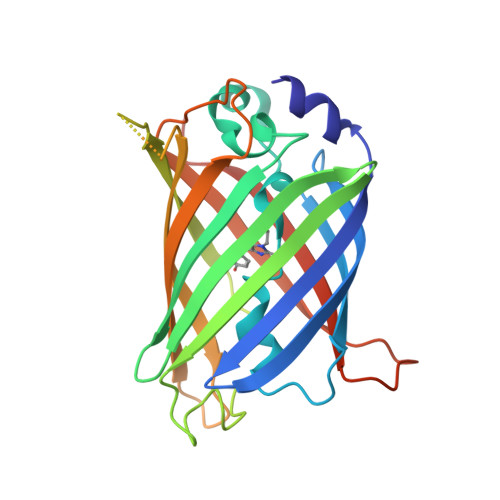
Application of the superfolder YFP bimolecular fluorescence complementation for studying protein-protein interactions in vitro


Experimental Data Snapshot

  • Method: X-RAY DIFFRACTION
  • Resolution: 2.70 Å
  • R-Value Free: 
    0.218 (Depositor), 0.226 (DCC) 
  • R-Value Work: 
    0.174 (Depositor), 0.186 (DCC) 
  • R-Value Observed: 
    0.177 (Depositor) 

wwPDB Validation 3D Report Full Report

Validation slider image for 3ED8

This is version 2.0 of the entry. See complete history

Literature

Applicability of superfolder YFP bimolecular fluorescence complementation in vitro.

Ottmann, C.Weyand, M.Wolf, A.Kuhlmann, J.Ottmann, C.

(2009) Biol Chem 390: 81-90

  • DOI: https://doi.org/10.1515/BC.2009.008
  • Primary Citation Related Structures: 
    3ED8

  • PubMed Abstract: 

    Bimolecular fluorescence complementation (BiFC) using yellow fluorescent protein (YFP) is a widely employed method to study protein-protein interactions in cells. As yet, this technique has not been used in vitro. To evaluate a possible application of BiFC in vitro, we constructed a 'superfolder split YFP' system where 15 mutations enhance expression of the fusion proteins in Escherichia coli and enable a native purification due to improved solubility. Here, we present the crystal structure of 'superfolder YFP', providing the structural basis for the enhanced folding and stability characteristics. Complementation between the two non-fluorescent YFP fragments fused to HRas and Raf1RBD or to 14-3-3 and PMA2-CT52 resulted in the constitution of the functional fluorophore. The in vivo BiFC with these protein interaction pairs was demonstrated in eukaryotic cell lines as well. Here, we present for the first time BiFC in vitro studies with natively purified superfolder YFP fusion proteins and show the potential and drawbacks of this method for analyzing protein-protein interactions.


  • Organizational Affiliation
    • Department of Structural Biology, Max Planck Institute of Molecular Physiology, Otto-Hahn-Str. 11, D-44227 Dortmund, Germany.

Macromolecule Content 

  • Total Structure Weight: 146.7 kDa 
  • Atom Count: 9,057 
  • Modeled Residue Count: 1,139 
  • Deposited Residue Count: 1,300 
  • Unique protein chains: 1

Macromolecules

Find similar proteins by:|  3D Structure
Entity ID: 1
MoleculeChains  Sequence LengthOrganismDetailsImage
yellow fluorescence protein
A, B, C, D, E
260Aequorea victoriaMutation(s): 1 
UniProt
Find proteins for P42212 (Aequorea victoria)
Explore P42212 
Go to UniProtKB:  P42212
Entity Groups
Sequence Clusters30% Identity50% Identity70% Identity90% Identity95% Identity100% Identity
UniProt GroupP42212
Sequence Annotations
Expand
Reference Sequence

Small Molecules

Modified Residues  1 Unique
IDChains TypeFormula2D DiagramParent
CRO
Query on CRO
A, B, C, D, E
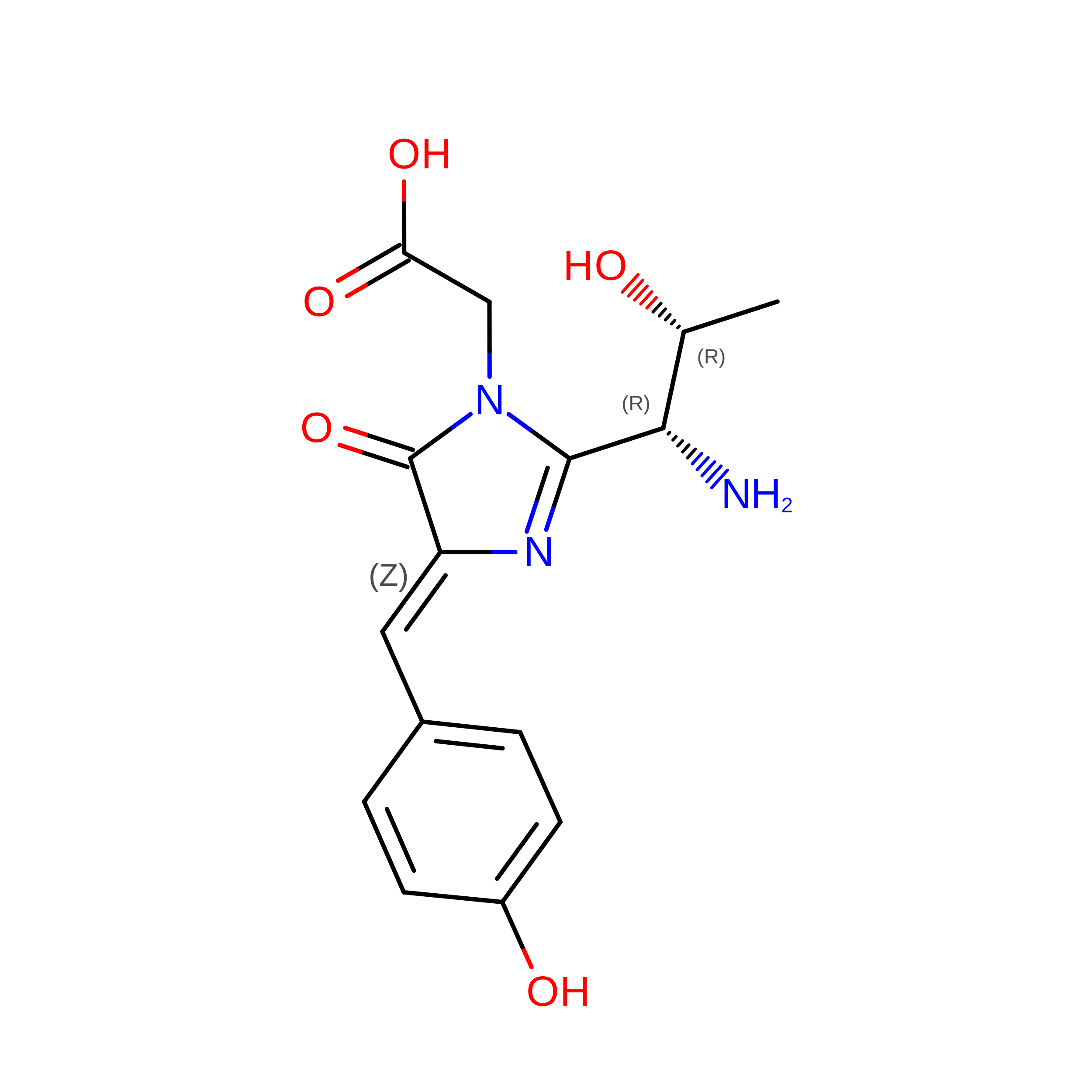
L-PEPTIDE LINKINGC15 H17 N3 O5THR, TYR, GLY

Experimental Data & Validation

Experimental Data

  • Method: X-RAY DIFFRACTION
  • Resolution: 2.70 Å
  • R-Value Free:  0.218 (Depositor), 0.226 (DCC) 
  • R-Value Work:  0.174 (Depositor), 0.186 (DCC) 
  • R-Value Observed: 0.177 (Depositor) 
Space Group: P 43 21 2
Unit Cell:
Length ( Å )Angle ( ˚ )
a = 123.04α = 90
b = 123.04β = 90
c = 247.71γ = 90
Software Package:
Software NamePurpose
PHASERphasing
REFMACrefinement
XDSdata reduction
XSCALEdata scaling

Structure Validation

View Full Validation Report


Entry History 

Deposition Data

Revision History  (Full details and data files)

  • Version 1.0: 2009-01-20
    Type: Initial release
  • Version 1.1: 2011-07-13
    Changes: Advisory, Refinement description, Version format compliance
  • Version 1.2: 2022-12-21
    Changes: Advisory, Database references, Derived calculations
  • Version 1.3: 2024-11-06
    Changes: Data collection, Structure summary
  • Version 2.0: 2026-03-18
    Changes: Polymer sequence