3ECR | pdb_00003ecr

Structure of human porphobilinogen deaminase


Experimental Data Snapshot

  • Method: X-RAY DIFFRACTION
  • Resolution: 2.18 Å
  • R-Value Free: 
    0.271 (Depositor), 0.247 (DCC) 
  • R-Value Work: 
    0.232 (Depositor) 
  • R-Value Observed: 
    0.234 (Depositor) 

wwPDB Validation 3D Report Full Report

Validation slider image for 3ECR

Ligand Structure Quality Assessment 


This is version 1.2 of the entry. See complete history

Literature

Structural insight into acute intermittent porphyria.

Song, G.Li, Y.Cheng, C.Zhao, Y.Gao, A.Zhang, R.Joachimiak, A.Shaw, N.Liu, Z.J.

(2009) FASEB J 23: 396-404

  • DOI: https://doi.org/10.1096/fj.08-115469
  • Primary Citation Related Structures: 
    3ECR

  • PubMed Abstract: 

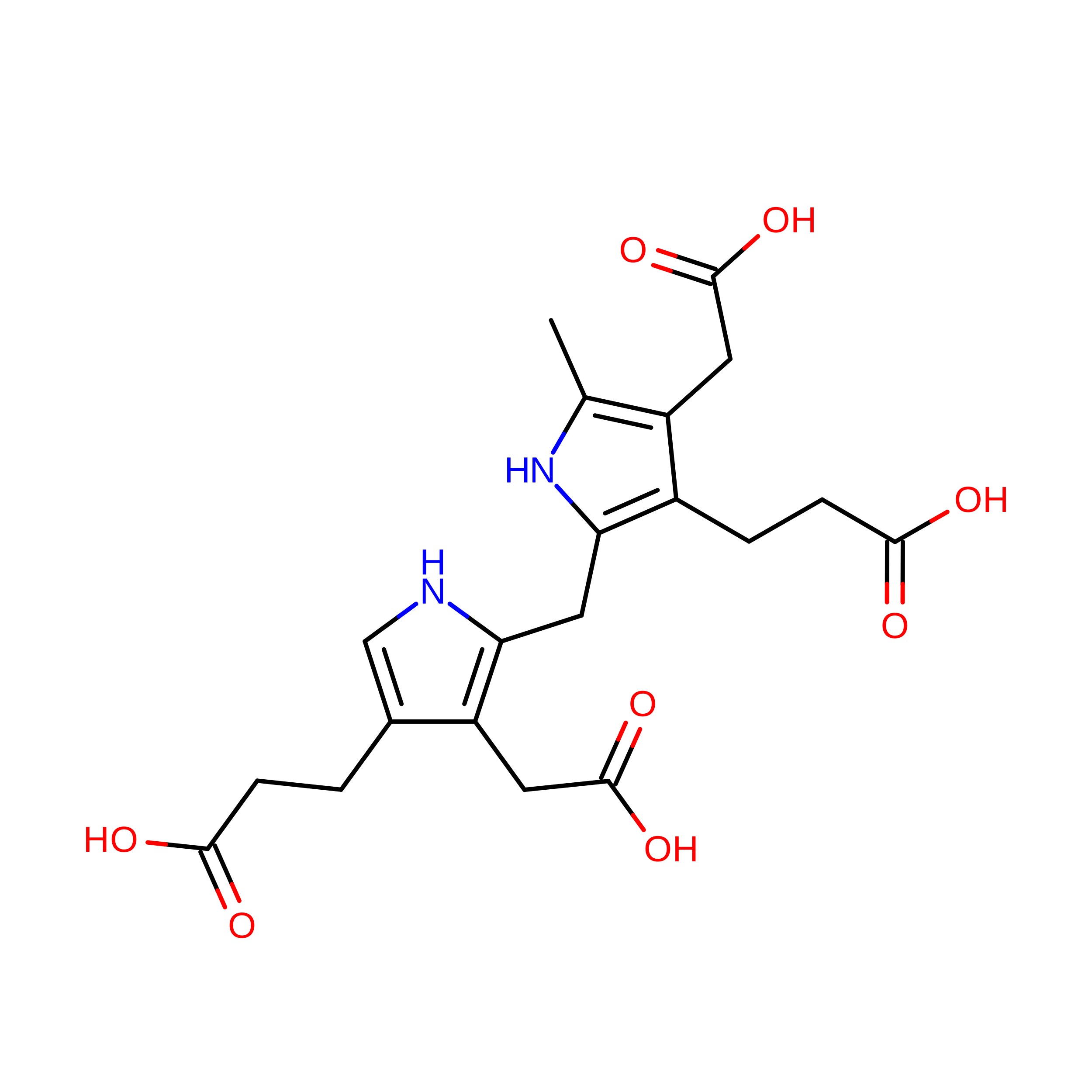
    Acute intermittent porphyria (AIP), an inherited disease of heme biosynthesis, is one of the most common types of porphyria. Reduced activity of the enzyme porphobilinogen deaminase (PBGD), which catalyzes the sequential condensation of 4 molecules of porphobilinogen to yield preuroporphyrinogen, has been linked to the symptoms of AIP. We have determined the 3-dimensional structure of human PBGD at 2.2 A resolution. Analysis of the structure revealed a dipyrromethane cofactor molecule covalently linked to C261, sitting in a positively charged cleft region. In addition to the critical catalytic D99, a number of other residues are seen hydrogen bonded to the cofactor and play a role in catalysis. Sequential entry of 4 pyrrole molecules into the active site is accomplished by movement of the domains around the hinges. H120P mutation resulted in an inactive enzyme, supporting the role of H120 as a hinge residue. Interestingly, some of the mutations of the human PBGD documented in patients suffering from AIP are located far away from the active site. The structure provides insights into the mechanism of action of PBGD at the molecular level and could aid the development of potential drugs for the up-regulation of PBGD activity in AIP.


  • Organizational Affiliation
    • National Laboratory of Biomacromolecules, Institute of Biophysics, 15 Datun Lu, Beijing 100101, China.

Macromolecule Content 

  • Total Structure Weight: 80.15 kDa 
  • Atom Count: 4,970 
  • Modeled Residue Count: 628 
  • Deposited Residue Count: 728 
  • Unique protein chains: 1

Macromolecules

Find similar proteins by:|  3D Structure
Entity ID: 1
MoleculeChains  Sequence LengthOrganismDetailsImage
Porphobilinogen deaminase
A, B
364Homo sapiensMutation(s): 0 
Gene Names: HMBSPBGDUPS
EC: 2.5.1.61
UniProt & NIH Common Fund Data Resources
Find proteins for P08397 (Homo sapiens)
Explore P08397 
Go to UniProtKB:  P08397
PHAROS:  P08397
GTEx:  ENSG00000256269 
Entity Groups
Sequence Clusters30% Identity50% Identity70% Identity90% Identity95% Identity100% Identity
UniProt GroupP08397
Sequence Annotations
Expand
Reference Sequence

Small Molecules

Ligands 1 Unique
IDChains Name / Formula / InChI Key2D Diagram3D Interactions
DPM

Query on DPM


Download:Ideal Coordinates CCD File
C [auth A],
D [auth B]
3-[5-{[3-(2-carboxyethyl)-4-(carboxymethyl)-5-methyl-1H-pyrrol-2-yl]methyl}-4-(carboxymethyl)-1H-pyrrol-3-yl]propanoic acid
C20 H24 N2 O8
LCAXMKQKEYTFDM-UHFFFAOYSA-N

Experimental Data & Validation

Experimental Data

  • Method: X-RAY DIFFRACTION
  • Resolution: 2.18 Å
  • R-Value Free:  0.271 (Depositor), 0.247 (DCC) 
  • R-Value Work:  0.232 (Depositor) 
  • R-Value Observed: 0.234 (Depositor) 
Space Group: P 21 21 21
Unit Cell:
Length ( Å )Angle ( ˚ )
a = 71.61α = 90
b = 81.061β = 90
c = 109.211γ = 90
Software Package:
Software NamePurpose
HKL-2000data collection
PHENIXmodel building
PHENIXrefinement
HKL-2000data reduction
HKL-2000data scaling
PHENIXphasing

Structure Validation

View Full Validation Report


Ligand Structure Quality Assessment 


Entry History 

Deposition Data

Revision History  (Full details and data files)

  • Version 1.0: 2008-09-30
    Type: Initial release
  • Version 1.1: 2011-07-13
    Changes: Version format compliance
  • Version 1.2: 2024-03-20
    Changes: Data collection, Database references, Derived calculations