3DUW | pdb_00003duw

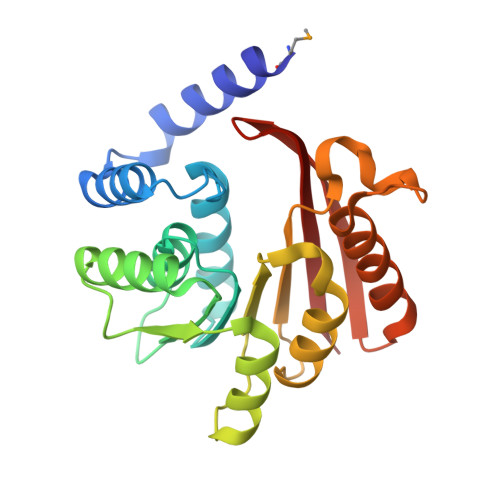
Crystal Structural Analysis of the O-methyltransferase from Bacillus cereus in complex SAH


Experimental Data Snapshot

  • Method: X-RAY DIFFRACTION
  • Resolution: 1.20 Å
  • R-Value Free: 
    0.234 (Depositor), 0.230 (DCC) 
  • R-Value Work: 
    0.221 (Depositor), 0.216 (DCC) 

wwPDB Validation 3D Report Full Report

Validation slider image for 3DUW

Ligand Structure Quality Assessment 


This is version 1.2 of the entry. See complete history

Literature

Structural and functional insights into O-methyltransferase from Bacillus cereus

Cho, J.-H.Park, Y.Ahn, J.-H.Lim, Y.Rhee, S.

(2008) J Mol Biology 382: 987-997

  • DOI: https://doi.org/10.1016/j.jmb.2008.07.080
  • Primary Citation Related Structures: 
    3DUL, 3DUW

  • PubMed Abstract: 

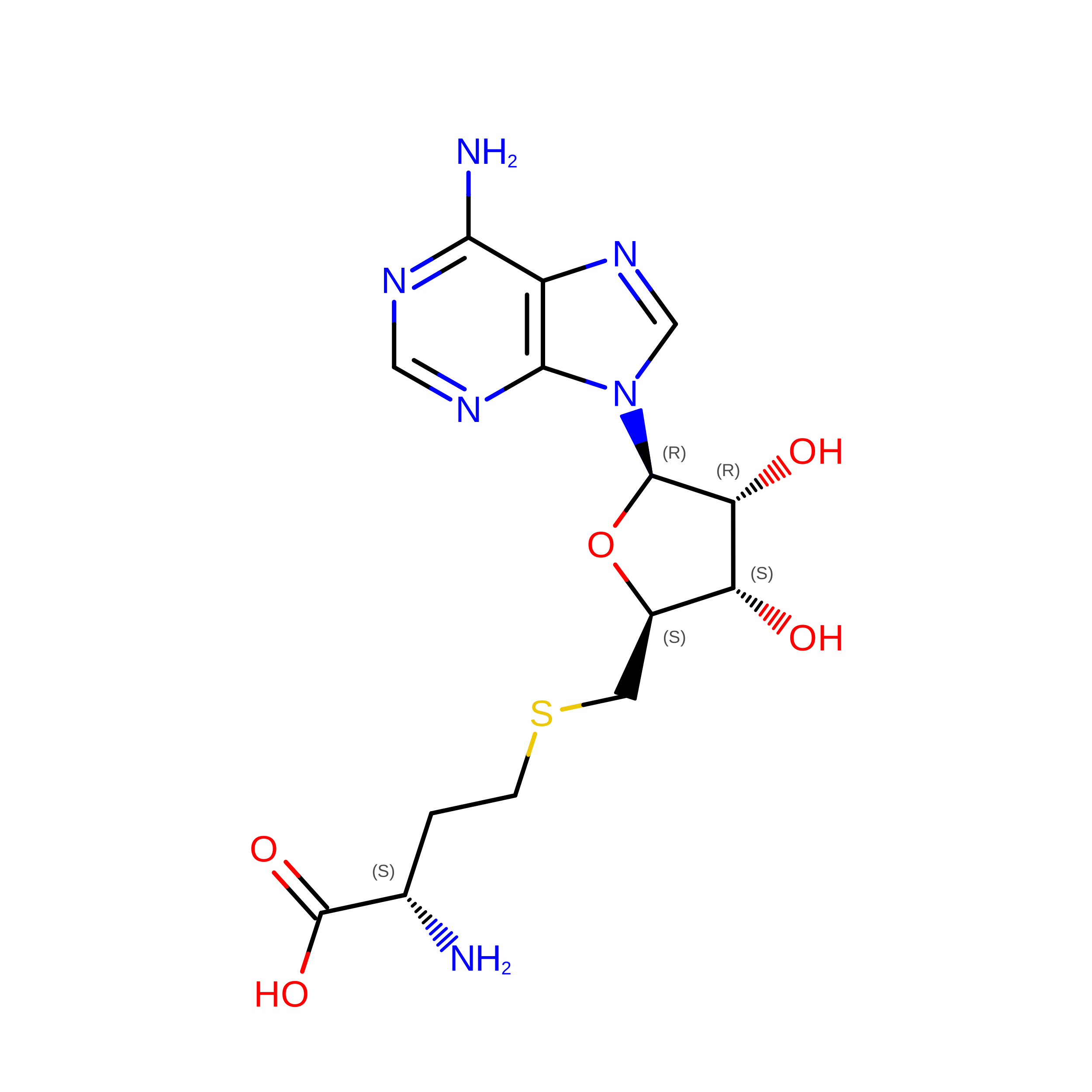
    The specific substrates, mechanisms, and structures of the bacterial O-methyltransferases (OMTs) are not as well characterized as those of other OMTs. Recent studies have suggested that bacterial OMTs catalyze regiospecific reactions that might be used to produce novel compounds. In this study, we investigated the structural and functional features of an OMT from Bacillus cereus (BcOMT2). This enzyme catalyzes the O-methylation of flavonoids in vitro in an S-adenosylmethionine-dependent and regiospecific manner. We solved the crystal structures of the BcOMT2 apoenzyme and the BcOMT2-S-adenosylhomocysteine (SAH) co-complex at resolutions of 1.8 and 1.2 A, respectively. These structures reveal that the overall structure of dimeric BcOMT2 is similar to that of the canonical OMT but that BcOMT2 also has a unique N-terminal helical region that is responsible for dimerization. The binding of SAH causes both local and remote conformational changes in the dimer interface that stabilize the dimerization of BcOMT2. SAH binding also causes ordering of residues Glu171 to Gly186, which are disordered in the apoenzyme structure and are known determinants of substrate specificity, and thus contributes to formation of the substrate binding pocket. Our structural analysis indicated a resemblance between the active site of BcOMT2 and that of metal-dependent OMTs. Using mutational analysis, we confirmed that BcOMT2 is a Mg(2+)-dependent OMT. These results provide structural and functional insights into the dimerization mechanism and substrate specificity of BcOMT2.


  • Organizational Affiliation
    • Department of Agricultural Biotechnology and Center for Agricultural Biomaterials, Seoul National University, Seoul 151-921, Korea.

Macromolecule Content 

  • Total Structure Weight: 50.31 kDa 
  • Atom Count: 3,904 
  • Modeled Residue Count: 440 
  • Deposited Residue Count: 446 
  • Unique protein chains: 1

Macromolecules

Find similar proteins by:|  3D Structure
Entity ID: 1
MoleculeChains  Sequence LengthOrganismDetailsImage
O-methyltransferase, putative
A, B
223Bacillus cereus ATCC 10987Mutation(s): 0 
Gene Names: BCE_2045
EC: 2.1.1
UniProt
Find proteins for Q739U3 (Bacillus cereus (strain ATCC 10987 / NRS 248))
Explore Q739U3 
Go to UniProtKB:  Q739U3
Entity Groups
Sequence Clusters30% Identity50% Identity70% Identity90% Identity95% Identity100% Identity
UniProt GroupQ739U3
Sequence Annotations
Expand
Reference Sequence

Small Molecules

Modified Residues  1 Unique
IDChains TypeFormula2D DiagramParent
MSE
Query on MSE
A, B
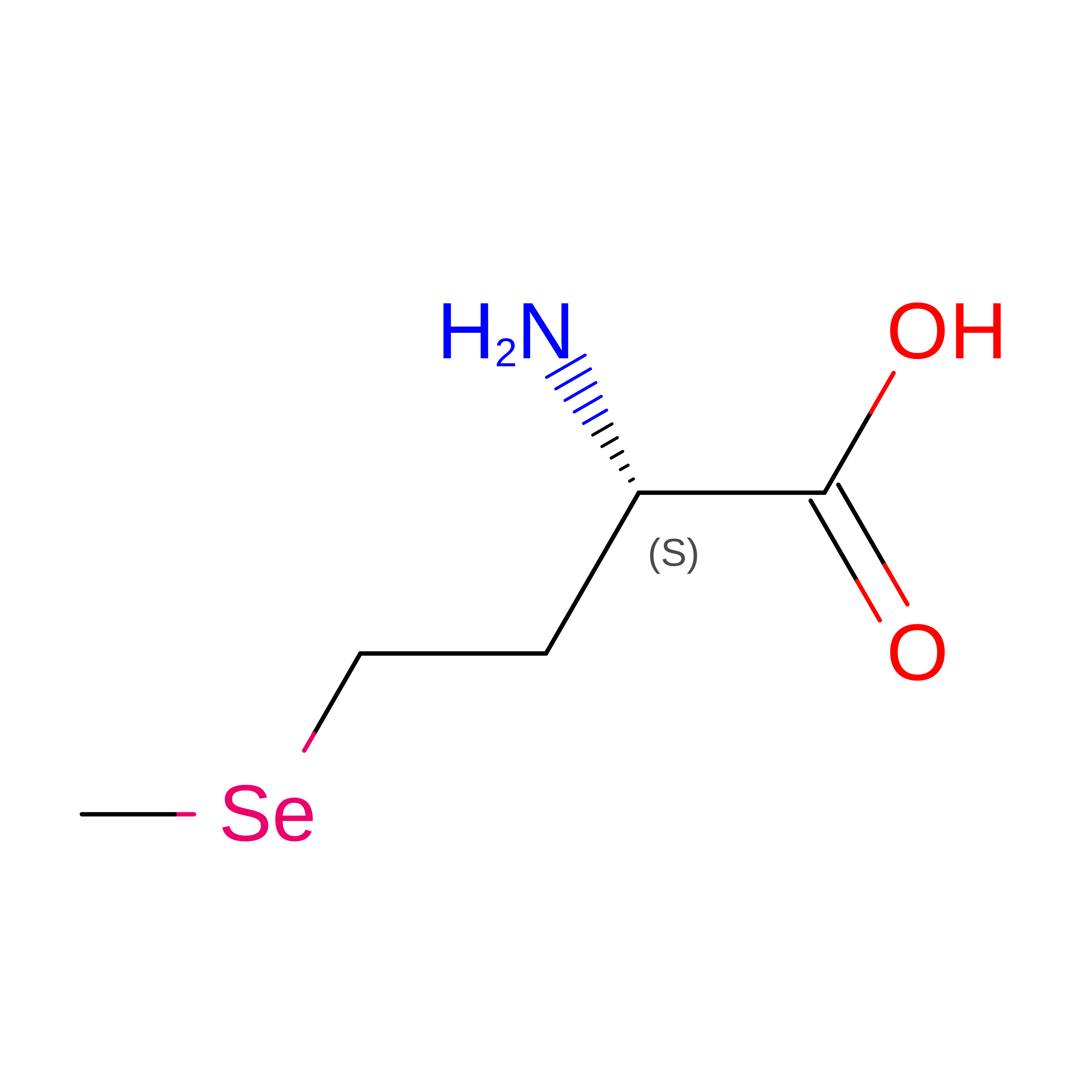
L-PEPTIDE LINKINGC5 H11 N O2 SeMET

Experimental Data & Validation

Experimental Data

  • Method: X-RAY DIFFRACTION
  • Resolution: 1.20 Å
  • R-Value Free:  0.234 (Depositor), 0.230 (DCC) 
  • R-Value Work:  0.221 (Depositor), 0.216 (DCC) 
Space Group: P 21 21 21
Unit Cell:
Length ( Å )Angle ( ˚ )
a = 66.6α = 90
b = 74.3β = 90
c = 90.6γ = 90
Software Package:
Software NamePurpose
HKL-2000data collection
SOLVEphasing
CNSrefinement
HKL-2000data reduction
HKL-2000data scaling

Structure Validation

View Full Validation Report


Ligand Structure Quality Assessment 


Entry History 

Deposition Data

Revision History  (Full details and data files)

  • Version 1.0: 2008-08-05
    Type: Initial release
  • Version 1.1: 2011-07-13
    Changes: Version format compliance
  • Version 1.2: 2024-11-20
    Changes: Data collection, Database references, Derived calculations, Structure summary