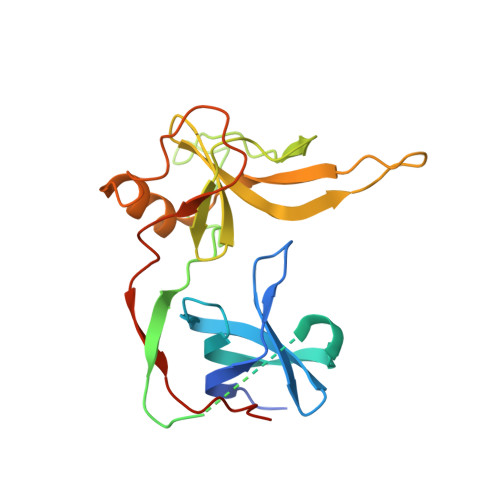
3DGS | pdb_00003dgs

Changing the determinants of protein stability from covalent to non-covalent interactions by in-vitro evolution: a structural and energetic analysis


Experimental Data Snapshot

  • Method: X-RAY DIFFRACTION
  • Resolution: 1.90 Å
  • R-Value Free: 
    0.263 (Depositor), 0.268 (DCC) 
  • R-Value Work: 
    0.216 (Depositor), 0.222 (DCC) 

Starting Model: experimental
View more details

wwPDB Validation 3D Report Full Report

Validation slider image for 3DGS

This is version 1.4 of the entry. See complete history

Literature

Changing the determinants of protein stability from covalent to non-covalent interactions by in vitro evolution: a structural and energetic analysis.

Kather, I.Jakob, R.P.Dobbek, H.Schmid, F.X.

(2008) J Mol Biology 381: 1040-1054

  • DOI: https://doi.org/10.1016/j.jmb.2008.06.073
  • Primary Citation Related Structures: 
    3DGS

  • PubMed Abstract: 

    The three disulfide bonds of the gene-3-protein of the phage fd are essential for the conformational stability of this protein, and it unfolds when they are removed by reduction or mutation. Previously, we used an iterative in vitro selection strategy to generate a stable and functional form of the gene-3-protein without these disulfides. It yielded optimal replacements for the disulfide bonds as well as several stabilizing second-site mutations. The best selected variant showed a higher thermal stability compared with the disulfide-bonded wild-type protein. Here, we investigated the molecular basis of this strong stabilization by solving the crystal structure of this variant and by analyzing the contributions to the conformational stability of the selected mutations individually. They could mostly be explained by improved side-chain packing. The R29W substitution alone increased the midpoint of the thermal unfolding transition by 14 deg and the conformational stability by about 25 kJ mol(-1). This key mutation (i) removed a charged side chain that forms a buried salt bridge in the disulfide-containing wild-type protein, (ii) optimized the local packing with the residues that replace the C46-C53 disulfide and (iii) improved the domain interactions. Apparently, certain residues in proteins indeed play key roles for stability.


  • Organizational Affiliation
    • Laboratorium für Biochemie, Universitat Bayreuth, 95440 Bayreuth, Germany.

Macromolecule Content 

  • Total Structure Weight: 49.55 kDa 
  • Atom Count: 3,211 
  • Modeled Residue Count: 372 
  • Deposited Residue Count: 454 
  • Unique protein chains: 1

Macromolecules

Find similar proteins by:|  3D Structure
Entity ID: 1
MoleculeChains  Sequence LengthOrganismDetailsImage
Coat protein A
A, B
227Enterobacteria phage fdMutation(s): 20 
Gene Names: III
UniProt
Find proteins for P03661 (Enterobacteria phage fd)
Explore P03661 
Go to UniProtKB:  P03661
Entity Groups
Sequence Clusters30% Identity50% Identity70% Identity90% Identity95% Identity100% Identity
UniProt GroupP03661
Sequence Annotations
Expand
Reference Sequence

Experimental Data & Validation

Experimental Data

  • Method: X-RAY DIFFRACTION
  • Resolution: 1.90 Å
  • R-Value Free:  0.263 (Depositor), 0.268 (DCC) 
  • R-Value Work:  0.216 (Depositor), 0.222 (DCC) 
Space Group: P 21 21 21
Unit Cell:
Length ( Å )Angle ( ˚ )
a = 48.86α = 90
b = 92.21β = 90
c = 94.35γ = 90
Software Package:
Software NamePurpose
MAR345dtbdata collection
AMoREphasing
CNSrefinement
XDSdata reduction
XDSdata scaling

Structure Validation

View Full Validation Report


Entry History 

Deposition Data

Revision History  (Full details and data files)

  • Version 1.0: 2008-07-22
    Type: Initial release
  • Version 1.1: 2011-07-13
    Changes: Version format compliance
  • Version 1.2: 2012-05-16
    Changes: Database references
  • Version 1.3: 2021-11-10
    Changes: Database references
  • Version 1.4: 2023-11-01
    Changes: Data collection, Refinement description