Download Mendeley
Arginine 49 is a bifunctional residue important in catalysis and biosynthesis of monomeric sarcosine oxidase: a context-sensitive model for the electrostatic impact of arginine to lysine mutations.
Hassan-Abdallah, A., Zhao, G., Chen, Z.W., Mathews, F.S., Schuman Jorns, M.(2008) Biochemistry 47: 2913-2922
- PubMed: 18251505 Search on PubMed
- DOI: https://doi.org/10.1021/bi702351v
- Primary Citation Related Structures:
3BHF, 3BHK - PubMed Abstract:
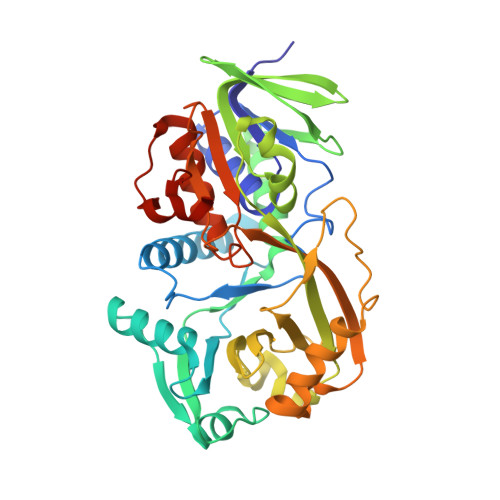
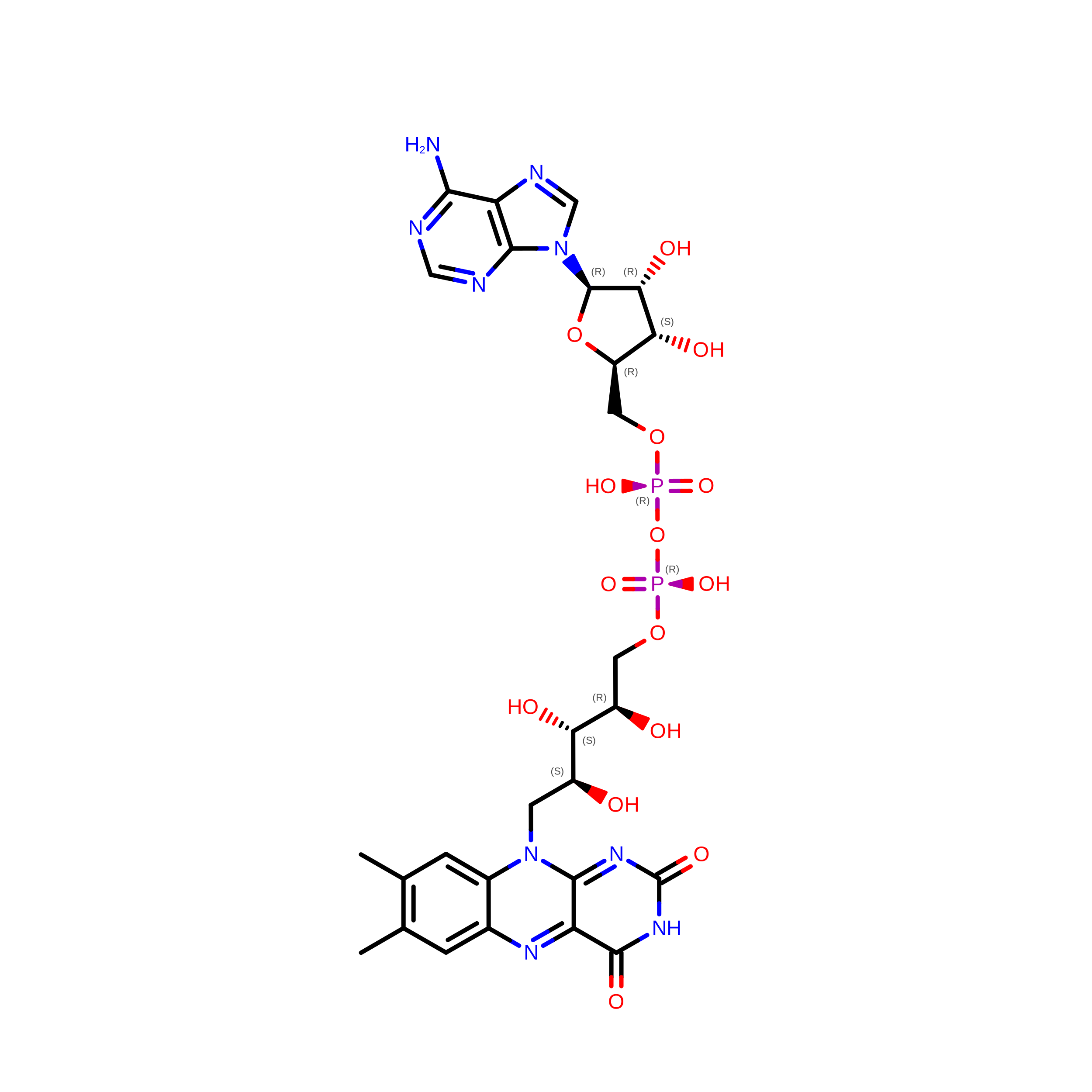
Monomeric sarcosine oxidase (MSOX) contains covalently bound FAD and catalyzes the oxidative demethylation of sarcosine ( N-methylglycine). The side chain of Arg49 is in van der Waals contact with the si face of the flavin ring; sarcosine binds just above the re face. Covalent flavin attachment requires a basic residue (Arg or Lys) at position 49. Although flavinylation is scarcely affected, mutation of Arg49 to Lys causes a 40-fold decrease in k cat and a 150-fold decrease in k cat/ K m sarcosine. The overall structure of the Arg49Lys mutant is very similar to wild-type MSOX; the side chain of Lys49 in the mutant is nearly congruent to that of Arg49 in the wild-type enzyme. The Arg49Lys mutant exhibits several features consistent with a less electropositive active site: (1) Charge transfer bands observed for mutant enzyme complexes with competitive inhibitors absorb at higher energy than the corresponding wild-type complexes. (2) The p K a for ionization at N(3)H of FAD is more than two pH units higher in the mutant than in wild-type MSOX. (3) The reduction potential of the oxidized/radical couple in the mutant is 100 mV lower than in the wild-type enzyme. The lower reduction potential is likely to be a major cause of the reduced catalytic activity of the mutant. Electrostatic interactions with Arg49 play an important role in catalysis and covalent flavinylation. A context-sensitive model for the electrostatic impact of an arginine to lysine mutation can account for the dramatically different consequences of the Arg49Lys mutation on MSOX catalysis and holoenzyme biosysnthesis.
- Department of Biochemistry and Molecular Biology, Drexel University College of Medicine, Philadelphia, Pennsylvania 19102, USA.
Organizational Affiliation: