3BCT | pdb_00003bct

THE ARMADILLO REPEAT REGION FROM MURINE BETA-CATENIN


Experimental Data Snapshot

  • Method: X-RAY DIFFRACTION
  • Resolution: 2.10 Å
  • R-Value Free: 
    0.260 (Depositor), 0.251 (DCC) 
  • R-Value Work: 
    0.229 (Depositor), 0.223 (DCC) 
  • R-Value Observed: 
    0.229 (Depositor) 

wwPDB Validation 3D Report Full Report

Validation slider image for 3BCT

This is version 2.0 of the entry. See complete history

Literature

Three-dimensional structure of the armadillo repeat region of beta-catenin.

Huber, A.H.Nelson, W.J.Weis, W.I.

(1997) Cell 90: 871-882

  • DOI: https://doi.org/10.1016/s0092-8674(00)80352-9
  • Primary Citation Related Structures: 
    2BCT, 3BCT

  • PubMed Abstract: 

    Beta-catenin is essential for cadherin-based cell adhesion and Wnt/Wingless growth factor signaling. In these roles, it binds to cadherins, Tcf-family transcription factors, and the tumor suppressor gene product Adenomatous Polyposis Coli (APC). A core region of beta-catenin, composed of 12 copies of a 42 amino acid sequence motif known as an armadillo repeat, mediates these interactions. The three-dimensional structure of a protease-resistant fragment of beta-catenin containing the armadillo repeat region has been determined. The 12 repeats form a superhelix of helices that features a long, positively charged groove. Although unrelated in sequence, the beta-catenin binding regions of cadherins, Tcfs, and APC are acidic and are proposed to interact with this groove.


  • Organizational Affiliation
    • Department of Structural Biology, Stanford University School of Medicine, California 94305, USA.

Macromolecule Content 

  • Total Structure Weight: 52.29 kDa 
  • Atom Count: 3,761 
  • Modeled Residue Count: 457 
  • Deposited Residue Count: 470 
  • Unique protein chains: 1

Macromolecules

Find similar proteins by:|  3D Structure
Entity ID: 1
MoleculeChains  Sequence LengthOrganismDetailsImage
BETA-CATENIN470Mus musculusMutation(s): 12 
UniProt & NIH Common Fund Data Resources
Find proteins for Q02248 (Mus musculus)
Explore Q02248 
Go to UniProtKB:  Q02248
IMPC:  MGI:88276
Entity Groups
Sequence Clusters30% Identity50% Identity70% Identity90% Identity95% Identity100% Identity
UniProt GroupQ02248
Sequence Annotations
Expand
Reference Sequence

Small Molecules

Ligands 2 Unique
IDChains Name / Formula / InChI Key2D Diagram3D Interactions
URE

Query on URE


Download:Ideal Coordinates CCD File
C [auth A]
D [auth A]
E [auth A]
F [auth A]
G [auth A]
C [auth A],
D [auth A],
E [auth A],
F [auth A],
G [auth A],
H [auth A],
I [auth A],
J [auth A]
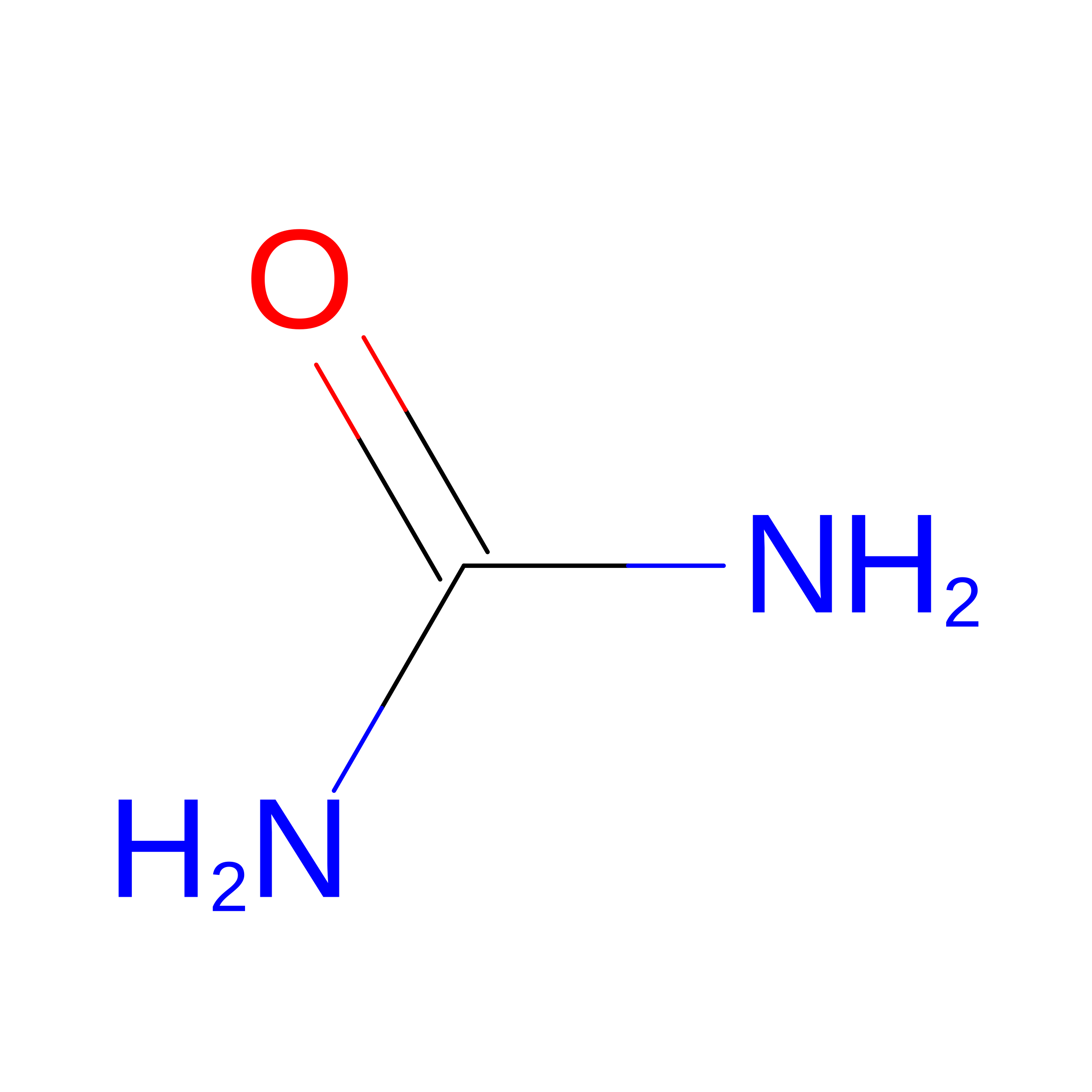
UREA
C H4 N2 O
XSQUKJJJFZCRTK-UHFFFAOYSA-N
CL

Query on CL


Download:Ideal Coordinates CCD File
B [auth A]CHLORIDE ION
Cl
VEXZGXHMUGYJMC-UHFFFAOYSA-M
Modified Residues  1 Unique
IDChains TypeFormula2D DiagramParent
MSE
Query on MSE
A
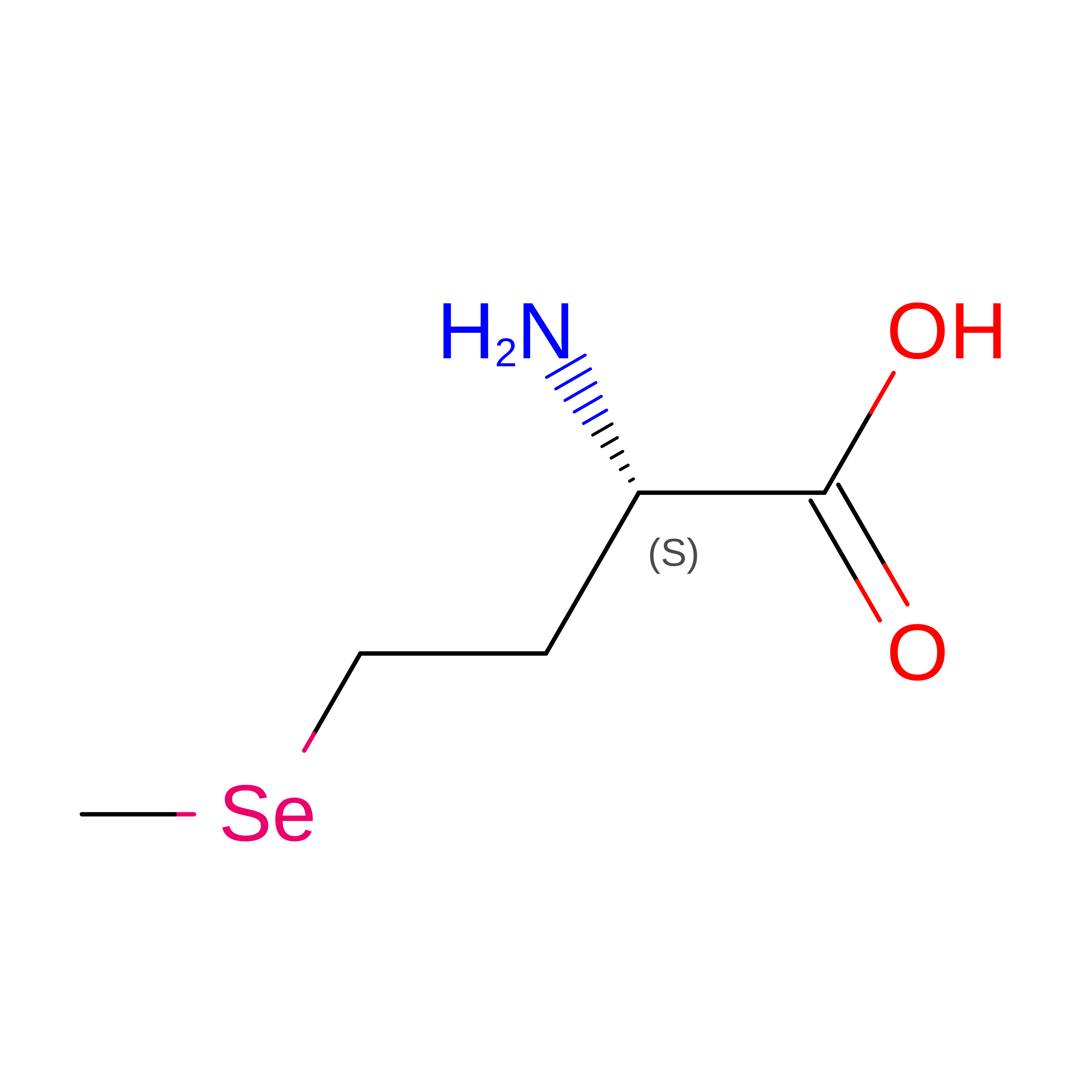
L-PEPTIDE LINKINGC5 H11 N O2 SeMET

Experimental Data & Validation

Experimental Data

  • Method: X-RAY DIFFRACTION
  • Resolution: 2.10 Å
  • R-Value Free:  0.260 (Depositor), 0.251 (DCC) 
  • R-Value Work:  0.229 (Depositor), 0.223 (DCC) 
  • R-Value Observed: 0.229 (Depositor) 
Space Group: C 2 2 21
Unit Cell:
Length ( Å )Angle ( ˚ )
a = 64.1α = 90
b = 102β = 90
c = 187γ = 90
Software Package:
Software NamePurpose
CNSrefinement
DENZOdata reduction
SCALEPACKdata scaling
CNSphasing

Structure Validation

View Full Validation Report


Entry History 

Deposition Data

Revision History  (Full details and data files)

  • Version 1.0: 1997-11-19
    Type: Initial release
  • Version 1.1: 2008-03-25
    Changes: Version format compliance
  • Version 1.2: 2011-07-13
    Changes: Version format compliance
  • Version 2.0: 2024-10-23
    Changes: Atomic model, Data collection, Database references, Derived calculations, Structure summary