3AFH | pdb_00003afh

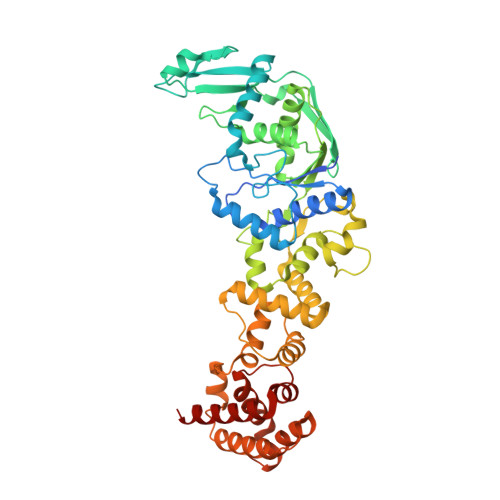
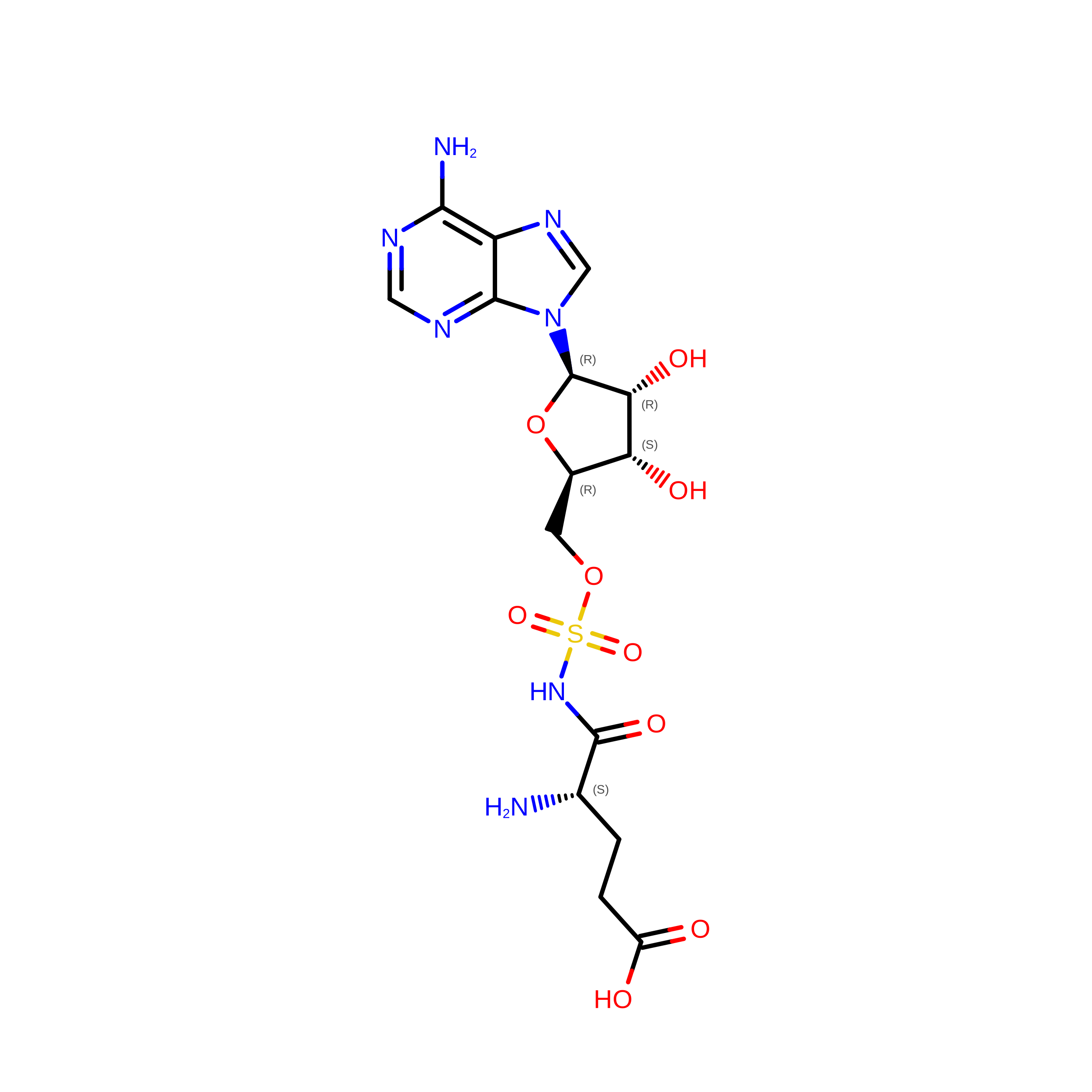
Crystal structure of Thermotoga maritima nondiscriminating glutamyl-tRNA synthetase in complex with a glutamyl-AMP analog


Experimental Data Snapshot

  • Method: X-RAY DIFFRACTION
  • Resolution: 2.00 Å
  • R-Value Free: 
    0.235 (Depositor), 0.235 (DCC) 
  • R-Value Work: 
    0.186 (Depositor), 0.186 (DCC) 
  • R-Value Observed: 
    0.186 (Depositor) 

Starting Model: experimental
View more details

wwPDB Validation 3D Report Full Report

Validation slider image for 3AFH

Ligand Structure Quality Assessment 


This is version 1.2 of the entry. See complete history

Literature

Structure of nondiscriminating glutamyl-tRNA synthetase from Thermotoga maritima

Ito, T.Kiyasu, N.Matsunaga, R.Takahashi, S.Yokoyama, S.

(2010) Acta Crystallogr D Biol Crystallogr 66: 813-820

  • DOI: https://doi.org/10.1107/S0907444910019086
  • Primary Citation Related Structures: 
    3AFH

  • PubMed Abstract: 

    Aminoacyl-tRNA synthetases produce aminoacyl-tRNAs from the substrate tRNA and its cognate amino acid with the aid of ATP. Two types of glutamyl-tRNA synthetase (GluRS) have been discovered: discriminating GluRS (D-GluRS) and nondiscriminating GluRS (ND-GluRS). D-GluRS glutamylates tRNA(Glu) only, while ND-GluRS glutamylates both tRNA(Glu) and tRNA(Gln). ND-GluRS produces the intermediate Glu-tRNA(Gln), which is converted to Gln-tRNA(Gln) by Glu-tRNA(Gln) amidotransferase. Two GluRS homologues from Thermotoga maritima, TM1875 and TM1351, have been biochemically characterized and it has been clarified that only TM1875 functions as an ND-GluRS. Furthermore, the crystal structure of the T. maritima ND-GluRS, TM1875, was determined in complex with a Glu-AMP analogue at 2.0 A resolution. The T. maritima ND-GluRS contains a characteristic structure in the connective-peptide domain, which is inserted into the catalytic Rossmann-fold domain. The glutamylation ability of tRNA(Gln) by ND-GluRS was measured in the presence of the bacterial Glu-tRNA(Gln) amidotransferase GatCAB. Interestingly, the glutamylation efficiency was not affected even in the presence of excess GatCAB. Therefore, GluRS avoids competition with GatCAB and glutamylates tRNA(Gln).


  • Organizational Affiliation
    • Department of Biophysics and Biochemistry, Graduate School of Science, The University of Tokyo, Bunkyo-ku, Tokyo, Japan.

Macromolecule Content 

  • Total Structure Weight: 58 kDa 
  • Atom Count: 4,403 
  • Modeled Residue Count: 463 
  • Deposited Residue Count: 488 
  • Unique protein chains: 1

Macromolecules

Find similar proteins by:|  3D Structure
Entity ID: 1
MoleculeChains  Sequence LengthOrganismDetailsImage
Glutamyl-tRNA synthetase 2488Thermotoga maritimaMutation(s): 0 
EC: 6.1.1.17
UniProt
Find proteins for Q9X2I8 (Thermotoga maritima (strain ATCC 43589 / DSM 3109 / JCM 10099 / NBRC 100826 / MSB8))
Explore Q9X2I8 
Go to UniProtKB:  Q9X2I8
Entity Groups
Sequence Clusters30% Identity50% Identity70% Identity90% Identity95% Identity100% Identity
UniProt GroupQ9X2I8
Sequence Annotations
Expand
Reference Sequence

Small Molecules

Ligands 1 Unique
IDChains Name / Formula / InChI Key2D Diagram3D Interactions
GSU

Query on GSU


Download:Ideal Coordinates CCD File
B [auth A]O5'-(L-GLUTAMYL-SULFAMOYL)-ADENOSINE
C15 H21 N7 O9 S
YBRKRYFZKHICLS-WERHYGNASA-N

Experimental Data & Validation

Experimental Data

  • Method: X-RAY DIFFRACTION
  • Resolution: 2.00 Å
  • R-Value Free:  0.235 (Depositor), 0.235 (DCC) 
  • R-Value Work:  0.186 (Depositor), 0.186 (DCC) 
  • R-Value Observed: 0.186 (Depositor) 
Space Group: P 21 21 2
Unit Cell:
Length ( Å )Angle ( ˚ )
a = 68.624α = 90
b = 207.317β = 90
c = 39.495γ = 90
Software Package:
Software NamePurpose
HKL-2000data collection
PHASERphasing
CNSrefinement
HKL-2000data reduction
HKL-2000data scaling

Structure Validation

View Full Validation Report


Ligand Structure Quality Assessment 


Entry History 

Deposition Data

Revision History  (Full details and data files)

  • Version 1.0: 2010-06-30
    Type: Initial release
  • Version 1.1: 2011-07-13
    Changes: Version format compliance
  • Version 1.2: 2023-11-01
    Changes: Data collection, Database references, Derived calculations, Refinement description