2YD9 | pdb_00002yd9

Crystal structure of the N-terminal Ig1-3 module of Human Receptor Protein Tyrosine Phosphatase Sigma


Experimental Data Snapshot

  • Method: X-RAY DIFFRACTION
  • Resolution: 2.60 Å
  • R-Value Free: 
    0.289 (Depositor), 0.292 (DCC) 
  • R-Value Work: 
    0.247 (Depositor), 0.248 (DCC) 
  • R-Value Observed: 
    0.249 (Depositor) 

Starting Model: experimental
View more details

wwPDB Validation 3D Report Full Report

Validation slider image for 2YD9

Ligand Structure Quality Assessment 


This is version 1.5 of the entry. See complete history

Literature

Proteoglycan-Specific Molecular Switch for Rptp Sigma Clustering and Neuronal Extension.

Coles, C.H.Shen, Y.Tenney, A.P.Siebold, C.Sutton, G.C.Lu, W.Gallagher, J.T.Jones, E.Y.Flanagan, J.G.Aricescu, A.R.

(2011) Science 332: 484

  • DOI: https://doi.org/10.1126/science.1200840
  • Primary Citation Related Structures: 
    2YD1, 2YD2, 2YD3, 2YD4, 2YD5, 2YD6, 2YD7, 2YD8, 2YD9

  • PubMed Abstract: 

    Heparan and chondroitin sulfate proteoglycans (HSPGs and CSPGs, respectively) regulate numerous cell surface signaling events, with typically opposite effects on cell function. CSPGs inhibit nerve regeneration through receptor protein tyrosine phosphatase sigma (RPTPσ). Here we report that RPTPσ acts bimodally in sensory neuron extension, mediating CSPG inhibition and HSPG growth promotion. Crystallographic analyses of a shared HSPG-CSPG binding site reveal a conformational plasticity that can accommodate diverse glycosaminoglycans with comparable affinities. Heparan sulfate and analogs induced RPTPσ ectodomain oligomerization in solution, which was inhibited by chondroitin sulfate. RPTPσ and HSPGs colocalize in puncta on sensory neurons in culture, whereas CSPGs occupy the extracellular matrix. These results lead to a model where proteoglycans can exert opposing effects on neuronal extension by competing to control the oligomerization of a common receptor.


  • Organizational Affiliation
    • Division of Structural Biology, Wellcome Trust Centre for Human Genetics, University of Oxford, Roosevelt Drive, Oxford, OX3 7BN, UK.

Macromolecule Content 

  • Total Structure Weight: 34.64 kDa 
  • Atom Count: 2,198 
  • Modeled Residue Count: 278 
  • Deposited Residue Count: 304 
  • Unique protein chains: 1

Macromolecules

Find similar proteins by:|  3D Structure
Entity ID: 1
MoleculeChains  Sequence LengthOrganismDetailsImage
RECEPTOR-TYPE TYROSINE-PROTEIN PHOSPHATASE S304Homo sapiensMutation(s): 2 
EC: 3.1.3.48
UniProt & NIH Common Fund Data Resources
Find proteins for Q13332 (Homo sapiens)
Explore Q13332 
Go to UniProtKB:  Q13332
PHAROS:  Q13332
GTEx:  ENSG00000105426 
Entity Groups
Sequence Clusters30% Identity50% Identity70% Identity90% Identity95% Identity100% Identity
UniProt GroupQ13332
Glycosylation
Glycosylation Sites: 2Go to GlyGen: Q13332-1
Sequence Annotations
Expand
Reference Sequence

Small Molecules

Ligands 4 Unique
IDChains Name / Formula / InChI Key2D Diagram3D Interactions
B3P

Query on B3P


Download:Ideal Coordinates CCD File
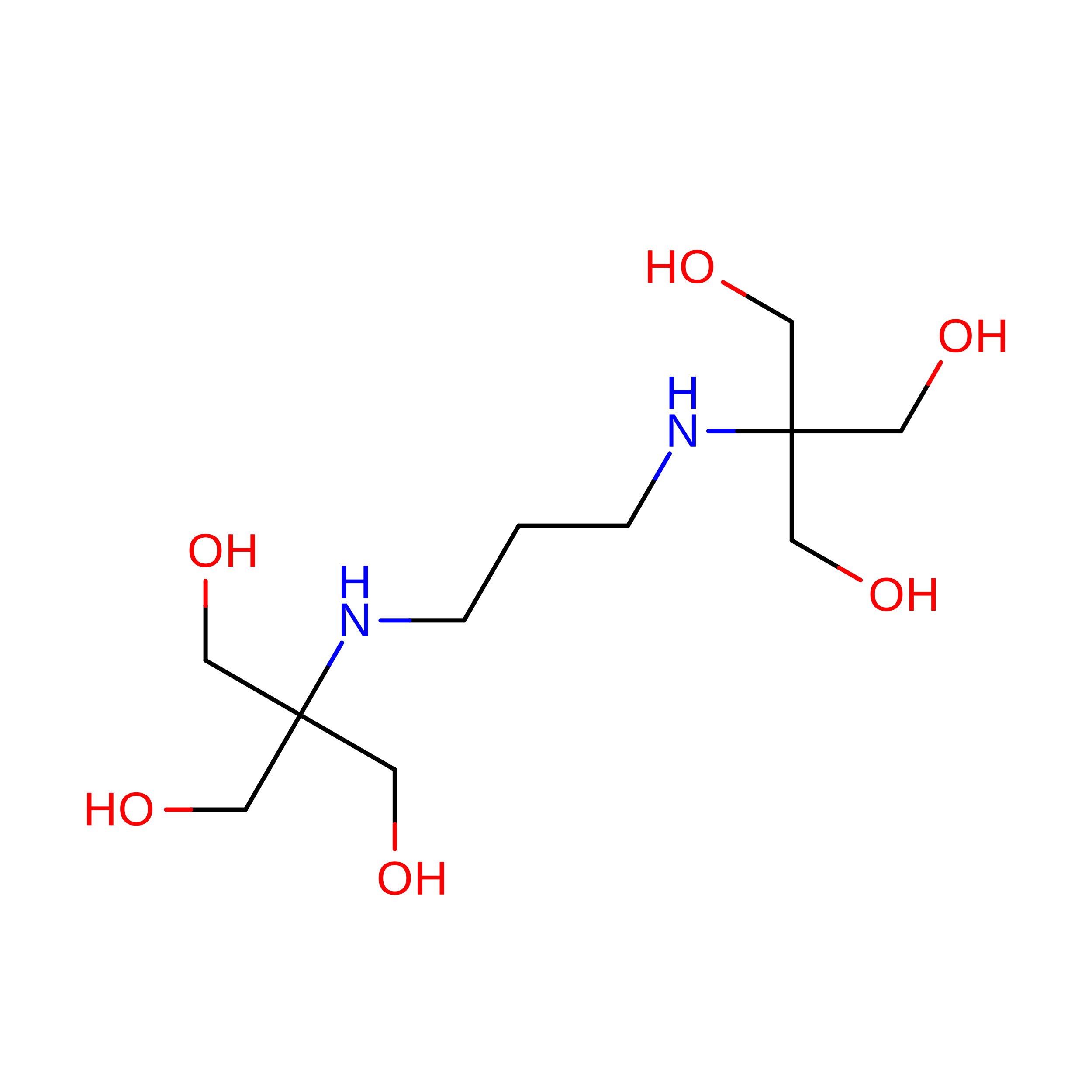
L [auth A]2-[3-(2-HYDROXY-1,1-DIHYDROXYMETHYL-ETHYLAMINO)-PROPYLAMINO]-2-HYDROXYMETHYL-PROPANE-1,3-DIOL
C11 H26 N2 O6
HHKZCCWKTZRCCL-UHFFFAOYSA-N
NAG

Query on NAG


Download:Ideal Coordinates CCD File
J [auth A],
K [auth A]
2-acetamido-2-deoxy-beta-D-glucopyranose
C8 H15 N O6
OVRNDRQMDRJTHS-FMDGEEDCSA-N
IOD

Query on IOD


Download:Ideal Coordinates CCD File
F [auth A],
G [auth A],
H [auth A],
I [auth A]
IODIDE ION
I
XMBWDFGMSWQBCA-UHFFFAOYSA-M
CL

Query on CL


Download:Ideal Coordinates CCD File
B [auth A],
C [auth A],
D [auth A],
E [auth A]
CHLORIDE ION
Cl
VEXZGXHMUGYJMC-UHFFFAOYSA-M

Experimental Data & Validation

Experimental Data

  • Method: X-RAY DIFFRACTION
  • Resolution: 2.60 Å
  • R-Value Free:  0.289 (Depositor), 0.292 (DCC) 
  • R-Value Work:  0.247 (Depositor), 0.248 (DCC) 
  • R-Value Observed: 0.249 (Depositor) 
Space Group: I 2 2 2
Unit Cell:
Length ( Å )Angle ( ˚ )
a = 71.699α = 90
b = 90.043β = 90
c = 143.283γ = 90
Software Package:
Software NamePurpose
REFMACrefinement
HKL-2000data reduction
SCALEPACKdata scaling
PHASERphasing

Structure Validation

View Full Validation Report


Ligand Structure Quality Assessment 


Entry History 

Deposition Data

Revision History  (Full details and data files)

  • Version 1.0: 2011-04-13
    Type: Initial release
  • Version 1.1: 2011-05-08
    Changes: Version format compliance
  • Version 1.2: 2011-07-13
    Changes: Version format compliance
  • Version 1.3: 2020-07-29
    Type: Remediation
    Reason: Carbohydrate remediation
    Changes: Data collection, Derived calculations, Other, Structure summary
  • Version 1.4: 2023-12-20
    Changes: Data collection, Database references, Refinement description, Structure summary
  • Version 1.5: 2024-11-20
    Changes: Structure summary