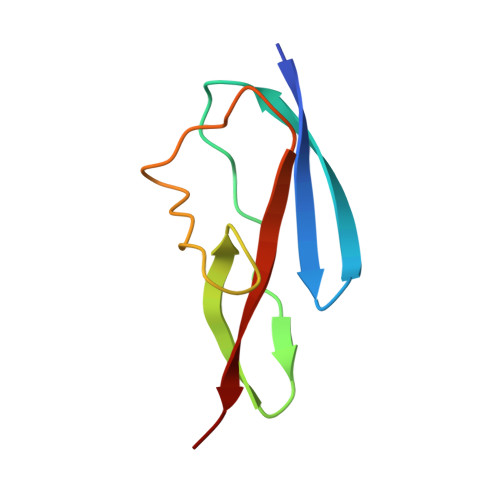
2Y5P | pdb_00002y5p

B-repeat of Listeria monocytogenes InlB (internalin B)


Experimental Data Snapshot

  • Method: X-RAY DIFFRACTION
  • Resolution: 1.30 Å
  • R-Value Free: 
    0.196 (Depositor), 0.205 (DCC) 
  • R-Value Work: 
    0.157 (Depositor) 
  • R-Value Observed: 
    0.158 (Depositor) 

wwPDB Validation 3D Report Full Report

Validation slider image for 2Y5P

This is version 1.4 of the entry. See complete history

Literature

Fold and Function of the Inlb B-Repeat.

Ebbes, M.Bleymuller, W.M.Cernescu, M.Nolker, R.Brutschy, B.Niemann, H.H.

(2011) J Biological Chem 286: 15496

  • DOI: https://doi.org/10.1074/jbc.M110.189951
  • Primary Citation Related Structures: 
    2Y5P, 2Y5Q

  • PubMed Abstract: 

    Host cell invasion by the facultative intracellular pathogen Listeria monocytogenes requires the invasion protein InlB in many cell types. InlB consists of an N-terminal internalin domain that binds the host cell receptor tyrosine kinase Met and C-terminal GW domains that bind to glycosaminoglycans (GAGs). Met binding and activation is required for host cell invasion, while the interaction between GW domains and GAGs enhances this effect. Soluble InlB elicits the same cellular phenotypes as the natural Met ligand hepatocyte growth factor/scatter factor (HGF/SF), e.g. cell scatter. So far, little is known about the central part of InlB, the B-repeat. Here we present a structural and functional characterization of the InlB B-repeat. The crystal structure reveals a variation of the β-grasp fold that is most similar to small ubiquitin-like modifiers (SUMOs). However, structural similarity also suggests a potential evolutionary relation to bacterial mucin-binding proteins. The B-repeat defines the prototype structure of a hitherto uncharacterized domain present in over a thousand bacterial proteins. Generally, this domain probably acts as a spacer or a receptor-binding domain in extracellular multi-domain proteins. In cellular assays the B-repeat acts synergistically with the internalin domain conferring to it the ability to stimulate cell motility. Thus, the B-repeat probably binds a further host cell receptor and thereby enhances signaling downstream of Met.


  • Organizational Affiliation
    • Department of Chemistry, Bielefeld University, Universitätsstrasse 25, 33615 Bielefeld, Germany.

Macromolecule Content 

  • Total Structure Weight: 33.64 kDa 
  • Atom Count: 2,910 
  • Modeled Residue Count: 289 
  • Deposited Residue Count: 296 
  • Unique protein chains: 1

Macromolecules

Find similar proteins by:|  3D Structure
Entity ID: 1
MoleculeChains  Sequence LengthOrganismDetailsImage
INTERNALIN B
A, B, C, D
74Listeria monocytogenes EGDMutation(s): 0 
UniProt
Find proteins for P0DQD2 (Listeria monocytogenes serovar 1/2a (strain ATCC BAA-679 / EGD-e))
Explore P0DQD2 
Go to UniProtKB:  P0DQD2
Entity Groups
Sequence Clusters30% Identity50% Identity70% Identity90% Identity95% Identity100% Identity
UniProt GroupP0DQD2
Sequence Annotations
Expand
Reference Sequence

Small Molecules

Ligands 2 Unique
IDChains Name / Formula / InChI Key2D Diagram3D Interactions
CA

Query on CA


Download:Ideal Coordinates CCD File
E [auth A]
F [auth A]
G [auth B]
H [auth B]
I [auth C]
E [auth A],
F [auth A],
G [auth B],
H [auth B],
I [auth C],
L [auth C],
M [auth C],
O [auth D]
CALCIUM ION
Ca
BHPQYMZQTOCNFJ-UHFFFAOYSA-N
CL

Query on CL


Download:Ideal Coordinates CCD File
J [auth C],
K [auth C],
N [auth D]
CHLORIDE ION
Cl
VEXZGXHMUGYJMC-UHFFFAOYSA-M

Experimental Data & Validation

Experimental Data

  • Method: X-RAY DIFFRACTION
  • Resolution: 1.30 Å
  • R-Value Free:  0.196 (Depositor), 0.205 (DCC) 
  • R-Value Work:  0.157 (Depositor) 
  • R-Value Observed: 0.158 (Depositor) 
Space Group: P 21 21 21
Unit Cell:
Length ( Å )Angle ( ˚ )
a = 28.61α = 90
b = 58.34β = 90
c = 158.07γ = 90
Software Package:
Software NamePurpose
REFMACrefinement
XDSdata reduction
XSCALEdata scaling
SHELXDphasing

Structure Validation

View Full Validation Report


Entry History 

Deposition Data

Revision History  (Full details and data files)

  • Version 1.0: 2011-02-23
    Type: Initial release
  • Version 1.1: 2014-12-10
    Changes: Data collection, Source and taxonomy, Version format compliance
  • Version 1.2: 2019-05-08
    Changes: Data collection, Experimental preparation, Other
  • Version 1.3: 2019-07-17
    Changes: Data collection
  • Version 1.4: 2024-05-08
    Changes: Data collection, Database references, Derived calculations, Other