2XWM | pdb_00002xwm

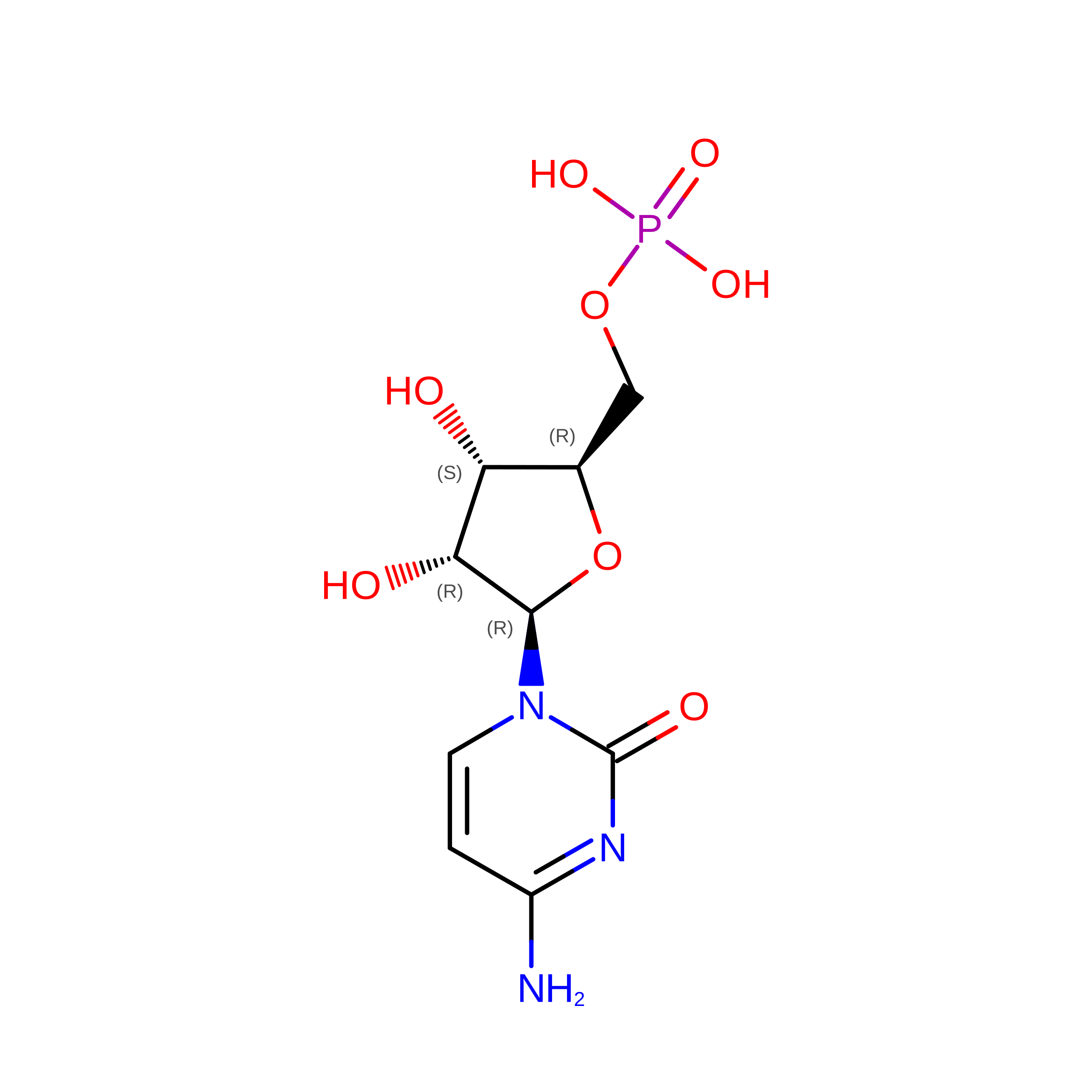
Crystal structure of IspD from Mycobacterium smegmatis in complex with CMP


Experimental Data Snapshot

  • Method: X-RAY DIFFRACTION
  • Resolution: 1.80 Å
  • R-Value Free: 
    0.215 (Depositor), 0.214 (DCC) 
  • R-Value Work: 
    0.180 (Depositor), 0.181 (DCC) 
  • R-Value Observed: 
    0.182 (Depositor) 

wwPDB Validation 3D Report Full Report

Validation slider image for 2XWM

Ligand Structure Quality Assessment 


This is version 1.4 of the entry. See complete history

Literature

Structural and Functional Studies on Mycobacterial Ispd Enzymes

Bjorkelid, C.Bergfors, T.Henriksson, L.M.Stern, A.L.Unge, T.Mowbray, S.L.Jones, T.A.

(2011) Acta Crystallogr D Biol Crystallogr 67: 403

  • DOI: https://doi.org/10.1107/S0907444911006160
  • Primary Citation Related Structures: 
    2XWL, 2XWM, 2XWN

  • PubMed Abstract: 

    A number of pathogens, including the causative agents of tuberculosis and malaria, synthesize isopentenyl diphosphate via the 2-C-methyl-D-erythritol 4-phosphate (MEP) pathway rather than the classical mevalonate pathway found in humans. As part of a structure-based drug-discovery program against tuberculosis, IspD, the enzyme that carries out the third step in the MEP pathway, was targeted. Constructs of both the Mycobacterium smegmatis and the Mycobacterium tuberculosis enzymes that were suitable for structural and inhibitor-screening studies were engineered. Two crystal structures of the M. smegmatis enzyme were produced, one in complex with CTP and the other in complex with CMP. In addition, the M. tuberculosis enzyme was crystallized in complex with CTP. Here, the structure determination and crystallographic refinement of these crystal forms and the enzymatic characterization of the M. tuberculosis enzyme construct are reported. A comparison with known IspD structures allowed the definition of the structurally conserved core of the enzyme. It indicates potential flexibility in the enzyme and in particular in areas close to the active site. These well behaved constructs provide tools for future target-based screening of potential inhibitors. The conserved nature of the extended active site suggests that any new inhibitor will potentially exhibit broad-spectrum activity.


  • Organizational Affiliation
    • Department of Cell and Molecular Biology, Uppsala University, Biomedical Center, Box 596, SE-75124 Uppsala, Sweden.

Macromolecule Content 

  • Total Structure Weight: 45.98 kDa 
  • Atom Count: 3,479 
  • Modeled Residue Count: 442 
  • Deposited Residue Count: 446 
  • Unique protein chains: 1

Macromolecules

Find similar proteins by:|  3D Structure
Entity ID: 1
MoleculeChains  Sequence LengthOrganismDetailsImage
2-C-METHYL-D-ERYTHRITOL 4-PHOSPHATE CYTIDYLYLTRANSFERASE
A, B
223Mycolicibacterium smegmatis MC2 155Mutation(s): 0 
EC: 2.7.7.60
UniProt
Find proteins for A0R560 (Mycolicibacterium smegmatis (strain ATCC 700084 / mc(2)155))
Explore A0R560 
Go to UniProtKB:  A0R560
Entity Groups
Sequence Clusters30% Identity50% Identity70% Identity90% Identity95% Identity100% Identity
UniProt GroupA0R560
Sequence Annotations
Expand
Reference Sequence

Experimental Data & Validation

Experimental Data

  • Method: X-RAY DIFFRACTION
  • Resolution: 1.80 Å
  • R-Value Free:  0.215 (Depositor), 0.214 (DCC) 
  • R-Value Work:  0.180 (Depositor), 0.181 (DCC) 
  • R-Value Observed: 0.182 (Depositor) 
Space Group: P 21 21 21
Unit Cell:
Length ( Å )Angle ( ˚ )
a = 45.59α = 90
b = 71.7β = 90
c = 111.89γ = 90
Software Package:
Software NamePurpose
REFMACrefinement
MOSFLMdata reduction
SCALAdata scaling
PHASERphasing

Structure Validation

View Full Validation Report


Ligand Structure Quality Assessment 


Entry History 

Deposition Data

Revision History  (Full details and data files)

  • Version 1.0: 2011-04-27
    Type: Initial release
  • Version 1.1: 2012-02-01
    Changes: Database references, Version format compliance
  • Version 1.2: 2019-03-06
    Changes: Data collection, Experimental preparation, Other
  • Version 1.3: 2019-05-15
    Changes: Data collection, Experimental preparation
  • Version 1.4: 2024-05-08
    Changes: Data collection, Database references, Derived calculations, Other