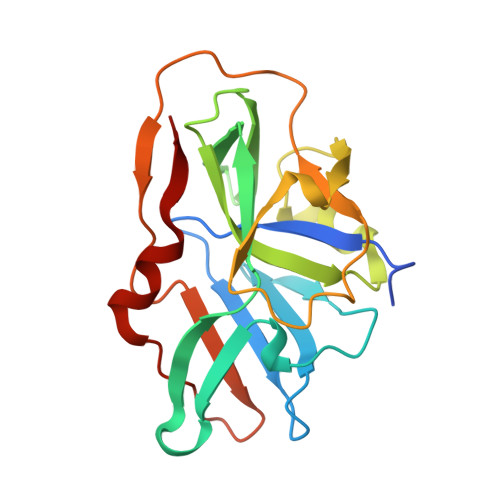
2XVO | pdb_00002xvo

SSO1725, a protein involved in the CRISPR/Cas pathway


Experimental Data Snapshot

  • Method: X-RAY DIFFRACTION
  • Resolution: 2.08 Å
  • R-Value Free: 
    0.231 (Depositor), 0.238 (DCC) 
  • R-Value Work: 
    0.199 (Depositor), 0.208 (DCC) 
  • R-Value Observed: 
    0.201 (Depositor) 

wwPDB Validation 3D Report Full Report

Validation slider image for 2XVO

This is version 1.3 of the entry. See complete history

Literature

Structure and Mechanism of the Cmr Complex for Crispr-Mediated Antiviral Immunity.

Zhang, J.Rouillon, C.Kerou, M.Reeks, J.Brugger, K.Graham, S.Reimann, J.Cannone, G.Liu, H.Albers, S.Naismith, J.H.Spagnolo, L.White, M.F.

(2012) Mol Cell 45: 303

  • DOI: https://doi.org/10.1016/j.molcel.2011.12.013
  • Primary Citation Related Structures: 
    2XVO

  • PubMed Abstract: 

    The prokaryotic clusters of regularly interspaced palindromic repeats (CRISPR) system utilizes genomically encoded CRISPR RNA (crRNA), derived from invading viruses and incorporated into ribonucleoprotein complexes with CRISPR-associated (CAS) proteins, to target and degrade viral DNA or RNA on subsequent infection. RNA is targeted by the CMR complex. In Sulfolobus solfataricus, this complex is composed of seven CAS protein subunits (Cmr1-7) and carries a diverse "payload" of targeting crRNA. The crystal structure of Cmr7 and low-resolution structure of the complex are presented. S. solfataricus CMR cleaves RNA targets in an endonucleolytic reaction at UA dinucleotides. This activity is dependent on the 8 nt repeat-derived 5' sequence in the crRNA, but not on the presence of a protospacer-associated motif (PAM) in the target. Both target and guide RNAs can be cleaved, although a single molecule of guide RNA can support the degradation of multiple targets.


  • Organizational Affiliation
    • Biomedical Sciences Research Complex, University of St Andrews, Fife KY16 9ST, UK.

Macromolecule Content 

  • Total Structure Weight: 86.68 kDa 
  • Atom Count: 5,980 
  • Modeled Residue Count: 724 
  • Deposited Residue Count: 768 
  • Unique protein chains: 1

Macromolecules

Find similar proteins by:|  3D Structure
Entity ID: 1
MoleculeChains  Sequence LengthOrganismDetailsImage
SSO1725
A, B, C, D
192Saccharolobus solfataricusMutation(s): 0 
UniProt
Find proteins for Q97XK8 (Saccharolobus solfataricus (strain ATCC 35092 / DSM 1617 / JCM 11322 / P2))
Explore Q97XK8 
Go to UniProtKB:  Q97XK8
Entity Groups
Sequence Clusters30% Identity50% Identity70% Identity90% Identity95% Identity100% Identity
UniProt GroupQ97XK8
Sequence Annotations
Expand
Reference Sequence

Experimental Data & Validation

Experimental Data

  • Method: X-RAY DIFFRACTION
  • Resolution: 2.08 Å
  • R-Value Free:  0.231 (Depositor), 0.238 (DCC) 
  • R-Value Work:  0.199 (Depositor), 0.208 (DCC) 
  • R-Value Observed: 0.201 (Depositor) 
Space Group: P 21 21 21
Unit Cell:
Length ( Å )Angle ( ˚ )
a = 77.75α = 90
b = 90.29β = 90
c = 111.65γ = 90
Software Package:
Software NamePurpose
REFMACrefinement
xia2data reduction
xia2data scaling

Structure Validation

View Full Validation Report


Entry History 

Deposition Data

Revision History  (Full details and data files)

  • Version 1.0: 2010-12-29
    Type: Initial release
  • Version 1.1: 2012-10-03
    Changes: Derived calculations, Version format compliance
  • Version 1.2: 2014-02-05
    Changes: Database references, Source and taxonomy
  • Version 1.3: 2025-04-09
    Changes: Data collection, Database references, Derived calculations, Other, Structure summary