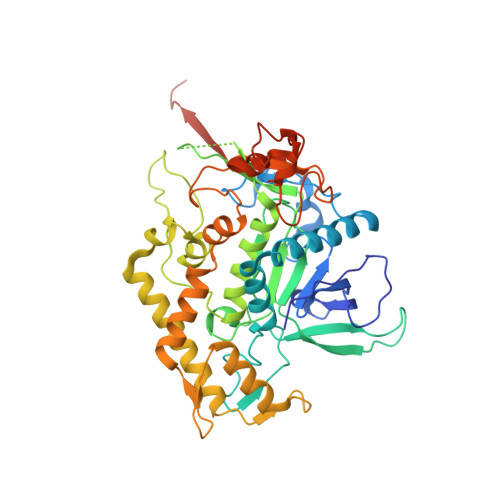
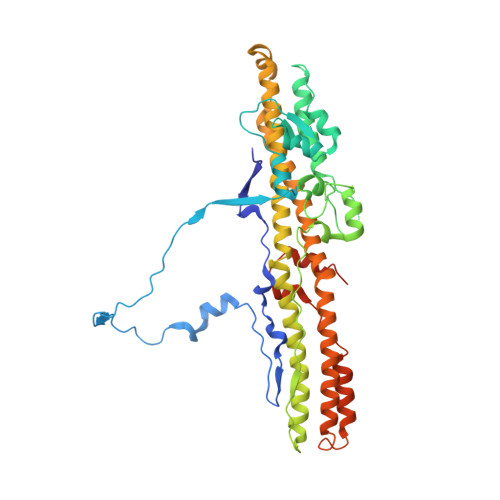
2XHL | pdb_00002xhl

Structure of a functional derivative of Clostridium botulinum neurotoxin type B


Experimental Data Snapshot

  • Method: X-RAY DIFFRACTION
  • Resolution: 2.80 Å
  • R-Value Free: 
    0.282 (Depositor), 0.245 (DCC) 
  • R-Value Work: 
    0.240 (Depositor), 0.231 (DCC) 
  • R-Value Observed: 
    0.242 (Depositor) 

Starting Model: experimental
View more details

wwPDB Validation 3D Report Full Report

Validation slider image for 2XHL

This is version 2.1 of the entry. See complete history

Literature

Structure and Activity of a Functional Derivative of Clostridium Botulinum Neurotoxin B.

Masuyer, G.Beard, M.Cadd, V.A.Chaddock, J.A.Acharya, K.R.

(2011) J Struct Biol 174: 52

  • DOI: https://doi.org/10.1016/j.jsb.2010.11.010
  • Primary Citation Related Structures: 
    2XHL

  • PubMed Abstract: 

    Botulinum neurotoxins (BoNTs) cause flaccid paralysis by inhibiting neurotransmission at cholinergic nerve terminals. BoNTs consist of three essential domains for toxicity: the cell binding domain (Hc), the translocation domain (Hn) and the catalytic domain (LC). A functional derivative (LHn) of the parent neurotoxin B composed of Hn and LC domains was recombinantly produced and characterised. LHn/B crystallographic structure at 2.8Å resolution is reported. The catalytic activity of LHn/B towards recombinant human VAMP was analysed by substrate cleavage assay and showed a higher specificity for VAMP-1, -2 compared to VAMP-3. LHn/B also showed measurable activity in living spinal cord neurons. Despite lacking the Hc (cell-targeting) domain, LHn/B retained the capacity to internalize and cleave intracellular VAMP-1 and -2 when added to the cells at high concentration. These activities of the LHn/B fragment demonstrate the utility of engineered botulinum neurotoxin fragments as analytical tools to study the mechanisms of action of BoNT neurotoxins and of SNARE proteins.


  • Organizational Affiliation
    • Department of Biology and Biochemistry, University of Bath, Claverton Down, Bath BA2 7AY, United Kingdom.

Macromolecule Content 

  • Total Structure Weight: 102.12 kDa 
  • Atom Count: 6,860 
  • Modeled Residue Count: 840 
  • Deposited Residue Count: 886 
  • Unique protein chains: 2

Macromolecules

Find similar proteins by:|  3D Structure
Entity ID: 1
MoleculeChains  Sequence LengthOrganismDetailsImage
BOTULINUM NEUROTOXIN B LIGHT CHAIN453Clostridium botulinumMutation(s): 0 
EC: 3.4.24.69
UniProt
Find proteins for P10844 (Clostridium botulinum)
Explore P10844 
Go to UniProtKB:  P10844
Entity Groups
Sequence Clusters30% Identity50% Identity70% Identity90% Identity95% Identity100% Identity
UniProt GroupP10844
Sequence Annotations
Expand
Reference Sequence
Find similar proteins by:|  3D Structure
Entity ID: 2
MoleculeChains  Sequence LengthOrganismDetailsImage
BOTULINUM NEUROTOXIN B HEAVY CHAIN433Clostridium botulinumMutation(s): 0 
UniProt
Find proteins for P10844 (Clostridium botulinum)
Explore P10844 
Go to UniProtKB:  P10844
Entity Groups
Sequence Clusters30% Identity50% Identity70% Identity90% Identity95% Identity100% Identity
UniProt GroupP10844
Sequence Annotations
Expand
Reference Sequence

Small Molecules

Ligands 1 Unique
IDChains Name / Formula / InChI Key2D Diagram3D Interactions
ZN

Query on ZN


Download:Ideal Coordinates CCD File
C [auth A]ZINC ION
Zn
PTFCDOFLOPIGGS-UHFFFAOYSA-N

Experimental Data & Validation

Experimental Data

  • Method: X-RAY DIFFRACTION
  • Resolution: 2.80 Å
  • R-Value Free:  0.282 (Depositor), 0.245 (DCC) 
  • R-Value Work:  0.240 (Depositor), 0.231 (DCC) 
  • R-Value Observed: 0.242 (Depositor) 
Space Group: P 21 21 2
Unit Cell:
Length ( Å )Angle ( ˚ )
a = 66.89α = 90
b = 149.1β = 90
c = 113.49γ = 90
Software Package:
Software NamePurpose
REFMACrefinement
MOSFLMdata reduction
SCALAdata scaling
PHASERphasing

Structure Validation

View Full Validation Report


Entry History 

Deposition Data

Revision History  (Full details and data files)

  • Version 1.0: 2010-12-01
    Type: Initial release
  • Version 1.1: 2011-06-30
    Changes: Version format compliance
  • Version 1.2: 2011-07-13
    Changes: Version format compliance
  • Version 1.3: 2023-12-20
    Changes: Data collection, Database references, Derived calculations, Other, Refinement description
  • Version 2.0: 2024-01-31
    Changes: Atomic model
  • Version 2.1: 2024-10-23
    Changes: Structure summary