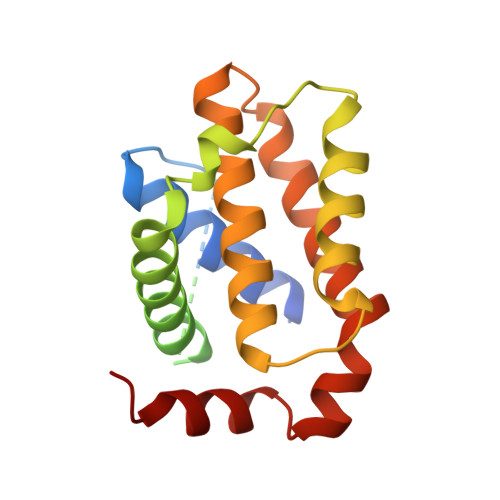
2XA0 | pdb_00002xa0

Crystal structure of BCL-2 in complex with a BAX BH3 peptide


Experimental Data Snapshot

  • Method: X-RAY DIFFRACTION
  • Resolution: 2.70 Å
  • R-Value Free: 
    0.242 (Depositor) 
  • R-Value Work: 
    0.222 (Depositor), 0.221 (DCC) 
  • R-Value Observed: 
    0.222 (Depositor) 

Starting Model: experimental
View more details

wwPDB Validation 3D Report Full Report

Validation slider image for 2XA0

This is version 1.3 of the entry. See complete history

Literature

Evidence that Inhibition of Bax Activation by Bcl- 2 Involves its Tight and Preferential Interaction with the Bh3 Domain of Bax.

Ku, B.Liang, C.Jung, J.U.Oh, B.H.

(2011) Cell Res 21: 627

  • DOI: https://doi.org/10.1038/cr.2010.149
  • Primary Citation Related Structures: 
    2XA0

  • PubMed Abstract: 

    Interactions between the BCL-2 family proteins determine the cell's fate to live or die. How they interact with each other to regulate apoptosis remains as an unsettled central issue. So far, the antiapoptotic BCL-2 proteins are thought to interact with BAX weakly, but the physiological significance of this interaction has been vague. Herein, we show that recombinant BCL-2 and BCL-w interact potently with a BCL-2 homology (BH) 3 domain-containing peptide derived from BAX, exhibiting the dissociation constants of 15 and 23 nM, respectively. To clarify the basis for this strong interaction, we determined the three-dimensional structure of a complex of BCL-2 with a BAX peptide spanning its BH3 domain. It revealed that their interactions extended beyond the canonical BH3 domain and involved three nonconserved charged residues of BAX. A novel BAX variant, containing the alanine substitution of these three residues, had greatly impaired affinity for BCL-2 and BCL-w, but was otherwise indistinguishable from wild-type BAX. Critically, the apoptotic activity of the BAX variant could not be restrained by BCL-2 and BCL-w, pointing that the observed tight interactions are critical for regulating BAX activation. We also comprehensively quantified the binding affinities between the three BCL-2 subfamily proteins. Collectively, the data show that due to the high affinity of BAX for BCL-2, BCL-w and A1, and of BAK for BCL-X(L), MCL-1 and A1, only a subset of BH3-only proteins, commonly including BIM, BID and PUMA, could be expected to free BAX or BAK from the antiapoptotic BCL-2 proteins to elicit apoptosis.


  • Organizational Affiliation
    • Department of Biological Sciences, KAIST Institute for the Biocentury, Daejeon, Korea.

Macromolecule Content 

  • Total Structure Weight: 52.87 kDa 
  • Atom Count: 2,733 
  • Modeled Residue Count: 326 
  • Deposited Residue Count: 476 
  • Unique protein chains: 2

Macromolecules

Find similar proteins by:|  3D Structure
Entity ID: 1
MoleculeChains  Sequence LengthOrganismDetailsImage
APOPTOSIS REGULATOR BCL-2
A, B
207Homo sapiensMutation(s): 0 
UniProt & NIH Common Fund Data Resources
Find proteins for P10415 (Homo sapiens)
Explore P10415 
Go to UniProtKB:  P10415
PHAROS:  P10415
GTEx:  ENSG00000171791 
Entity Groups
Sequence Clusters30% Identity50% Identity70% Identity90% Identity95% Identity100% Identity
UniProt GroupP10415
Sequence Annotations
Expand
Reference Sequence
Find similar proteins by:|  3D Structure
Entity ID: 2
MoleculeChains  Sequence LengthOrganismDetailsImage
APOPTOSIS REGULATOR BAX
C, D
31Mus musculusMutation(s): 0 
UniProt
Find proteins for Q07813 (Mus musculus)
Explore Q07813 
Go to UniProtKB:  Q07813
Entity Groups
Sequence Clusters30% Identity50% Identity70% Identity90% Identity95% Identity100% Identity
UniProt GroupQ07813
Sequence Annotations
Expand
Reference Sequence

Experimental Data & Validation

Experimental Data

  • Method: X-RAY DIFFRACTION
  • Resolution: 2.70 Å
  • R-Value Free:  0.242 (Depositor) 
  • R-Value Work:  0.222 (Depositor), 0.221 (DCC) 
  • R-Value Observed: 0.222 (Depositor) 
Space Group: P 31 2 1
Unit Cell:
Length ( Å )Angle ( ˚ )
a = 81.973α = 90
b = 81.973β = 90
c = 138.85γ = 120
Software Package:
Software NamePurpose
CNSrefinement

Structure Validation

View Full Validation Report


Entry History 

Deposition Data

Revision History  (Full details and data files)

  • Version 1.0: 2010-11-24
    Type: Initial release
  • Version 1.1: 2011-05-26
    Changes: Version format compliance
  • Version 1.2: 2011-07-13
    Changes: Version format compliance
  • Version 1.3: 2023-12-20
    Changes: Data collection, Database references, Other, Refinement description