Download Mendeley
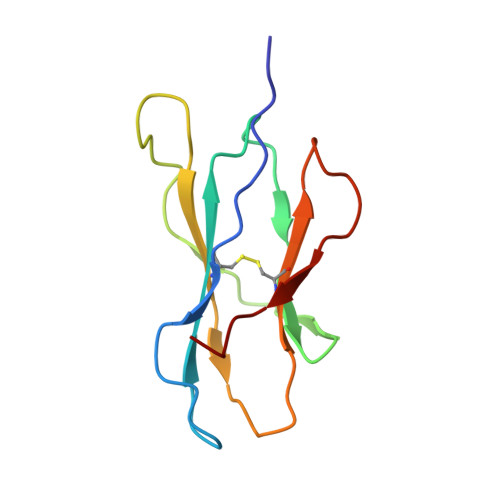
The Controlling Roles of Trp60 and Trp95 in Beta2-Microglobulin Function, Folding and Amyloid Aggregation Properties.
Esposito, G., Ricagno, S., Corazza, A., Rennella, E., Gumral, D., Mimmi, M.C., Betto, E., Pucillo, C.E.M., Fogolari, F., Viglino, P., Raimondi, S., Giorgetti, S., Bolognesi, B., Merlini, G., Stoppini, M., Bolognesi, M., Bellotti, V.(2008) J Mol Biol 378: 885
- PubMed: 18395224 Search on PubMed
- DOI: https://doi.org/10.1016/j.jmb.2008.03.002
- Primary Citation Related Structures:
2VB5, 2Z9T - PubMed Abstract:
Amyloidosis associated to hemodialysis is caused by persistently high beta(2)-microglobulin (beta(2)m) serum levels. beta(2)m is an intrinsically amyloidogenic protein whose capacity to assemble into amyloid fibrils in vitro and in vivo is concentration dependent; no beta(2)m genetic variant is known in the human population. We investigated the roles of two evolutionary conserved Trp residues in relation to beta(2)m structure, function and folding/misfolding by means of a combined biophysical and functional approach. We show that Trp60 plays a functional role in promoting the association of beta(2)m in class I major histocompatibility complex; it is exposed to the solvent at the apex of a protein loop in order to accomplish such function. The Trp60-->Gly mutation has a threefold effect: it stabilizes beta(2)m, inhibits beta(2)m amyloidogenic propensity and weakens the interaction with the class I major histocompatibility complex heavy chain. On the contrary, Trp95 is buried in the beta(2)m core; the Trp95-->Gly mutation destabilizes the protein, which is unfolded in solution, yielding nonfibrillar beta(2)m aggregates. Trp60 and Trp95 therefore play differential and complementary roles in beta(2)m, being relevant for function (Trp60) and for maintenance of a properly folded structure (Trp95) while affecting in distinct ways the intrinsic propensity of wild-type beta(2)m towards self-aggregation into amyloid fibrils.
- Department of Biomedical Science and Technology, University of Udine, Piazzale Kolbe 4, 33100 Udine, Italy.
Organizational Affiliation: