2Q3E | pdb_00002q3e

Structure of human UDP-glucose dehydrogenase complexed with NADH and UDP-glucose


Experimental Data Snapshot

  • Method: X-RAY DIFFRACTION
  • Resolution: 2.00 Å
  • R-Value Free: 
    0.205 (Depositor), 0.209 (DCC) 
  • R-Value Work: 
    0.172 (Depositor), 0.176 (DCC) 
  • R-Value Observed: 
    0.173 (Depositor) 

Starting Model: experimental
View more details

wwPDB Validation 3D Report Full Report

Validation slider image for 2Q3E

Ligand Structure Quality Assessment 


This is version 1.7 of the entry. See complete history

Literature

Structure and mechanism of human UDP-glucose 6-dehydrogenase.

Egger, S.Chaikuad, A.Kavanagh, K.L.Oppermann, U.Nidetzky, B.

(2011) J Biological Chem 286: 23877-23887

  • DOI: https://doi.org/10.1074/jbc.M111.234682
  • Primary Citation Related Structures: 
    2Q3E, 2QG4, 3ITK

  • PubMed Abstract: 

    Elevated production of the matrix glycosaminoglycan hyaluronan is strongly implicated in epithelial tumor progression. Inhibition of synthesis of the hyaluronan precursor UDP-glucuronic acid (UDP-GlcUA) therefore presents an emerging target for cancer therapy. Human UDP-glucose 6-dehydrogenase (hUGDH) catalyzes, in two NAD(+)-dependent steps without release of intermediate aldehyde, the biosynthetic oxidation of UDP-glucose (UDP-Glc) to UDP-GlcUA. Here, we present a structural characterization of the hUGDH reaction coordinate using crystal structures of the apoenzyme and ternary complexes of the enzyme bound with UDP-Glc/NADH and UDP-GlcUA/NAD(+). The quaternary structure of hUGDH is a disc-shaped trimer of homodimers whose subunits consist of two discrete α/β domains with the active site located in the interdomain cleft. Ternary complex formation is accompanied by rigid-body and restrained movement of the N-terminal NAD(+) binding domain, sequestering substrate and coenzyme in their reactive positions through interdomain closure. By alternating between conformations in and out of the active site during domain motion, Tyr(14), Glu(161), and Glu(165) participate in control of coenzyme binding and release during 2-fold oxidation. The proposed mechanism of hUGDH involves formation and breakdown of thiohemiacetal and thioester intermediates whereby Cys(276) functions as the catalytic nucleophile. Stopped-flow kinetic data capture the essential deprotonation of Cys(276) in the course of the first oxidation step, allowing the thiolate side chain to act as a trap of the incipient aldehyde. Because thiohemiacetal intermediate accumulates at steady state under physiological reaction conditions, hUGDH inhibition might best explore ligand binding to the NAD(+) binding domain.


  • Organizational Affiliation
    • Institute of Biotechnology and Biochemical Engineering, Graz University of Technology, Petersgasse 12/1, A-8010 Graz, Austria.

Macromolecule Content 

  • Total Structure Weight: 640.21 kDa 
  • Atom Count: 46,652 
  • Modeled Residue Count: 5,516 
  • Deposited Residue Count: 5,604 
  • Unique protein chains: 1

Macromolecules

Find similar proteins by:|  3D Structure
Entity ID: 1
MoleculeChains  Sequence LengthOrganismDetailsImage
UDP-glucose 6-dehydrogenase
A, B, C, D, E
A, B, C, D, E, F, G, H, I, J, K, L
467Homo sapiensMutation(s): 0 
Gene Names: UGDH
EC: 1.1.1.22
UniProt & NIH Common Fund Data Resources
Find proteins for O60701 (Homo sapiens)
Explore O60701 
Go to UniProtKB:  O60701
PHAROS:  O60701
GTEx:  ENSG00000109814 
Entity Groups
Sequence Clusters30% Identity50% Identity70% Identity90% Identity95% Identity100% Identity
UniProt GroupO60701
Sequence Annotations
Expand
Reference Sequence

Small Molecules

Ligands 3 Unique
IDChains Name / Formula / InChI Key2D Diagram3D Interactions
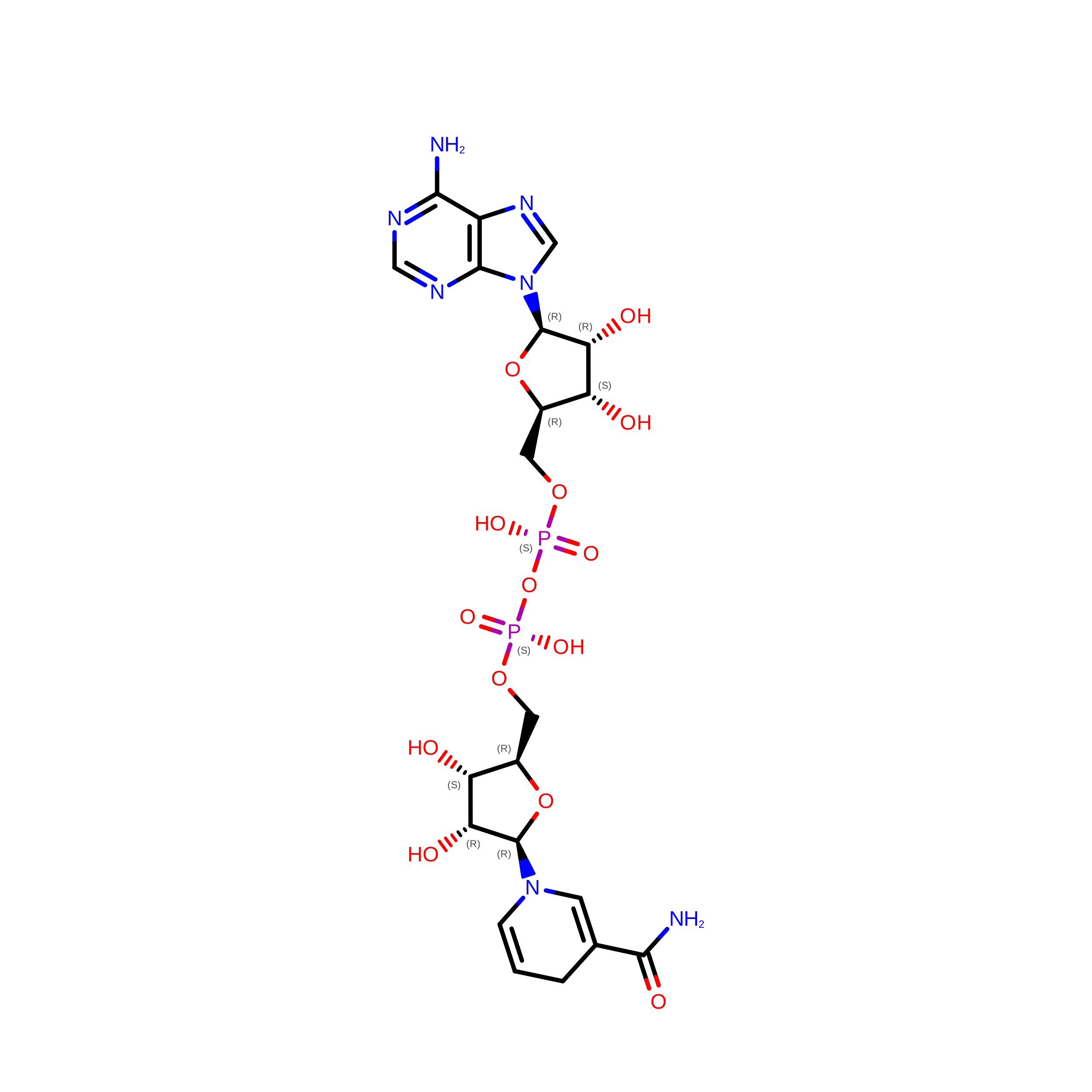
NAI

Query on NAI


Download:Ideal Coordinates CCD File
CA [auth F]
FA [auth G]
IA [auth H]
LA [auth I]
N [auth A]
CA [auth F],
FA [auth G],
IA [auth H],
LA [auth I],
N [auth A],
OA [auth J],
Q [auth B],
RA [auth K],
T [auth C],
UA [auth L],
W [auth D],
Z [auth E]
1,4-DIHYDRONICOTINAMIDE ADENINE DINUCLEOTIDE
C21 H29 N7 O14 P2
BOPGDPNILDQYTO-NNYOXOHSSA-N
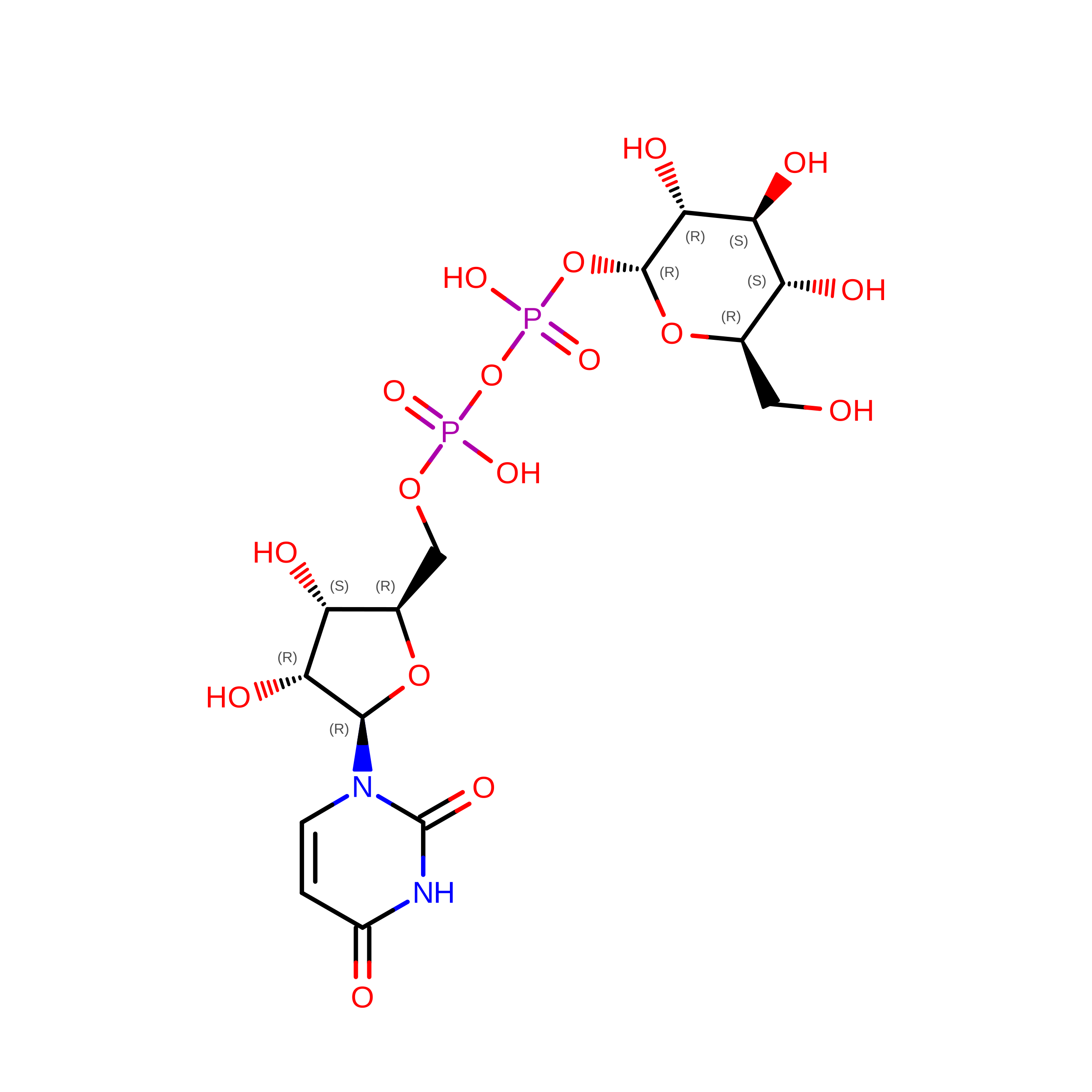
UPG

Query on UPG


Download:Ideal Coordinates CCD File
AA [auth E]
DA [auth F]
GA [auth G]
JA [auth H]
MA [auth I]
AA [auth E],
DA [auth F],
GA [auth G],
JA [auth H],
MA [auth I],
O [auth A],
PA [auth J],
R [auth B],
SA [auth K],
U [auth C],
VA [auth L],
X [auth D]
URIDINE-5'-DIPHOSPHATE-GLUCOSE
C15 H24 N2 O17 P2
HSCJRCZFDFQWRP-JZMIEXBBSA-N
CL

Query on CL


Download:Ideal Coordinates CCD File
BA [auth F]
EA [auth G]
HA [auth H]
KA [auth I]
M [auth A]
BA [auth F],
EA [auth G],
HA [auth H],
KA [auth I],
M [auth A],
NA [auth J],
P [auth B],
QA [auth K],
S [auth C],
TA [auth L],
V [auth D],
Y [auth E]
CHLORIDE ION
Cl
VEXZGXHMUGYJMC-UHFFFAOYSA-M

Experimental Data & Validation

Experimental Data

  • Method: X-RAY DIFFRACTION
  • Resolution: 2.00 Å
  • R-Value Free:  0.205 (Depositor), 0.209 (DCC) 
  • R-Value Work:  0.172 (Depositor), 0.176 (DCC) 
  • R-Value Observed: 0.173 (Depositor) 
Space Group: P 1 21 1
Unit Cell:
Length ( Å )Angle ( ˚ )
a = 115.99α = 90
b = 184.132β = 109.23
c = 170.943γ = 90
Software Package:
Software NamePurpose
REFMACrefinement
MAR345data collection
MOSFLMdata reduction
SCALAdata scaling
PHASERphasing

Structure Validation

View Full Validation Report


Ligand Structure Quality Assessment 


Entry History 

Revision History  (Full details and data files)

  • Version 1.0: 2007-07-03
    Type: Initial release
  • Version 1.1: 2008-05-01
    Changes: Version format compliance
  • Version 1.2: 2011-07-13
    Changes: Advisory, Version format compliance
  • Version 1.3: 2011-08-31
    Changes: Database references
  • Version 1.4: 2013-10-30
    Changes: Non-polymer description
  • Version 1.5: 2017-10-18
    Changes: Refinement description
  • Version 1.6: 2018-01-31
    Changes: Structure summary
  • Version 1.7: 2023-08-30
    Changes: Data collection, Database references, Derived calculations, Refinement description