2OXL | pdb_00002oxl

Structure and Function of the E. coli Protein YmgB: a Protein Critical for Biofilm Formation and Acid Resistance


Experimental Data Snapshot

  • Method: X-RAY DIFFRACTION
  • Resolution: 1.80 Å
  • R-Value Free: 
    0.238 (Depositor), 0.223 (DCC) 
  • R-Value Work: 
    0.215 (Depositor) 
  • R-Value Observed: 
    0.216 (Depositor) 

wwPDB Validation 3D Report Full Report

Validation slider image for 2OXL

Ligand Structure Quality Assessment 


This is version 1.4 of the entry. See complete history

Literature

Structure and Function of the Escherichia coli Protein YmgB: A Protein Critical for Biofilm Formation and Acid-resistance.

Lee, J.Page, R.Garcia-Contreras, R.Palermino, J.M.Zhang, X.S.Doshi, O.Wood, T.K.Peti, W.

(2007) J Mol Biology 373: 11-26

  • DOI: https://doi.org/10.1016/j.jmb.2007.07.037
  • Primary Citation Related Structures: 
    2OXL

  • PubMed Abstract: 

    The Escherichia coli gene cluster ymgABC was identified in transcriptome studies to have a role in biofilm development and stability. In this study, we showed that YmgB represses biofilm formation in rich medium containing glucose, decreases cellular motility, and protects the cell from acid indicating that YmgB has a major role in acid-resistance in E. coli. Our data show that these phenotypes are potentially mediated through interactions with the important cell signal indole. In addition, gel mobility-shift assays suggest that YmgB may be a non-specific DNA-binding protein. Using nickel-enrichment DNA microarrays, we showed that YmgB binds, either directly or indirectly, via a probable ligand, genes important for biofilm formation. To advance our understanding of the function of YmgB, we used X-ray crystallography to solve the structure of the protein to 1.8 A resolution. YmgB is a biological dimer that is structurally homologous to the E. coli gene regulatory protein Hha, despite having only 5% sequence identity. This supports our DNA microarray data showing that YmgB is a gene regulatory protein. Therefore, this protein, which clearly has a critical role in acid-resistance in E. coli, has been renamed as AriR for regulator of acid resistance influenced by indole.


  • Organizational Affiliation
    • Artie McFerrin Department of Chemical Engineering, Texas A & M University, College Station, TX 77843-3122, USA.

Macromolecule Content 

  • Total Structure Weight: 14.92 kDa 
  • Atom Count: 1,037 
  • Modeled Residue Count: 124 
  • Deposited Residue Count: 128 
  • Unique protein chains: 1

Macromolecules

Find similar proteins by:|  3D Structure
Entity ID: 1
MoleculeChains  Sequence LengthOrganismDetailsImage
Hypothetical protein ymgB
A, B
64Escherichia coliMutation(s): 1 
Gene Names: ymgB
UniProt
Find proteins for P75993 (Escherichia coli (strain K12))
Explore P75993 
Go to UniProtKB:  P75993
Entity Groups
Sequence Clusters30% Identity50% Identity70% Identity90% Identity95% Identity100% Identity
UniProt GroupP75993
Sequence Annotations
Expand
Reference Sequence

Small Molecules

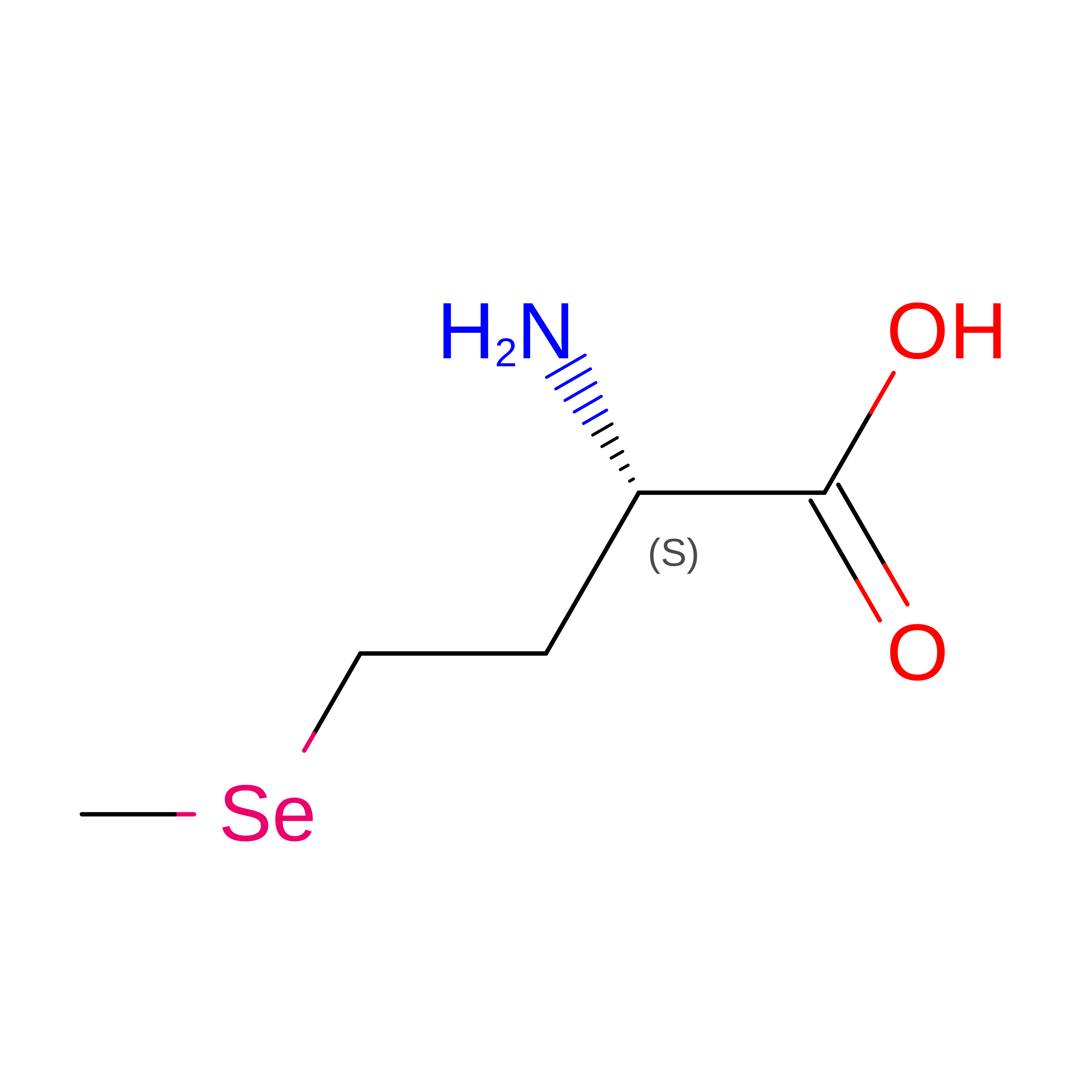
Modified Residues  1 Unique
IDChains TypeFormula2D DiagramParent
MSE
Query on MSE
A, B
L-PEPTIDE LINKINGC5 H11 N O2 SeMET

Experimental Data & Validation

Experimental Data

  • Method: X-RAY DIFFRACTION
  • Resolution: 1.80 Å
  • R-Value Free:  0.238 (Depositor), 0.223 (DCC) 
  • R-Value Work:  0.215 (Depositor) 
  • R-Value Observed: 0.216 (Depositor) 
Space Group: C 2 2 21
Unit Cell:
Length ( Å )Angle ( ˚ )
a = 69.919α = 90
b = 69.945β = 90
c = 55.021γ = 90
Software Package:
Software NamePurpose
DENZOdata reduction
SCALEPACKdata scaling
SOLVEphasing
RESOLVEphasing
REFMACrefinement
PDB_EXTRACTdata extraction
ADSCdata collection
HKL-2000data reduction
HKL-2000data scaling

Structure Validation

View Full Validation Report


Ligand Structure Quality Assessment 


Entry History 

Deposition Data

Revision History  (Full details and data files)

  • Version 1.0: 2007-10-30
    Type: Initial release
  • Version 1.1: 2011-07-13
    Changes: Advisory, Refinement description, Version format compliance
  • Version 1.2: 2017-10-18
    Changes: Refinement description
  • Version 1.3: 2020-07-29
    Type: Remediation
    Reason: Carbohydrate remediation
    Changes: Advisory, Data collection, Database references, Derived calculations, Structure summary
  • Version 1.4: 2024-10-30
    Changes: Data collection, Database references, Structure summary