2OAG | pdb_00002oag

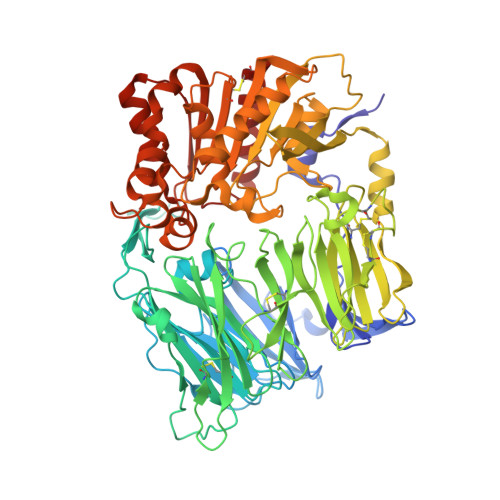
Crystal structure of human dipeptidyl peptidase IV (DPPIV) with pyrrolidine-constrained phenethylamine 29g


Experimental Data Snapshot

  • Method: X-RAY DIFFRACTION
  • Resolution: 2.30 Å
  • R-Value Free: 
    0.240 (Depositor), 0.237 (DCC) 
  • R-Value Work: 
    0.197 (Depositor), 0.196 (DCC) 

wwPDB Validation 3D Report Full Report

Validation slider image for 2OAG

Ligand Structure Quality Assessment 


This is version 1.4 of the entry. See complete history

Literature

Pyrrolidine-constrained phenethylamines: The design of potent, selective, and pharmacologically efficacious dipeptidyl peptidase IV (DPP4) inhibitors from a lead-like screening hit.

Backes, B.J.Longenecker, K.Hamilton, G.L.Stewart, K.Lai, C.Kopecka, H.von Geldern, T.W.Madar, D.J.Pei, Z.Lubben, T.H.Zinker, B.A.Tian, Z.Ballaron, S.J.Stashko, M.A.Mika, A.K.Beno, D.W.Kempf-Grote, A.J.Black-Schaefer, C.Sham, H.L.Trevillyan, J.M.

(2007) Bioorg Med Chem Lett 17: 2005-2012

  • DOI: https://doi.org/10.1016/j.bmcl.2007.01.026
  • Primary Citation Related Structures: 
    2OAE, 2OAG

  • PubMed Abstract: 

    A novel series of pyrrolidine-constrained phenethylamines were developed as dipeptidyl peptidase IV (DPP4) inhibitors for the treatment of type 2 diabetes. The cyclohexene ring of lead-like screening hit 5 was replaced with a pyrrolidine to enable parallel chemistry, and protein co-crystal structural data guided the optimization of N-substituents. Employing this strategy, a >400x improvement in potency over the initial hit was realized in rapid fashion. Optimized compounds are potent and selective inhibitors with excellent pharmacokinetic profiles. Compound 30 was efficacious in vivo, lowering blood glucose in ZDF rats that were allowed to feed freely on a mixed meal.


  • Organizational Affiliation
    • Metabolic Disease Research, Abbott Laboratories, Abbott Park Road, Abbott Park, IL 60064-6099, USA. bradley.backes@abbott.com

Macromolecule Content 

  • Total Structure Weight: 337.46 kDa 
  • Atom Count: 27,142 
  • Modeled Residue Count: 2,904 
  • Deposited Residue Count: 2,904 
  • Unique protein chains: 1

Macromolecules

Find similar proteins by:|  3D Structure
Entity ID: 1
MoleculeChains  Sequence LengthOrganismDetailsImage
Dipeptidyl peptidase 4
A, B, C, D
726Homo sapiensMutation(s): 0 
Gene Names: DPP4ADCP2CD26
EC: 3.4.14.5
UniProt & NIH Common Fund Data Resources
Find proteins for P27487 (Homo sapiens)
Explore P27487 
Go to UniProtKB:  P27487
PHAROS:  P27487
GTEx:  ENSG00000197635 
Entity Groups
Sequence Clusters30% Identity50% Identity70% Identity90% Identity95% Identity100% Identity
UniProt GroupP27487
Sequence Annotations
Expand
Reference Sequence

Small Molecules

Ligands 1 Unique
IDChains Name / Formula / InChI Key2D Diagram3D Interactions
DLI

Query on DLI


Download:Ideal Coordinates CCD File
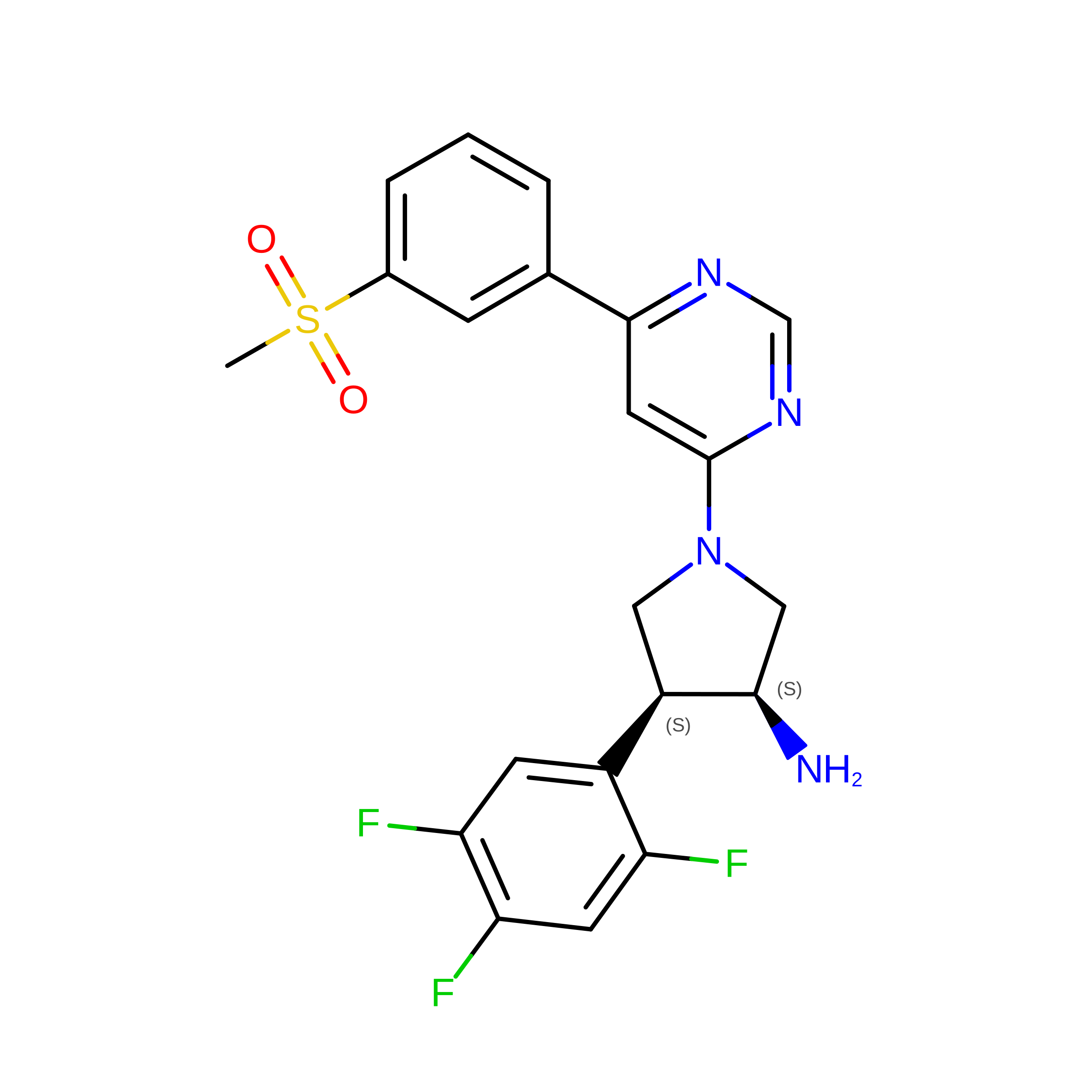
E [auth B](3R,4S)-1-{6-[3-(METHYLSULFONYL)PHENYL]PYRIMIDIN-4-YL}-4-(2,4,5-TRIFLUOROPHENYL)PYRROLIDIN-3-AMINE
C21 H19 F3 N4 O2 S
OAWGQHXWGXOUKV-BEFAXECRSA-N

Experimental Data & Validation

Experimental Data

  • Method: X-RAY DIFFRACTION
  • Resolution: 2.30 Å
  • R-Value Free:  0.240 (Depositor), 0.237 (DCC) 
  • R-Value Work:  0.197 (Depositor), 0.196 (DCC) 
Space Group: P 1 21 1
Unit Cell:
Length ( Å )Angle ( ˚ )
a = 120.006α = 90
b = 126.225β = 96.51
c = 127.563γ = 90
Software Package:
Software NamePurpose
DENZOdata reduction
SCALEPACKdata scaling
CNSrefinement
PDB_EXTRACTdata extraction
HKL-2000data collection
MOLREPphasing

Structure Validation

View Full Validation Report


Ligand Structure Quality Assessment 


Entry History 

Deposition Data

Revision History  (Full details and data files)

  • Version 1.0: 2007-09-11
    Type: Initial release
  • Version 1.1: 2011-07-13
    Changes: Atomic model, Database references, Derived calculations, Non-polymer description, Structure summary, Version format compliance
  • Version 1.2: 2017-10-18
    Changes: Refinement description
  • Version 1.3: 2023-12-27
    Changes: Data collection, Database references, Derived calculations
  • Version 1.4: 2024-11-06
    Changes: Structure summary