2NTV | pdb_00002ntv

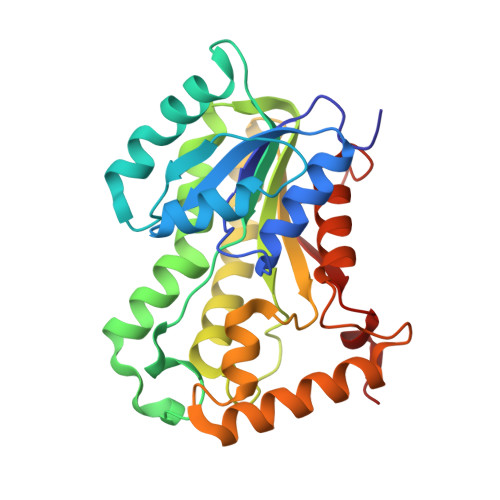
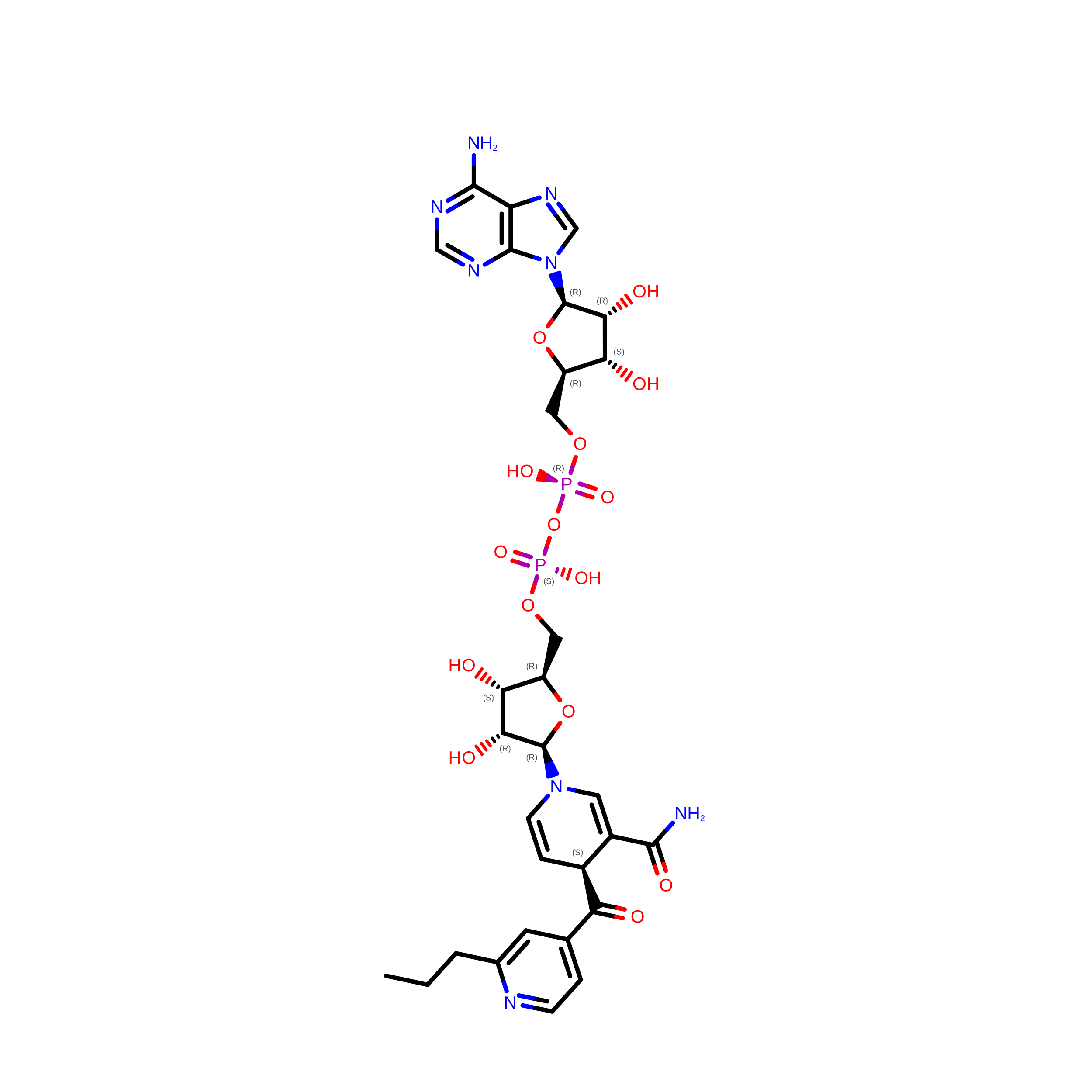
Mycobacterium leprae InhA bound with PTH-NAD adduct


Experimental Data Snapshot

  • Method: X-RAY DIFFRACTION
  • Resolution: 2.10 Å
  • R-Value Free: 
    0.244 (Depositor), 0.241 (DCC) 
  • R-Value Work: 
    0.219 (Depositor), 0.215 (DCC) 
  • R-Value Observed: 
    0.220 (Depositor) 

Starting Model: experimental
View more details

wwPDB Validation 3D Report Full Report

Validation slider image for 2NTV

Ligand Structure Quality Assessment 


This is version 1.4 of the entry. See complete history

Literature

Mechanism of thioamide drug action against tuberculosis and leprosy.

Wang, F.Langley, R.Gulten, G.Dover, L.G.Besra, G.S.Jacobs, W.R.Sacchettini, J.C.

(2007) J Exp Medicine 204: 73-78

  • DOI: https://doi.org/10.1084/jem.20062100
  • Primary Citation Related Structures: 
    2H9I, 2NTJ, 2NTV

  • PubMed Abstract: 

    Thioamide drugs, ethionamide (ETH) and prothionamide (PTH), are clinically effective in the treatment of Mycobacterium tuberculosis, M. leprae, and M. avium complex infections. Although generally considered second-line drugs for tuberculosis, their use has increased considerably as the number of multidrug resistant and extensively drug resistant tuberculosis cases continues to rise. Despite the widespread use of thioamide drugs to treat tuberculosis and leprosy, their precise mechanisms of action remain unknown. Using a cell-based activation method, we now have definitive evidence that both thioamides form covalent adducts with nicotinamide adenine dinucleotide (NAD) and that these adducts are tight-binding inhibitors of M. tuberculosis and M. leprae InhA. The crystal structures of the inhibited M. leprae and M. tuberculosis InhA complexes provide the molecular details of target-drug interactions. The purified ETH-NAD and PTH-NAD adducts both showed nanomolar Kis against M. tuberculosis and M. leprae InhA. Knowledge of the precise structures and mechanisms of action of these drugs provides insights into designing new drugs that can overcome drug resistance.


  • Organizational Affiliation
    • Department of Biochemistry and Biophysics, Texas A&M University, College Station, TX 77843, USA.

Macromolecule Content 

  • Total Structure Weight: 58.83 kDa 
  • Atom Count: 4,329 
  • Modeled Residue Count: 536 
  • Deposited Residue Count: 536 
  • Unique protein chains: 1

Macromolecules

Find similar proteins by:|  3D Structure
Entity ID: 1
MoleculeChains  Sequence LengthOrganismDetailsImage
Enoyl-[ACP] reductase
A, B
268Mycobacterium lepraeMutation(s): 0 
Gene Names: inhA
EC: 1.3.1.9
UniProt
Find proteins for Q9CBM1 (Mycobacterium leprae (strain TN))
Explore Q9CBM1 
Go to UniProtKB:  Q9CBM1
Entity Groups
Sequence Clusters30% Identity50% Identity70% Identity90% Identity95% Identity100% Identity
UniProt GroupQ9CBM1
Sequence Annotations
Expand
Reference Sequence

Small Molecules

Ligands 1 Unique
IDChains Name / Formula / InChI Key2D Diagram3D Interactions
P1H

Query on P1H


Download:Ideal Coordinates CCD File
C [auth A],
D [auth B]
{(2R,3S,4R,5R)-5-[(4S)-3-(AMINOCARBONYL)-4-(2-PROPYLISONICOTINOYL)PYRIDIN-1(4H)-YL]-3,4-DIHYDROXYTETRAHYDROFURAN-2-YL}M ETHYL [(2R,3S,4R,5R)-5-(6-AMINO-9H-PURIN-9-YL)-3,4-DIHYDROXYTETRAHYDROFURAN-2-YL]METHYL DIHYDROGEN DIPHOSPHATE
C30 H38 N8 O15 P2
INZZWAGIWIYXKO-NNTKUHMYSA-N

Experimental Data & Validation

Experimental Data

  • Method: X-RAY DIFFRACTION
  • Resolution: 2.10 Å
  • R-Value Free:  0.244 (Depositor), 0.241 (DCC) 
  • R-Value Work:  0.219 (Depositor), 0.215 (DCC) 
  • R-Value Observed: 0.220 (Depositor) 
Space Group: I 21 21 21
Unit Cell:
Length ( Å )Angle ( ˚ )
a = 91.232α = 90
b = 100.019β = 90
c = 186.622γ = 90
Software Package:
Software NamePurpose
DENZOdata reduction
SCALEPACKdata scaling
REFMACrefinement
PDB_EXTRACTdata extraction
ADSCdata collection
HKL-2000data reduction
MOLREPphasing

Structure Validation

View Full Validation Report


Ligand Structure Quality Assessment 


Entry History 

Deposition Data

Revision History  (Full details and data files)

  • Version 1.0: 2007-01-30
    Type: Initial release
  • Version 1.1: 2008-05-01
    Changes: Version format compliance
  • Version 1.2: 2011-07-13
    Changes: Derived calculations, Version format compliance
  • Version 1.3: 2017-10-18
    Changes: Refinement description
  • Version 1.4: 2023-08-30
    Changes: Data collection, Database references, Derived calculations, Refinement description, Structure summary