Download Mendeley
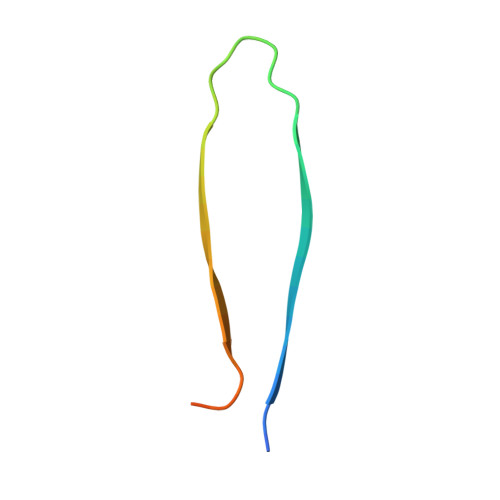
General structural motifs of amyloid protofilaments.
Ferguson, N., Becker, J., Tidow, H., Tremmel, S., Sharpe, T.D., Krause, G., Flinders, J., Petrovich, M., Berriman, J., Oschkinat, H., Fersht, A.R.(2006) Proc Natl Acad Sci U S A 103: 16248-16253
- PubMed: 17060612 Search on PubMedSearch on PubMed Central
- DOI: https://doi.org/10.1073/pnas.0607815103
- Primary Citation Related Structures:
2NNT - PubMed Abstract:
Human CA150, a transcriptional activator, binds to and is co-deposited with huntingtin during Huntington's disease. The second WW domain of CA150 is a three-stranded beta-sheet that folds in vitro in microseconds and forms amyloid fibers under physiological conditions. We found from exhaustive alanine scanning studies that fibrillation of this WW domain begins from its denatured conformations, and we identified a subset of residues critical for fibril formation. We used high-resolution magic-angle-spinning NMR studies on site-specific isotopically labeled fibrils to identify abundant long-range interactions between side chains. The distribution of critical residues identified by the alanine scanning and NMR spectroscopy, along with the electron microscopy data, revealed the protofilament repeat unit: a 26-residue non-native beta-hairpin. The structure we report has similarities to the hairpin formed by the A(beta)((1-40)) protofilament, yet also contains closely packed side-chains in a "steric zipper" arrangement found in the cross-beta spine formed from small peptides from the Sup35 prion protein. Fibrillation of unrelated amyloidogenic sequences shows the common feature of zippered repeat units that act as templates for fiber elongation.
- Medical Research Council Centre for Protein Engineering, Hills Road, Cambridge CB2 2QH, United Kingdom. nf1@mrc-lmb.cam.ac.uk
Organizational Affiliation: