Download Mendeley
Structural basis for KCNE3 modulation of potassium recycling in epithelia.
Kroncke, B.M., Van Horn, W.D., Smith, J., Kang, C., Welch, R.C., Song, Y., Nannemann, D.P., Taylor, K.C., Sisco, N.J., George, A.L., Meiler, J., Vanoye, C.G., Sanders, C.R.(2016) Sci Adv 2: e1501228-e1501228
- PubMed: 27626070 Search on PubMedSearch on PubMed Central
- DOI: https://doi.org/10.1126/sciadv.1501228
- Primary Citation Related Structures:
2NDJ - PubMed Abstract:
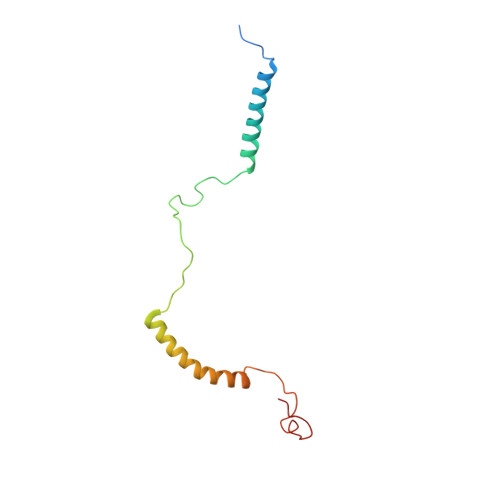
The single-span membrane protein KCNE3 modulates a variety of voltage-gated ion channels in diverse biological contexts. In epithelial cells, KCNE3 regulates the function of the KCNQ1 potassium ion (K(+)) channel to enable K(+) recycling coupled to transepithelial chloride ion (Cl(-)) secretion, a physiologically critical cellular transport process in various organs and whose malfunction causes diseases, such as cystic fibrosis (CF), cholera, and pulmonary edema. Structural, computational, biochemical, and electrophysiological studies lead to an atomically explicit integrative structural model of the KCNE3-KCNQ1 complex that explains how KCNE3 induces the constitutive activation of KCNQ1 channel activity, a crucial component in K(+) recycling. Central to this mechanism are direct interactions of KCNE3 residues at both ends of its transmembrane domain with residues on the intra- and extracellular ends of the KCNQ1 voltage-sensing domain S4 helix. These interactions appear to stabilize the activated "up" state configuration of S4, a prerequisite for full opening of the KCNQ1 channel gate. In addition, the integrative structural model was used to guide electrophysiological studies that illuminate the molecular basis for how estrogen exacerbates CF lung disease in female patients, a phenomenon known as the "CF gender gap."
- Department of Biochemistry, Vanderbilt University, Nashville, TN 37240, USA.; Center for Structural Biology, Vanderbilt University, Nashville, TN 37240, USA.
Organizational Affiliation: