Download Mendeley
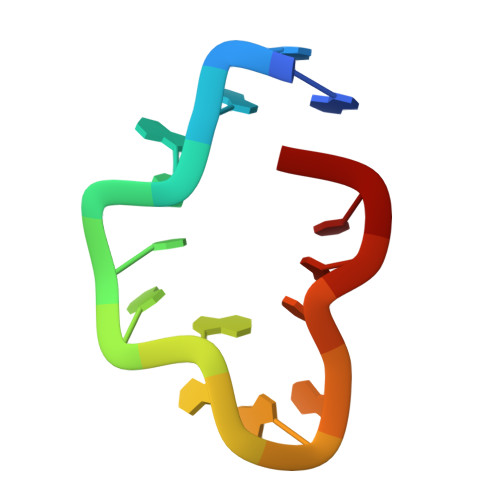
A tetrahelical DNA fold adopted by tandem repeats of alternating GGG and GCG tracts.
Kocman, V., Plavec, J.(2014) Nat Commun 5: 5831-5831
- PubMed: 25500730 Search on PubMedSearch on PubMed Central
- DOI: https://doi.org/10.1038/ncomms6831
- Primary Citation Related Structures:
2MJJ - PubMed Abstract:
DNA can form diverse higher-order structures, whose details are greatly dependent on nucleotide sequence. G-rich sequences containing four or more repeats of three guanines are expected to form G-quadruplexes. Here we show that DNA sequences with GGGAGCG repeats found in the regulatory region of the PLEKHG3 gene are capable of forming tetrahelical DNA structures that are distinct from G-quadruplexes. The d(GGGAGCGAGGGAGCG) sequence, VK1, forms a dimer. Two VK1 sequences connected by an adenine residue, VK2, fold into a monomer, which shares identical structural characteristics with the VK1 fold. Their four-stranded architectures are stabilized by four G-C, four G-A and six G-G base pairs. No G-quartets or Hoogsteen-type hydrogen-bonded guanine residues are present and the overall topology is conserved in the presence of Li(+), Na(+), K(+) and NH4(+) ions. Unique structural features include two edgewise loops on each side of the structure stabilized by three G-G base pairs in N1-carbonyl symmetric geometry.
- Slovenian NMR Centre, National Institute of Chemistry, SI-1000 Ljubljana, Slovenia.
Organizational Affiliation: