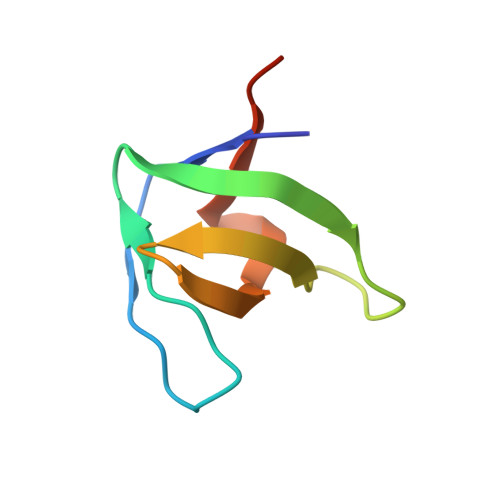
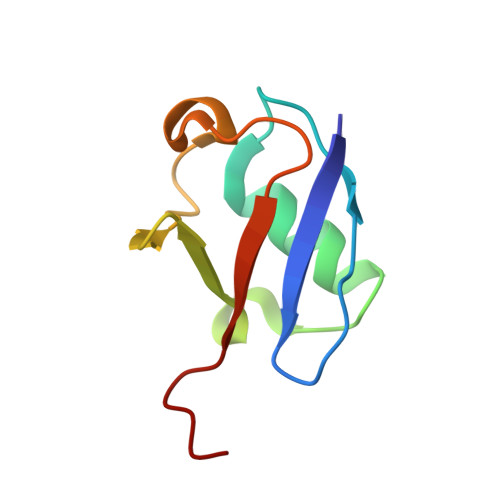
2MCN | pdb_00002mcn

Distinct ubiquitin binding modes exhibited by SH3 domains: molecular determinants and functional implications


Experimental Data Snapshot

  • Method: SOLUTION NMR
  • Conformers Calculated: 200 
  • Conformers Submitted: 10 
  • Selection Criteria: target function 

wwPDB Validation 3D Report Full Report

Validation slider image for 2MCN

This is version 1.3 of the entry. See complete history

Literature

Distinct ubiquitin binding modes exhibited by SH3 domains: molecular determinants and functional implications.

Ortega Roldan, J.L.Casares, S.Ringkjbing Jensen, M.Cardenes, N.Bravo, J.Blackledge, M.Azuaga, A.I.van Nuland, N.A.

(2013) PLoS One 8: e73018-e73018

  • DOI: https://doi.org/10.1371/journal.pone.0073018
  • Primary Citation Related Structures: 
    2LZ6, 2MCN, 2YDL

  • PubMed Abstract: 

    SH3 domains constitute a new type of ubiquitin-binding domains. We previously showed that the third SH3 domain (SH3-C) of CD2AP binds ubiquitin in an alternative orientation. We have determined the structure of the complex between first CD2AP SH3 domain and ubiquitin and performed a structural and mutational analysis to decipher the determinants of the SH3-C binding mode to ubiquitin. We found that the Phe-to-Tyr mutation in CD2AP and in the homologous CIN85 SH3-C domain does not abrogate ubiquitin binding, in contrast to previous hypothesis and our findings for the first two CD2AP SH3 domains. The similar alternative binding mode of the SH3-C domains of these related adaptor proteins is characterised by a higher affinity to C-terminal extended ubiquitin molecules. We conclude that CD2AP/CIN85 SH3-C domain interaction with ubiquitin constitutes a new ubiquitin-binding mode involved in a different cellular function and thus changes the previously established mechanism of EGF-dependent CD2AP/CIN85 mono-ubiquitination.


  • Organizational Affiliation
    • Departamento de Química Física e Instituto de Biotecnología, Facultad de Ciencias, Universidad de Granada, Granada, Spain ; Department of Biochemistry, University of Oxford, Oxford, United Kingdom.

Macromolecule Content 

  • Total Structure Weight: 15.86 kDa 
  • Atom Count: 1,078 
  • Modeled Residue Count: 133 
  • Deposited Residue Count: 137 
  • Unique protein chains: 2

Macromolecules

Find similar proteins by:|  3D Structure
Entity ID: 1
MoleculeChains  Sequence LengthOrganismDetailsImage
CD2-associated protein61Mus musculusMutation(s): 0 
Gene Names: Cd2apMets1
UniProt & NIH Common Fund Data Resources
Find proteins for Q9JLQ0 (Mus musculus)
Explore Q9JLQ0 
Go to UniProtKB:  Q9JLQ0
IMPC:  MGI:1330281
Entity Groups
Sequence Clusters30% Identity50% Identity70% Identity90% Identity95% Identity100% Identity
UniProt GroupQ9JLQ0
Sequence Annotations
Expand
Reference Sequence
Find similar proteins by:|  3D Structure
Entity ID: 2
MoleculeChains  Sequence LengthOrganismDetailsImage
Ubiquitin76Homo sapiensMutation(s): 0 
Gene Names: UBC
UniProt & NIH Common Fund Data Resources
Find proteins for P0CG48 (Homo sapiens)
Explore P0CG48 
Go to UniProtKB:  P0CG48
PHAROS:  P0CG48
GTEx:  ENSG00000150991 
Entity Groups
Sequence Clusters30% Identity50% Identity70% Identity90% Identity95% Identity100% Identity
UniProt GroupP0CG48
Sequence Annotations
Expand
Reference Sequence

Experimental Data & Validation

Experimental Data

  • Method: SOLUTION NMR
  • Conformers Calculated: 200 
  • Conformers Submitted: 10 
  • Selection Criteria: target function 

Structure Validation

View Full Validation Report


Entry History 

Deposition Data

Revision History  (Full details and data files)

  • Version 1.0: 2014-02-05
    Type: Initial release
  • Version 1.1: 2016-04-27
    Changes: Structure summary
  • Version 1.2: 2023-06-14
    Changes: Data collection, Database references, Other
  • Version 1.3: 2024-05-15
    Changes: Data collection, Database references