Download Mendeley
The contribution of entropy, enthalpy, and hydrophobic desolvation to cooperativity in repeat-protein folding.
Aksel, T., Majumdar, A., Barrick, D.(2011) Structure 19: 349-360
- PubMed: 21397186 Search on PubMedSearch on PubMed Central
- DOI: https://doi.org/10.1016/j.str.2010.12.018
- Primary Citation Related Structures:
2L6B - PubMed Abstract:
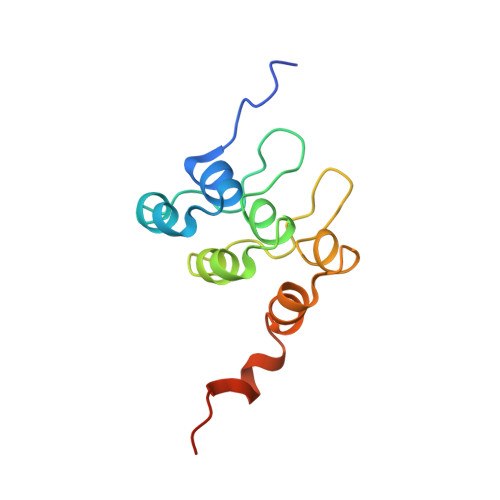
Cooperativity is a defining feature of protein folding, but its thermodynamic and structural origins are not completely understood. By constructing consensus ankyrin repeat protein arrays that have nearly identical sequences, we quantify cooperativity by resolving stability into intrinsic and interfacial components. Heteronuclear NMR and CD spectroscopy show that these constructs adopt ankyrin repeat structures. Applying a one-dimensional Ising model to a series of constructs chosen to maximize information content in unfolding transitions, we quantify stabilities of the terminal capping repeats, and resolve the effects of denaturant into intrinsic and interfacial components. Reversible thermal denaturation resolves interfacial and intrinsic free energies into enthalpic, entropic, and heat capacity terms. Intrinsic folding is entropically disfavored, whereas interfacial interaction is entropically favored and attends a decrease in heat capacity. These results suggest that helix formation and backbone ordering occurs upon intrinsic folding, whereas hydrophobic desolvation occurs upon interfacial interaction, contributing to cooperativity.
- Institute for Multiscale Modeling of Biomolecular Interactions, Johns Hopkins University, Baltimore, MD 21218, USA.
Organizational Affiliation: