Download Mendeley
A natively unfolded beta gamma-crystallin domain from Hahella chejuensis.
Srivastava, A.K., Sharma, Y., Chary, K.V.(2010) Biochemistry 49: 9746-9755
- PubMed: 20929244 Search on PubMed
- DOI: https://doi.org/10.1021/bi101000m
- Primary Citation Related Structures:
2KP5 - PubMed Abstract:
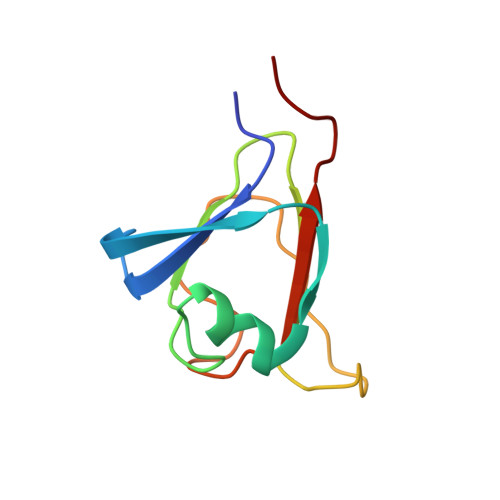
To date, very few βγ-crystallins have been identified and structurally characterized. Several of them have been shown to bind Ca(2+) and thereby enhance their stability without any significant change in structure. Although Ca(2+)-induced conformational changes have been reported in two putative βγ-crystallins from Caulobacter crescentus and Yersinia pestis, they are shown to be partially unstructured, and whether they acquire a βγ-crystallin fold is not known. We describe here a βγ-crystallin domain, hahellin, its Ca(2+) binding properties and NMR structure. Unlike any other βγ-crystallin, hahellin is characterized as a pre-molten globule (PMG) type of natively unfolded protein domain. It undergoes drastic conformational change and acquires a typical βγ-crystallin fold upon Ca(2+) binding and hence acts as a Ca(2+)-regulated conformational switch. However, it does not bind Mg(2+). The intrinsically disordered Ca(2+)-free state and the close structural similarity of Ca(2+)-bound hahellin to a microbial βγ-crystallin homologue, Protein S, which shows Ca(2+)-dependent stress response, make it a potential candidate for the cellular functions. This study indicates the presence of a new class of natively unfolded βγ-crystallins and therefore the commencement of the possible functional roles of such proteins in this superfamily.
- Department of Chemical Sciences, Tata Institute of Fundamental Research, Mumbai 400005, India.
Organizational Affiliation: