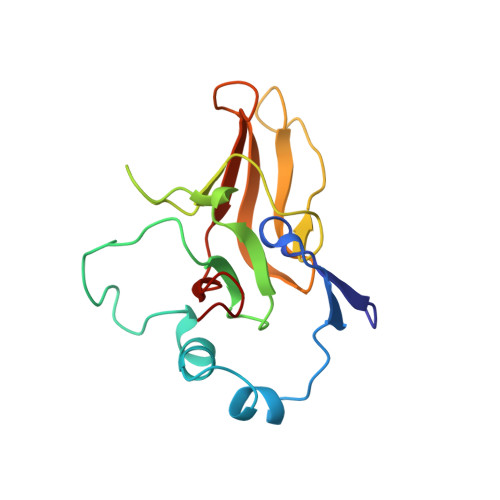
2K8D | pdb_00002k8d

Solution structure of a zinc-binding methionine sulfoxide reductase


Experimental Data Snapshot

  • Method: SOLUTION NMR
  • Conformers Calculated: 100 
  • Conformers Submitted: 20 
  • Selection Criteria: target function 

wwPDB Validation 3D Report Full Report

Validation slider image for 2K8D

This is version 1.3 of the entry. See complete history

Literature

Structure-function relationship in an archaebacterial methionine sulphoxide reductase B.

Carella, M.Becher, J.Ohlenschlager, O.Ramachandran, R.Guhrs, K.H.Wellenreuther, G.Meyer-Klaucke, W.Heinemann, S.H.Gorlach, M.

(2011) Mol Microbiol 79: 342-358

  • DOI: https://doi.org/10.1111/j.1365-2958.2010.07447.x
  • Primary Citation Related Structures: 
    2K8D

  • PubMed Abstract: 

    Oxidation of methionine to methionine sulphoxide (MetSO) may lead to loss of molecular integrity and function. This oxidation can be 'repaired' by methionine sulphoxide reductases (MSRs), which reduce MetSO back to methionine. Two structurally unrelated classes of MSRs, MSRA and MSRB, show stereoselectivity towards the S and the R enantiomer of the sulphoxide respectively. Interestingly, these enzymes were even maintained throughout evolution in anaerobic organisms. Here, the activity and the nuclear magnetic resonance (NMR) structure of MTH711, a zinc containing MSRB from the thermophilic, methanogenic archaebacterium Methanothermobacter thermoautotrophicus, are described. The structure appears more rigid as compared with similar MSRBs from aerobic and mesophilic organisms. No significant structural differences between the oxidized and the reduced MTH711 state can be deduced from our NMR data. A stable sulphenic acid is formed at the catalytic Cys residue upon oxidation of the enzyme with MetSO. The two non-zinc-binding cysteines outside the catalytic centre are not necessary for activity of MTH711 and are not situated close enough to the active-site cysteine to serve in regenerating the active centre via the formation of an intramolecular disulphide bond. These findings imply a reaction cycle that differs from that observed for other MSRBs.


  • Organizational Affiliation
    • Leibniz-Institut für Altersforschung Fritz-Lipmann-Institut, Beutenbergstr. 11, D-07745 Jena, Germany.

Macromolecule Content 

  • Total Structure Weight: 17.4 kDa 
  • Atom Count: 1,213 
  • Modeled Residue Count: 151 
  • Deposited Residue Count: 151 
  • Unique protein chains: 1

Macromolecules

Find similar proteins by:|  3D Structure
Entity ID: 1
MoleculeChains  Sequence LengthOrganismDetailsImage
Peptide methionine sulfoxide reductase msrB151Methanothermobacter thermautotrophicus str. Delta HMutation(s): 0 
Gene Names: msrBMTH_711
EC: 1.8.4.12
UniProt
Find proteins for O26807 (Methanothermobacter thermautotrophicus (strain ATCC 29096 / DSM 1053 / JCM 10044 / NBRC 100330 / Delta H))
Explore O26807 
Go to UniProtKB:  O26807
Entity Groups
Sequence Clusters30% Identity50% Identity70% Identity90% Identity95% Identity100% Identity
UniProt GroupO26807
Sequence Annotations
Expand
Reference Sequence

Small Molecules

Ligands 1 Unique
IDChains Name / Formula / InChI Key2D Diagram3D Interactions
ZN

Query on ZN


Download:Ideal Coordinates CCD File
B [auth A]ZINC ION
Zn
PTFCDOFLOPIGGS-UHFFFAOYSA-N

Experimental Data & Validation

Experimental Data

  • Method: SOLUTION NMR
  • Conformers Calculated: 100 
  • Conformers Submitted: 20 
  • Selection Criteria: target function 

Structure Validation

View Full Validation Report


Entry History 

Deposition Data

Revision History  (Full details and data files)

  • Version 1.0: 2008-12-16
    Type: Initial release
  • Version 1.1: 2011-07-13
    Changes: Source and taxonomy, Version format compliance
  • Version 1.2: 2015-10-28
    Changes: Database references
  • Version 1.3: 2024-05-01
    Changes: Data collection, Database references, Derived calculations