2JJJ | pdb_00002jjj

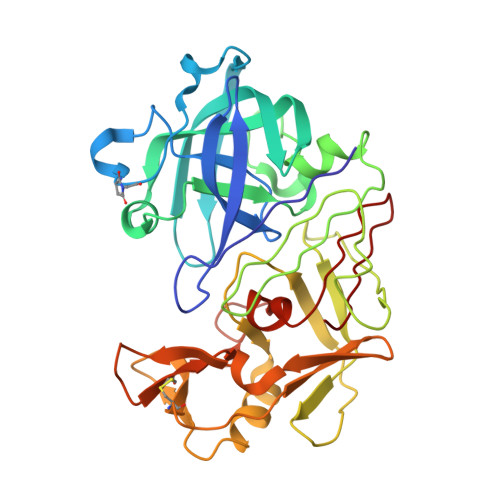
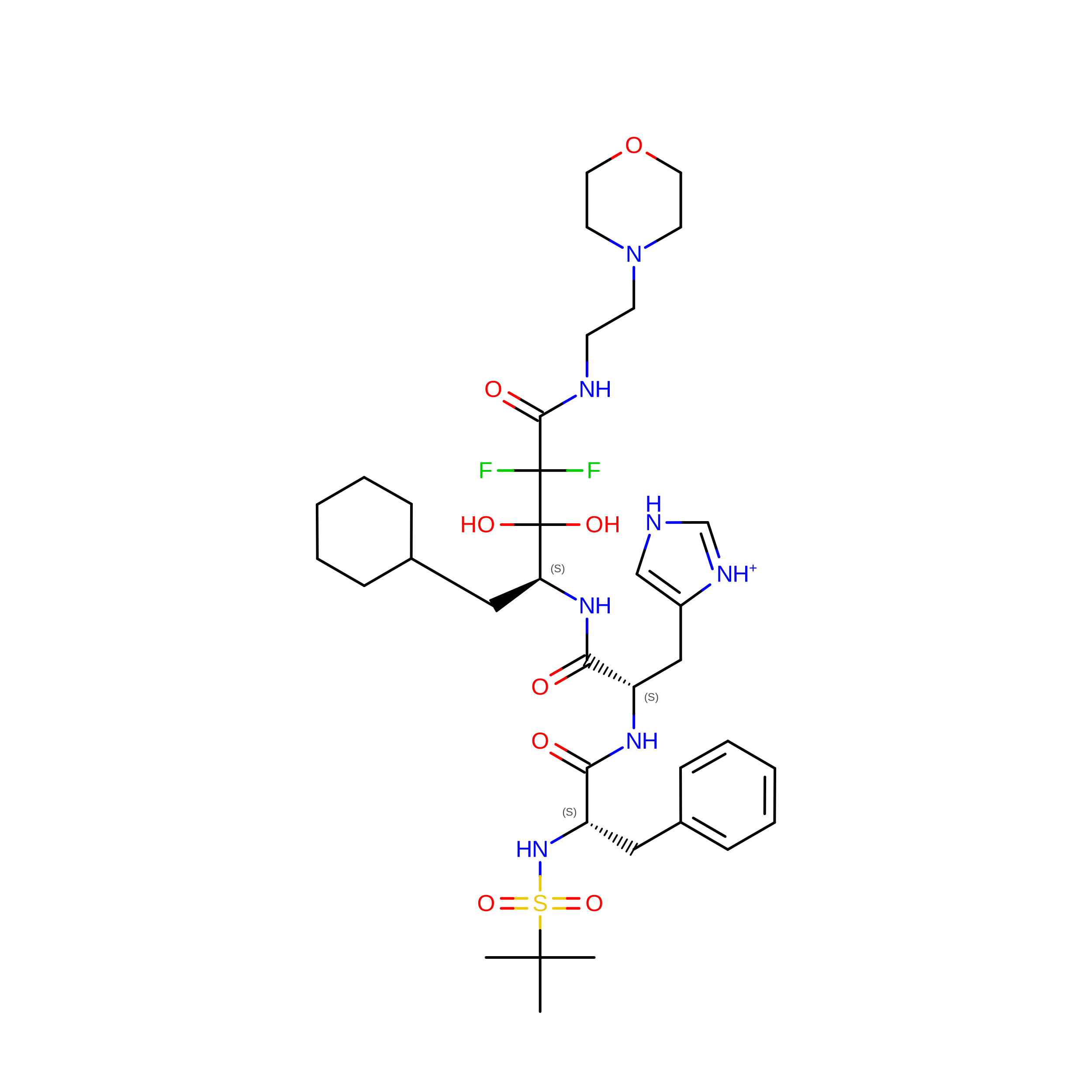
Endothiapepsin in complex with a gem-diol inhibitor.


Experimental Data Snapshot

  • Method: X-RAY DIFFRACTION
  • Resolution: 1.00 Å
  • R-Value Free: 
    0.136 (Depositor), 0.134 (DCC) 
  • R-Value Work: 
    0.113 (DCC) 
  • R-Value Observed: 
    0.112 (Depositor) 

wwPDB Validation 3D Report Full Report

Validation slider image for 2JJJ

Ligand Structure Quality Assessment 


This is version 2.0 of the entry. See complete history

Literature

The Catalytic Mechanism of an Aspartic Proteinase Explored with Neutron and X-Ray Diffraction

Coates, L.Tuan, H.-F.Tomanicek, S.J.Kovalevsky, A.Mustyakimov, M.Erskine, P.Cooper, J.

(2008) J Am Chem Soc 130: 7235

  • DOI: https://doi.org/10.1021/ja801269x
  • Primary Citation Related Structures: 
    2JJI, 2JJJ, 2VS2

  • PubMed Abstract: 

    Hydrogen atoms play key roles in enzyme mechanism, but as this study shows, even high-quality X-ray data to a resolution of 1 A cannot directly visualize them. Neutron diffraction, however, can locate deuterium atoms even at resolutions around 2 A. Both neutron and X-ray diffraction data have been used to investigate the transition state of the aspartic proteinase endothiapepsin. The different techniques reveal a different part of the story, revealing the clearest picture yet of the catalytic mechanism by which the enzyme operates. Room temperature neutron and X-ray diffraction data were used in a newly developed joint refinement software package to visualize deuterium atoms within the active site of the enzyme when a gem-diol transition state analogue inhibitor is bound at the active site. These data were also used to estimate their individual occupancy, while analysis of the differences between the bond lengths of the catalytic aspartates was performed using atomic resolution X-ray data. The two methods are in agreement on the protonation state of the active site with a transition state analogue inhibitor bound confirming the catalytic mechanism at which the enzyme operates.


  • Organizational Affiliation
    • Spallation Neutron Source, Oak Ridge National Laboratory, 1 Bethel Valley Road, Oak Ridge, Tennessee 37831, USA.

Macromolecule Content 

  • Total Structure Weight: 34.97 kDa 
  • Atom Count: 3,068 
  • Modeled Residue Count: 329 
  • Deposited Residue Count: 329 
  • Unique protein chains: 1

Macromolecules

Find similar proteins by:|  3D Structure
Entity ID: 1
MoleculeChains  Sequence LengthOrganismDetailsImage
ENDOTHIAPEPSIN329Cryphonectria parasiticaMutation(s): 0 
EC: 3.4.23.22
UniProt
Find proteins for P11838 (Cryphonectria parasitica)
Explore P11838 
Go to UniProtKB:  P11838
Entity Groups
Sequence Clusters30% Identity50% Identity70% Identity90% Identity95% Identity100% Identity
UniProt GroupP11838
Sequence Annotations
Expand
Reference Sequence

Small Molecules

Modified Residues  1 Unique
IDChains TypeFormula2D DiagramParent
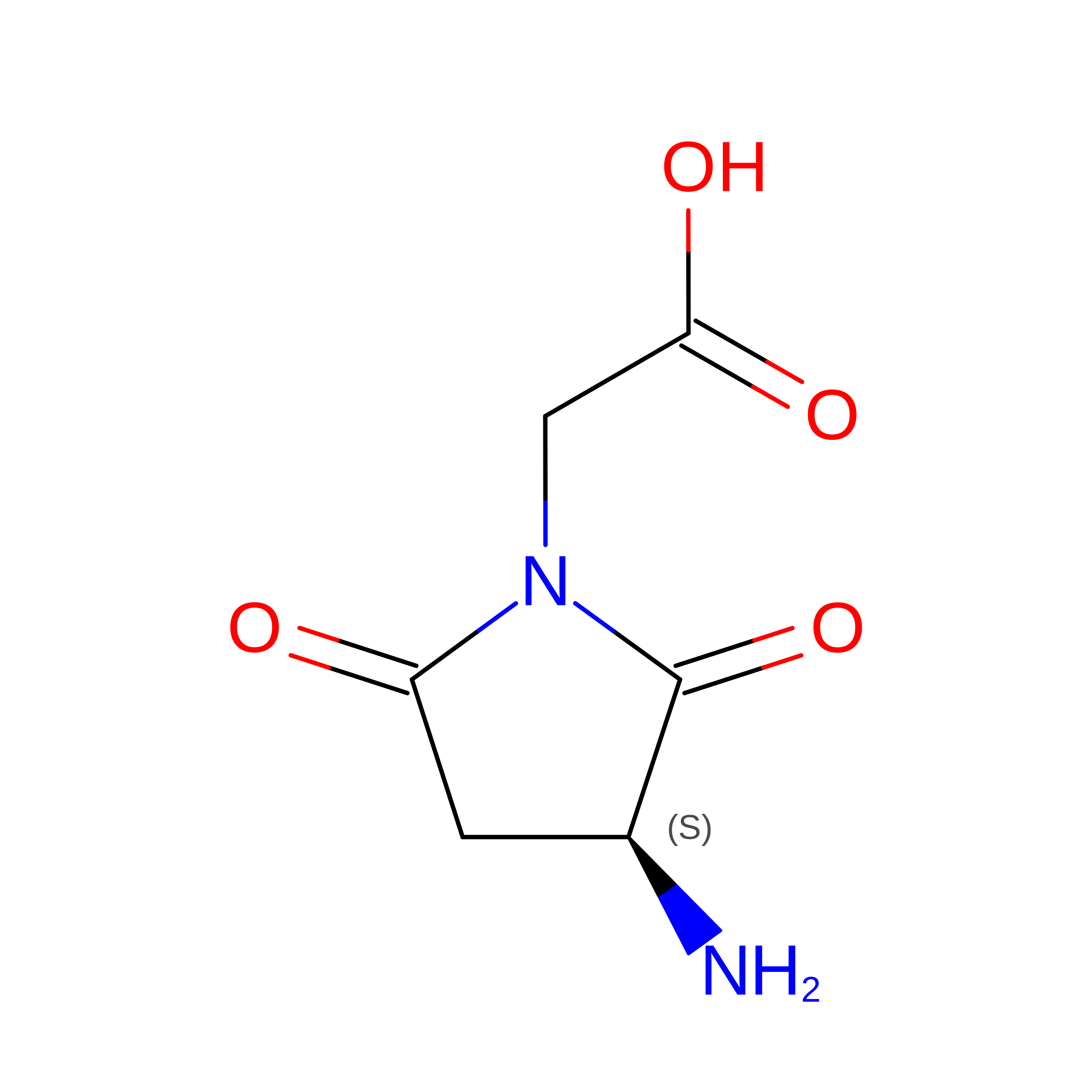
SUI
Query on SUI
A
L-PEPTIDE LINKINGC6 H8 N2 O4ASP, GLY

Biologically Interesting Molecules (External Reference) 

1 Unique

Experimental Data & Validation

Experimental Data

  • Method: X-RAY DIFFRACTION
  • Resolution: 1.00 Å
  • R-Value Free:  0.136 (Depositor), 0.134 (DCC) 
  • R-Value Work:  0.113 (DCC) 
  • R-Value Observed: 0.112 (Depositor) 
Space Group: P 1 21 1
Unit Cell:
Length ( Å )Angle ( ˚ )
a = 42.69α = 90
b = 74.34β = 97.49
c = 42.53γ = 90
Software Package:
Software NamePurpose
SHELXL-97refinement
MOSFLMdata reduction
SCALAdata scaling

Structure Validation

View Full Validation Report


Ligand Structure Quality Assessment 


Entry History 

Deposition Data

Revision History  (Full details and data files)

  • Version 1.0: 2008-05-27
    Type: Initial release
  • Version 1.1: 2011-07-13
    Changes: Atomic model, Database references, Derived calculations, Non-polymer description, Structure summary, Version format compliance
  • Version 1.2: 2013-03-06
    Changes: Other
  • Version 1.3: 2013-09-25
    Changes: Database references, Other
  • Version 1.4: 2019-05-22
    Changes: Data collection, Derived calculations, Other, Refinement description
  • Version 2.0: 2023-11-15
    Changes: Atomic model, Data collection, Database references, Derived calculations, Other