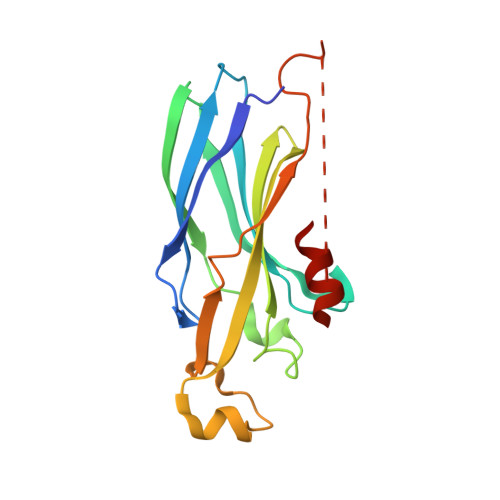
2IDC | pdb_00002idc

Structure of the Histone H3-Asf1 Chaperone Interaction


Experimental Data Snapshot

  • Method: X-RAY DIFFRACTION
  • Resolution: 2.20 Å
  • R-Value Free: 
    0.239 (Depositor), 0.243 (DCC) 
  • R-Value Work: 
    0.194 (Depositor), 0.197 (DCC) 
  • R-Value Observed: 
    0.196 (Depositor) 

Starting Model: experimental
View more details

wwPDB Validation 3D Report Full Report

Validation slider image for 2IDC

This is version 1.4 of the entry. See complete history

Literature

Structure of the yeast histone H3-ASF1 interaction: implications for chaperone mechanism, species-specific interactions, and epigenetics.

Antczak, A.J.Tsubota, T.Kaufman, P.D.Berger, J.M.

(2006) BMC Struct Biol 6: 26-26

  • DOI: https://doi.org/10.1186/1472-6807-6-26
  • Primary Citation Related Structures: 
    2IDC

  • PubMed Abstract: 

    The histone H3/H4 chaperone Asf1 (anti-silencing function 1) is required for the establishment and maintenance of proper chromatin structure, as well as for genome stability in eukaryotes. Asf1 participates in both DNA replication-coupled (RC) and replication-independent (RI) histone deposition reactions in vitro and interacts with complexes responsible for both pathways in vivo. Asf1 is known to directly bind histone H3, however, high-resolution structural information about the geometry of this interaction was previously unknown. Here we report the structure of a histone/histone chaperone interaction. We have solved the 2.2 A crystal structure of the conserved N-terminal immunoglobulin fold domain of yeast Asf1 (residues 2-155) bound to the C-terminal helix of yeast histone H3 (residues 121-134). The structure defines a histone-binding patch on Asf1 consisting of both conserved and yeast-specific residues; mutation of these residues abrogates H3/H4 binding affinity. The geometry of the interaction indicates that Asf1 binds to histones H3/H4 in a manner that likely blocks sterically the H3/H3 interface of the nucleosomal four-helix bundle. These data clarify how Asf1 regulates histone stoichiometry to modulate epigenetic inheritance. The structure further suggests a physical model in which Asf1 contributes to interpretation of a "histone H3 barcode" for sorting H3 isoforms into different deposition pathways.


  • Organizational Affiliation
    • Department of Molecular and Cell Biology, University of California, Berkeley, California 94720, USA. antczaka@berkeley.edu <antczaka@berkeley.edu>

Macromolecule Content 

  • Total Structure Weight: 20.08 kDa 
  • Atom Count: 1,429 
  • Modeled Residue Count: 167 
  • Deposited Residue Count: 179 
  • Unique protein chains: 1

Macromolecules

Find similar proteins by:|  3D Structure
Entity ID: 1
MoleculeChains  Sequence LengthOrganismDetailsImage
ANTI-SILENCING PROTEIN 1 AND HISTONE H3 CHIMERA179Saccharomyces cerevisiae S288CMutation(s): 0 
Gene Names: 
UniProt
Find proteins for P32447 (Saccharomyces cerevisiae (strain ATCC 204508 / S288c))
Explore P32447 
Go to UniProtKB:  P32447
Find proteins for P61830 (Saccharomyces cerevisiae (strain ATCC 204508 / S288c))
Explore P61830 
Go to UniProtKB:  P61830
Entity Groups
Sequence Clusters30% Identity50% Identity70% Identity90% Identity95% Identity100% Identity
UniProt GroupsP61830P32447
Sequence Annotations
Expand
Reference Sequence

Experimental Data & Validation

Experimental Data

  • Method: X-RAY DIFFRACTION
  • Resolution: 2.20 Å
  • R-Value Free:  0.239 (Depositor), 0.243 (DCC) 
  • R-Value Work:  0.194 (Depositor), 0.197 (DCC) 
  • R-Value Observed: 0.196 (Depositor) 
Space Group: P 21 21 21
Unit Cell:
Length ( Å )Angle ( ˚ )
a = 44.431α = 90
b = 52.094β = 90
c = 86.676γ = 90
Software Package:
Software NamePurpose
SCALAdata scaling
PHASERphasing
REFMACrefinement
PDB_EXTRACTdata extraction
Blu-Icedata collection
MOSFLMdata reduction
CCP4data scaling

Structure Validation

View Full Validation Report


Entry History 

Deposition Data

Revision History  (Full details and data files)

  • Version 1.0: 2007-01-30
    Type: Initial release
  • Version 1.1: 2008-05-01
    Changes: Version format compliance
  • Version 1.2: 2011-07-13
    Changes: Advisory, Version format compliance
  • Version 1.3: 2017-06-14
    Changes: Database references, Source and taxonomy, Structure summary
  • Version 1.4: 2023-08-30
    Changes: Data collection, Database references, Refinement description