Download Mendeley
Associative and Structural Properties of the Region of Complement Factor H Encompassing the Tyr402His Disease-related Polymorphism and its Interactions with Heparin.
Fernando, A.N., Furtado, P.B., Clark, S.J., Gilbert, H.E., Day, A.J., Sim, R.B., Perkins, S.J.(2007) J Mol Biol 368: 564-581
- PubMed: 17362990 Search on PubMed
- DOI: https://doi.org/10.1016/j.jmb.2007.02.038
- Primary Citation Related Structures:
2IC4 - PubMed Abstract:
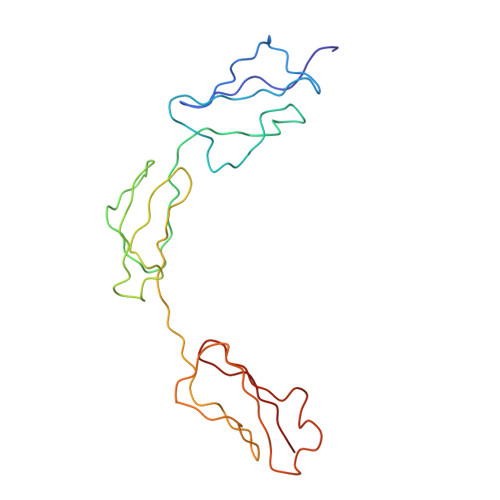
Factor H (FH) is a major complement control protein in serum. The seventh short complement regulator (SCR-7) domain of the 20 in FH is associated with age-related macular degeneration through a Tyr402His polymorphism. The recombinant SCR-6/8 domains containing either His402 or Tyr402 and their complexes with a heparin decasaccharide were studied by analytical ultracentrifugation and X-ray scattering. The sedimentation coefficient is concentration dependent, giving a value of 2.0 S at zero concentration and a frictional ratio f/f(o) of 1.2 for both allotypes. The His402 allotype showed a slightly greater self-association than the Tyr402 allotype, and small amounts of dimeric SCR-6/8 were found for both allotypes in 50 mM, 137 mM and 250 mM NaCl buffers. Sedimentation equilibrium data were interpreted in terms of a monomer-dimer equilibrium with a dissociation constant of 40 microM for the His402 form. The Guinier radius of gyration R(G) of 3.1-3.3 nm and the R(G)/R(O) ratio of 2.0-2.1 showed that SCR-6/8 is relatively extended in solution. The distance distribution function P(r) showed a maximum dimension of 10 nm, which is less than the length expected for a linear domain arrangement. The constrained scattering and sedimentation modelling of FH SCR-6/8 showed that bent SCR arrangements fit the data better than linear arrangements. Previously identified heparin-binding residues were exposed on the outside curvature of this bent domain structure. Heparin caused the formation of a more linear structure, possibly by binding to residues in the linker. It was concluded that the His402 allotype may self-associate more readily than the Tyr402 allotype, SCR-6/8 is partly responsible for the folded-back structure of intact FH, and SCR-6/8 changes conformation upon heparin binding.
- Department of Biochemistry and Molecular Biology, Darwin Building, University College London, Gower Street, London WC1E 6BT, UK.
Organizational Affiliation: