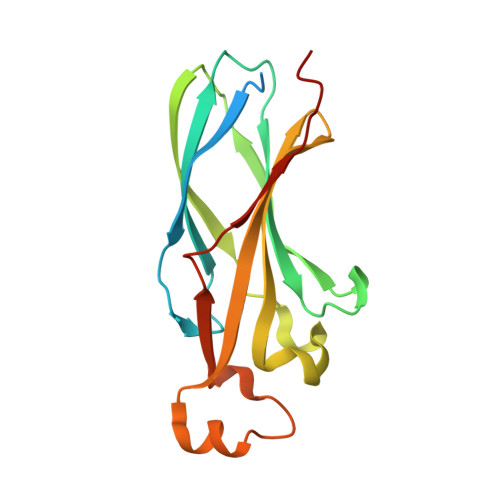
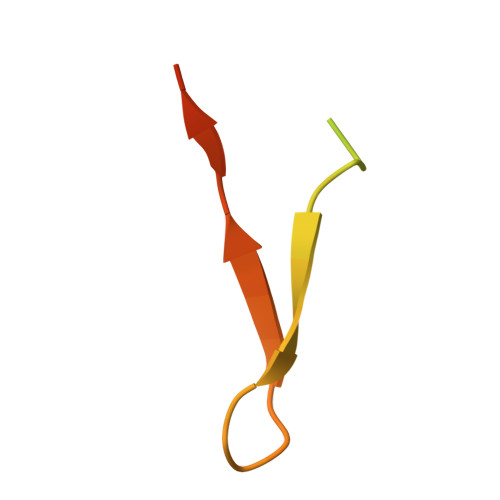
2I32 | pdb_00002i32

Structure of a human ASF1a-HIRA complex and insights into specificity of histone chaperone complex assembly


Experimental Data Snapshot

  • Method: X-RAY DIFFRACTION
  • Resolution: 2.70 Å
  • R-Value Free: 
    0.269 (Depositor), 0.259 (DCC) 
  • R-Value Work: 
    0.229 (Depositor), 0.240 (DCC) 

Starting Model: experimental
View more details

wwPDB Validation 3D Report Full Report

Validation slider image for 2I32

This is version 1.4 of the entry. See complete history. 

Literature

Structure of a human ASF1a-HIRA complex and insights into specificity of histone chaperone complex assembly.

Tang, Y., Poustovoitov, M.V., Zhao, K., Garfinkel, M., Canutescu, A., Dunbrack, R., Adams, P.D., Marmorstein, R.

(2006) Nat Struct Mol Biol 13: 921-929

  • DOI: https://doi.org/10.1038/nsmb1147
  • Primary Citation Related Structures: 
    2I32

  • PubMed Abstract: 

    Human HIRA, ASF1a, ASF1b and CAF-1 are evolutionally conserved histone chaperones that form multiple functionally distinct chromatin-assembly complexes, with roles linked to diverse nuclear process, such as DNA replication and formation of heterochromatin in senescent cells. We report the crystal structure of an ASF1a-HIRA heterodimer and a biochemical dissection of ASF1a's mutually exclusive interactions with HIRA and the p60 subunit of CAF-1. The HIRA B domain forms an antiparallel beta-hairpin that binds perpendicular to the strands of the beta-sandwich of ASF1a, via beta-sheet, salt bridge and van der Waals contacts. The N- and C-terminal regions of ASF1a and ASF1b determine the different affinities of these two proteins for HIRA, by contacting regions outside the HIRA B domain. CAF-1 p60 also uses B domain-like motifs for binding to ASF1a, thereby competing with HIRA. Together, these studies begin to define the molecular determinants of assembly of functionally diverse macromolecular histone chaperone complexes.


  • Organizational Affiliation: 
    • The Wistar Institute, Philadelphia, Pennsylvania 19104, USA.

Macromolecule Content 

  • Total Structure Weight: 54.11 kDa 
  • Atom Count: 2,910 
  • Modeled Residue Count: 345 
  • Deposited Residue Count: 478 
  • Unique protein chains: 2

Macromolecules

Find similar proteins by:|  3D Structure
Entity ID: 1
MoleculeChains  Sequence LengthOrganismDetailsImage
Anti-Silencing Factor 1 paralog a
A, B
182Homo sapiensMutation(s): 0 
Gene Names: ASF1A, DKFZp564E2182
UniProt & NIH Common Fund Data Resources
Find proteins for Q9Y294 (Homo sapiens)
Explore Q9Y294 
Go to UniProtKB:  Q9Y294
PHAROS:  Q9Y294
GTEx:  ENSG00000111875 
Entity Groups
Sequence Clusters30% Identity50% Identity70% Identity90% Identity95% Identity100% Identity
UniProt GroupQ9Y294
Sequence Annotations
Expand
Reference Sequence
Find similar proteins by:|  3D Structure
Entity ID: 2
MoleculeChains  Sequence LengthOrganismDetailsImage
Histone Regulatory homolog AC [auth E],
D [auth F]
57Homo sapiensMutation(s): 0 
Gene Names: HIRA, DGCR1, HIR, TUPLE1
UniProt & NIH Common Fund Data Resources
Find proteins for P54198 (Homo sapiens)
Explore P54198 
Go to UniProtKB:  P54198
PHAROS:  P54198
GTEx:  ENSG00000100084 
Entity Groups
Sequence Clusters30% Identity50% Identity70% Identity90% Identity95% Identity100% Identity
UniProt GroupP54198
Sequence Annotations
Expand
Reference Sequence

Experimental Data & Validation

Experimental Data

  • Method: X-RAY DIFFRACTION
  • Resolution: 2.70 Å
  • R-Value Free:  0.269 (Depositor), 0.259 (DCC) 
  • R-Value Work:  0.229 (Depositor), 0.240 (DCC) 
Space Group: P 65 2 2
Unit Cell:
Length ( Å )Angle ( ˚ )
a = 116.226α = 90
b = 116.226β = 90
c = 167.599γ = 120
Software Package:
Software NamePurpose
DENZOdata reduction
SCALEPACKdata scaling
PHASERphasing
CNSrefinement
PDB_EXTRACTdata extraction
HKL-2000data collection
HKL-2000data reduction
HKL-2000data scaling

Structure Validation

View Full Validation Report


Entry History 

Deposition Data

Revision History  (Full details and data files)

  • Version 1.0: 2006-09-19
    Type: Initial release
  • Version 1.1: 2008-05-01
    Changes: Version format compliance
  • Version 1.2: 2011-07-13
    Changes: Version format compliance
  • Version 1.3: 2017-10-18
    Changes: Refinement description
  • Version 1.4: 2023-08-30
    Changes: Data collection, Database references, Refinement description